We've been talking about writing and ways to increase productivity in this recent series of posts. I'd like to take a little side-trip at this point into the realm of creativity and inspiration.
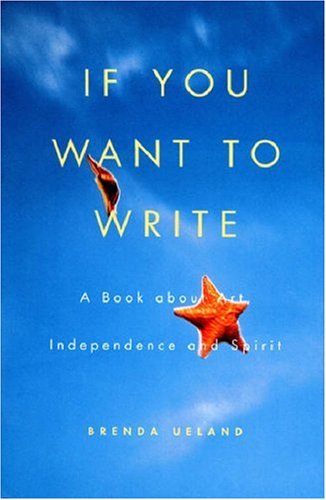
The title of this post is the title of a book I stumbled across a while ago. Written by Brenda Ueland in 1938, it is described by Carl Sandburg as "the best book ever written about how to write". For my money, it's the best book ever written about creativity and inspiration--and how to nurture them. During her 93 years, Ueland published six million words. The book, "If You Want to Write", contains not only her philosophy about writing, but many examples and inspirational stories from her writing classes and workshops, in which she taught professors, housewives, and factory workers alike.
Ueland's advice is clearly useful for fiction writers, but do any of her insights have relevance for us as technical writers? I think so, which is why I'm taking the time to discuss her book. Everything she has to say about how to tap into one's genius is relevant to us, not only in writing but in stimulating creative ideas and innovative ways to pursue them.
Ueland taught all kinds of people to write: rich and poor, educated and those who had never been to high school, housewives and salesmen, professors and students. This is what she learned: "everybody is talented, original and has something important to say". Some of her most amazing examples of enthralling, inspired writing were penned by timid stenographers, lonely unemployed women, and housewives who had no prior training or experience. Ueland compares these writings to those in glossy magazines of the time written by highly paid writers--boring, uninspired drivel. The message for us scientists and students of science is that we can just as readily tap into our creative nature and produce something original and worthwhile. How did Ueland get this result from her students?
Here are a few nuggets:
The imagination works slowly and quietly. You should not expect inspiration to come like a bolt of lightning. Instead, you may spend a lot of time just sitting and thinking or daydreaming. If you are always busy, talking to other people, running around carrying out tasks, or always plugged into your iPod, your thoughts have no chance to grow and develop into creative ideas. Ueland encourages people to dare to be idle for a time, not always pressed or driven to accomplish something. I have a long commute from home to work (2 hours roundtrip) during which I just think. I do not listen to the radio or to "books on tape" (which is always what people encourage me to do). Ideas don't always come to me during the drive--the drive allows my thoughts to swirl around and begin to gel. Suddenly, at some later time, the creative idea will pop into my head.
Be in the present. When you sit down to write or to contemplate a research project, no logical thought comes to mind. You try to force thought, but paralysis sets in (sounds familiar). You begin to doubt yourself and to suspect that your mental abilities must be limited because you have no good ideas. Ultimately, you give up and go do some menial task: washing glassware or filing reprints, and only then you have some original, illuminating thoughts. You are self conscious in the first instance, not so in the second.
Be careless, reckless. Many novice writers start out being pretentious and use a lot of jargon and overblown phrases because they think this is a sign of good writing. Actually, it is boring and annoying to read such writing. Don't worry about what other people will think. Write simply and honestly. Technical papers that are dense and take a tremendous effort to understand are not a pleasure to read. Why would any scientist aspire to write such things? You are writing about science, a fascinating topic. Why not show in your writing how interesting, thought-provoking, and exciting your findings are?
Develop true self-confidence. Ueland: "..self-confidence never rests, but is always working and striving, and it is always modest and grateful and open to what is new and better." That is one of my favorite definitions of self-confidence. It is different from conceit, which is "a static state where you rest on some past (or fancied) accomplishment." Today, conceit is additionally colored by a sense of entitlement, based not on any accomplishment or positive traits, but simply on the belief that adulation is deserved. True self-confidence will carry you safely through criticism of your work, rejection of your papers, and various other disappointments. Conceit will fail you in such instances.
Be microscopically truthful. We often write things by rote, repeating the same boring information in our introductions and methods. We may repeat what we've read in other papers a dozen times, trying to reword it in a fresh way. We may be stumped as to how to describe our results in an interesting way. To write in a microscopically truthful way is to write "...with exquisite and completely detached exactness and truthfulness." You say precisely what you observed and what you think about it, even if it sounds awkward at first. Don't imagine what someone else might say or expect you to say. Think about your topic, your experiment and write about it in your own eloquent way, providing those precise details that make it uniquely yours.
Keep a diary. Or a blog. Here's Ueland: "Yes, from writing a diary I am sure that I have learned things. But I don't think the learning process would have moved on so well, if I had not written down today's minute revelation. And that is why, if you want to write, you might try it." I think she would have approved of blogs.
Write what is next. Here's Ueland again: "And so try this yourself when you write an article. Do not worry about the whole. Write what is next, the idea that comes now at the moment. Don't be afraid. For there will be more coherence and arrangement in your thoughts than you think."
The essential message here is to nurture your creative side by spending time 1. with your thoughts and 2. writing unselfconsciously--in a diary or a blog.
If you never spend time alone thinking and are always listening to music, commentary, and other distractions, creative ideas are less likely to develop. Your head becomes so filled with other people's thoughts and opinions, that there is no room for yours. Some people are afraid to be alone with their thoughts--as if something dreadful might jump out. But such solitary musings are essential to writing well.
To write well, you must also practice it regularly and deliberately. Keeping a diary of daily events, thoughts, dreams, or insights helps develop an ease with writing unselfconsciously. There is no pressure to produce something witty or wise in a diary, so you can learn to easily express yourself in writing. Even writing about mundane things can produce some amazing results, if you let yourself go and write what is in your heart. Blogging is a step further in which you put your writing in the public eye and invite feedback. If you look at your favorite blogs--the ones that really speak to you--you will see that the author is writing unselfconsciously.
The next post describes in more detail how to write spontaneously.
Sunday, November 29, 2009
Saturday, November 28, 2009
Are You Satisfied With Your Writing Productivity?
The topic of this series of posts is writing problems. If you've been following along, you may be thinking at this point that you don't have a writing problem or that you write "well enough"---and consequently don't need to analyze your habits and attitudes toward writing. Such an attitude, by itself, can be sign of a problem.Most of us, for whom writing is an integral part of what we do in our jobs, would like to improve our productivity. I rarely hear colleagues say, "Well, I'm really satisfied with the number of papers I published last year." More often, they are lamenting how they can't seem to get out as many papers as they would like.
In most organizations, there are one or two scientists who publish prolifically and account for a good proportion of the total scientific output. Not all of these prodigious scientists are producing good work; they may be publishing work of little significance. At the other extreme are the people who rarely publish or who don't publish at all--at least not in peer-reviewed journals. The majority fall in between, but there can be a large range in productivity within this group.
To succeed in most scientific positions, one must publish. Getting a good job, keeping the job, getting promoted, and ultimately getting tenure (academic) or permanent status (government) is strongly influenced by one's writing abilities and productivity. Learning early to be a good writer will put you well ahead of others vying for jobs, grants, or space in journals. The earlier you start writing well, the more productive you will be over the entire span of your career----and the faster you will move through those career milestones. Even if you are reasonably satisfied with your publication rate, you can always benefit from being more efficient in your writing efforts.
To be productive throughout your career, it's important to know what your strengths and particularly your weaknesses are. Note that these may change over time. What plagues novice writers may be overcome, only to be replaced with other challenges in the more seasoned writer. Most people avoid considering their weaknesses and focus on those aspects they do well. That's human nature. But it's not the way to improve. People who instead focus on their weaknesses and work to eliminate them show dramatic jumps in their overall abilities. This approach is known as "deliberate practice", which I described in earlier posts: "Is Talent Overrated?" and "Is Talent Overrated Part 2". It's the secret behind so-called child prodigies and other people who exhibit amazing talents.
In the previous post, I listed the common writing problems. These typically cluster together into four patterns:
1. Work apprehension and low energy and enthusiasm for writing
2. Dysphoria (unhappiness) and evaluation anxiety
3. Perfectionism
4. Procrastination and impatience
A useful place to start improving productivity (or to get started writing) is to analyze your weaknesses. The book I've mentioned previously, "Professors as Writers--A Self-Help Guide to Productive Writing", has a self-assessment test in it. I looked to see if there were any online tests, but could not find any. Even if you don't do a formal assessment with such a test, you probably have an idea of where your problems lie.
If your main problem is getting started or finding time to write, a suggested technique is called "contingency management" (Boice, 1990). The idea is simple. Pick a daily activity (checking email, showering, having breakfast, exercising) and make it contingent on writing for a set amount of time or a set number of pages. This approach may sound difficult, but people who use it say it works. See this personal description of how contingency management works.
Another helpful activity is to keep track of your writing progress by preparing a graph of the number of hours devoted to writing along with the output. See example below modified from Boice 1990:
For novice writers, there may be some apprehension regarding grammar and punctuation and other writing rules. Most word processing programs can help with this as can many online help sites for students with writing problems. An example can be found at "Common Student Writing Problems". There are many others.
Boice, R. 1990. Professors as Writers: A Self-Help Guide to Productive Writing. New Forums Press, Stillwater, OK.
Photo credit: Library of Congress, Charles Gibson artist, circa 1911
Thursday, November 26, 2009
Writing Worries
Most of us started out in science with visions of all the neat experiments we would run; the interesting plants, animals, and environments we would work with; the exciting people we would meet; and the fame we would enjoy when we made some new discovery. We were not aware (or if aware, did not give it much thought) that to succeed in science and continue doing all those other fun things, we would have to write....a lot. And the writing would have to be good. And it would be scrutinized by reviewers and editors. And it might not pass muster. Little wonder that many scientists struggle at some point in their development with writing problems.
Until I did some reading about writing problems, aka "writer's block", I thought these were due to single factors such as perfectionism. According to R. Boice, author of a book on writer's block, things are a bit more complicated.
Information about writing problems apparently is based more on conjecture than on empirical study. People view writer's block as being as mysterious as writing itself. A lot of myths surround the process of writing, which can contribute to some of the problems novice writers encounter. For example, I often hear people say that they have to have a good idea of what they are going to say before starting to write. The fact that this is a statement often made by people with writer's block speaks for itself. I find, in contrast to this idea, that the very act of writing stimulates ideas and insights that do not necessarily come while just contemplating a writing project.
So what are the causes of writing problems? The following points are modified from the book, "Professors as Writers-Self Help Guide to Productive Writing", by R. Boice:
1. Poor work habits. I would guess the single most common reason given for not writing is lack of time. I know I use that excuse. However, observations of academicians' activities show small blocks of time during the work week in which writing could be done, but isn't taken advantage of. These writers often say that they need large blocks of uninterrupted time to write. In fact, professors who write in brief, daily chunks (30 min) accomplish more than their colleagues who binge-write. Successful writers tend to write early in the morning when they are fresh, work at a regular schedule, and ensure a good physical environment for writing.
2. Fear of failure. We fear that our writing may turn out to be inaccurate or boring and get rejected. Or we may fail to complete the writing task on time. These writers are apprehensive about the outcome and engage in behavior that undermines their writing.
3. The internal critic. This construct of our own brains censors our ideas as not being good enough, which prevents us from getting any ideas down on paper until they are perfect in our heads. This mental censor kills spontaneity and confidence.
4. Perfectionism. This trait is a major cause of writing problems and one that has connections with #2, fear of failure and #3 internal critic. For some writers, this manifests itself as a compulsion to keep revising and never getting to the point of finishing. For others, perfectionism prevents spontaneity and getting ideas down on paper because they think it has to be written perfectly the first time.
5. Procrastination. Because writing is an intermittent activity and easily put off, it suffers inordinately from procrastination. People procrastinate because of #2 fear of failure and distaste of the task.
6. Early experience. This cause can range from being told unproductive myths about writing by teachers to a terrible writing experience such as the one I described previously.
7. Mental health. Writers and other creative people have traditionally been portrayed as being mentally or emotionally unstable. This idea about writers' psychopathology naturally extends to why writers have writing problems. Studies correlate mood disorders with creativity in writers and conclude a cause and effect relationship. But it may be that mood disorders arise from the writer's work habits or that both are responding to a third, unobserved factor.
8. Personality types. This cause is related to several of the others. People who are introverted and more self-conscious (perfectionists) may be inclined toward writing problems more than those who are extroverts and less concerned about what other people think of them.
In the next posts, I'll take a closer look at some of these issues and some possible solutions.
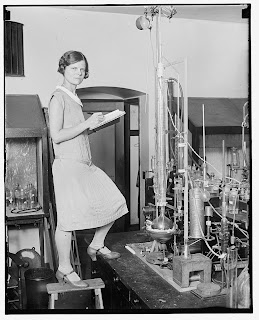
Photo credit: Library of Congress, unidentified "woman scientist" circa 1909
Tuesday, November 24, 2009
"I Hate Writing"
...was the emphatic statement made by a young acquaintance recently. Why do some find writing akin to passing kidney stones, whereas others absolutely love writing?
I think the answer is that people who abhor writing are people with writing problems, otherwise known as "writer's block". Contrary to what most people imagine writer's block to be, this affliction encompasses a whole suite of behaviors (and their accompanying thoughts) that many writers will recognize:
"I don't feel like writing [this morning, today, this week, this semester......the rest of my life]!"
"I have no ideas for this writing project."
"Even if I do a good job [writing], the reviewers will criticize it for some picayune reason."
"I write best when I'm under the gun."
"I wish I had never agreed to write this [paper, book chapter, review]."
"My writing will never be as good as my peers."
"I've got too much to do, and not enough time."
"I like to keep revising and perfecting, even after the paper is 'good enough'."
"What if I've made a mistake or left out an important reference?"
"I hate outlines."
"I can't write unless I can set aside large blocks of time when no deadlines are looming."
The above thoughts are from a test for writer's block in a book by R. Boice. The next series of posts is going to focus on writing problems. I hope to cover the causes of writing problems and some possible solutions for dealing with them. Some of this discussion will be based on information in resources such as the book mentioned above. Other insights will be based on my own experience and that of colleagues.
But first, a personal story to illustrate the fact that it is possible to go from near paralysis at the thought of writing to adoring writing (technical and non-technical) and everything about writing.
I was entering the home stretch of my master's program, having completed all my field and laboratory research and data analysis. It was time to write my thesis. I had not given much thought to this part of the process up to that point because I had been so busy taking classes, working in the lab, and admiring my data. The memory of the moment I sat down to begin writing is scorched into my brain. I was in my apartment at my desk, which faced a window overlooking a forested lot. Outside, the day was somewhat overcast, but still bright enough so that I did not need additional light. I had a new yellow legal pad and several new pencils sharpened to perfection (this was way before personal computers). I picked up a pencil, looked at the blank page, and.....froze. Not my mind though. It was going 90 miles an hour. Thoughts of how to start, what should I say, which parts should I include, what did my results mean--all tumbled around in my head. I could not focus on any single thought. The harder I tried, the worse it got. It was like trying to grasp an handful of sand. The more I squeezed, the faster the grains escaped.
I thought, "Oh, God. I'm stuck."
And I was, in more ways than one. For the next several hours, I sat there, paralyzed. I could not move. The longer I sat, the more difficult it was to move...to even imagine moving. The light grew dimmer as evening approached. Still I sat, staring at that yellow pad. My initial shock turned to despair. I began imagining how I was going to explain to my adviser that I couldn't finish my thesis. What would happen to me? Where would I go now? What about my dreams of becoming a scientist?
"Stop it! Stop thinking. Just sit and try to relax." I finally started talking to myself. I did not know what else to do. Eventually, I felt the need to go to the bathroom, but I could not move. I felt that if I moved from my spot that something dreadful would happen. "You've got to move," I said to myself. "Are you just going to sit there and wet your pants?" That thought galvanized me. I told myself all I had to do was to go to the bathroom and then I could come back and cower in the chair.
That was all it took. Once I started moving, I was able to gradually do other things. I eventually applied the same tactic to my writing--breaking it into small stages. I would set a tiny goal for myself in the beginning--write the first paragraph of the methods. Then another paragraph. I did not think about anything beyond the next small task. Before I knew it, I had a rough draft of the Materials and Methods done. Eventually, I finished my thesis and passed my defense.
That experience put me off writing for a long, long time--years in fact. In the coming posts, I'll describe how I transformed from that writing-averse person to a well-published author, now approaching my 100th publication. Along the way, I'll relate my experiences to known causes of writing problems and describe what can be done to resolve them... or avoid them in the first place.
I hope you'll share your writing problems and solutions.
Sunday, November 22, 2009
Dress Code
In a previous post about how female scientists are portrayed on TV and in popular film, I mentioned how the women of CSI are often dressed provocatively, which undermines the positive message of women in professional and high-ranking science positions. I also described other instances in film where female (mostly young, attractive) scientists were dressed inappropriately. We might think that such depictions are totally unrealistic, and in most cases this is true. Scientists are not exactly known for their fashion sense, and some even might be described as being fashion-challenged. Problems don't often arise, either with regard to provocative dress or too informal dress. Most research institutes have no real dress code, and scientists and students tend to dress for comfort rather than for any other reason.
However, I have had to deal with students and staff who dressed inappropriately on occasion.
In one case, a female student came to her general exam dressed in a very low-cut top and short skirt. All the other members of her committee were male, and I could only imagine the impression this was going to make. I had instructed her beforehand to wear something suitable--not the usual graduate student garb. She clearly did not understand and selected something that was more appropriate for a cocktail party. I struggled momentarily with how to handle this. On the one hand, I did not want to make her self-conscious right before her exam. On the other, I knew her appearance would be distracting at best and send the wrong message at worst. Fortunately, it was freezing in the conference room, and she was already shivering by the time I arrived (and admitted she was uncomfortable--from the cold, not embarrassment). So I ran down the hall and borrowed the bulkiest sweater I could find from a secretary. The student gladly wore it, and her committee never knew any different. I had a talk with her before her final exam, and she followed my advice.
The other case was more refractory. A female post-doc who was, let's say, very well proportioned routinely wore quite revealing outfits--short shorts, halter tops, etc. I really did not care what she wore at work as long as it did not interfere with her job. She was required to wear a lab coat and other protective clothing in the lab, but this code did not extend to other areas, such as our greenhouses. Due to the heat and humidity, working in the greenhouse or outdoors in shorts made sense. But she carried it to the extreme. The male facility workers were quite happy, whereas the women who worked in the admin. office were mostly scandalized. She identified with the movies Erin Brockavich and Legally Blonde, which gives a good idea of her attitude toward dress codes. She often stated that it was important to her to remain feminine and sexy while being a scientist.
I eventually got a phone call requesting that I have a talk with her (she had been sent home twice by the administrative office to change into more appropriate attire). I resisted for a while because I had not exactly been conservative in my dress in my younger days (mini-skirt era) and understood her attitude.
I finally came up with a plan though.
She was scheduled to give a presentation at a conference, so I took the opportunity to discuss appropriate attire for a meeting and generally how one's appearance can influence other's views of us as professionals. I suggested that she invest in a good suit--fashionable but conservative. She balked, insisting that it should not matter if she dressed attractively (i.e., sexy).
I was ready for this argument.
I asked her if she preferred her audience to listen to her scientific message or instead be judged on her physical attributes. I suggested that the audience might be distracted by her outfit and pay more attention to her appearance than to her presentation....and ultimately conclude that she was not very professional. She was very keen on being accepted by fellow scientists, so this question made her see herself as they might view her. She finally acquiesced and ended up wearing a stylish suit and looking very professional during her talk. I complimented her on her appearance, as did others. She was excited about how her talk went (she also followed some other advice I gave), and this attitude lasted for a while. Unfortunately, she eventually reverted to some of her previous habits.
Dress is a very personal choice, but we have to consider how our appearance influences other people's opinion of us. I was very rebellious in my younger days and would have laughed at such a statement. The transition (in dress) from graduate student/post-doc to faculty or other science positions is often difficult, particularly for women. I now believe that part of one's strategy for being accepted as a professional is to dress appropriately for your position.
There is a saying about dressing for the job you want, not the job you have.
If you are constantly mistaken for a graduate student, it may be partly due to how you dress. For women, if you dress too well, you may be mistaken for secretarial staff. For scientists and other professionals, I think the goal should be to dress so that no one notices your appearance as being out of the ordinary (either too fashionable, age-inappropriate, or sloppy and unprofessional).
A few quotes to ponder:
"The finest clothing made is a person's skin, but, of course, society demands something more than this." ~Mark Twain
"I base most of my fashion sense on what doesn't itch." ~Gilda Radner
"It is an interesting question how far men would retain their relative rank if they were divested of their clothes." ~Henry David Thoreau
"Clothes can suggest, persuade, connote, insinuate, or indeed lie, and apply subtle pressure while their wearer is speaking frankly and straightforwardly of other matters." ~Anne Hollander
"Those hot pants of hers were so damned tight, I could hardly breathe." ~Benny Hill
Saturday, November 21, 2009
Balanced Science Reporting
I recently attended a lecture by a Pulitzer Prize-winning journalist. As the previous series of posts demonstrate, I have an interest in how the media report science and portray scientists. I've talked earlier about the decline of science journalism and how science blogs seem to be increasing in importance.This lecture was disappointing. I was hoping for some serious discussion of journalism ethics, decline in science journalism, balance in science reporting, or something equally weighty. He gave an entertaining talk about his (and his paper's) coverage of a recent disaster, but I was looking for more in-depth information. His audience was mostly scientists and journalism/science writers, who could have benefited from a more profound talk.
The audience questions, however, prompted more interesting discussion.
One question of interest was about how journalists report certain science topics and give equal time to qualified scientists and unqualified people who represent a minority opinion. He responded that this question usually comes up in reference to climate change and that while it's true that too much emphasis is given to minority opinion (by some journalists), it was important to report both sides of a political debate. I agree in general with him, but the problem is that there is often not a distinction made between discussion of the science and presentation of the political issues related to the science. He side-stepped the question and seemed to be defending the way scientific topics are usually covered, i.e., giving equal weight to opposing sides (whether he actually meant this or not, I don't know). At issue is that scientific aspects are confused with political aspects in stories, and many readers cannot distinguish between the two. A false conflict is set up between these two aspects in some news reports, contributing to public confusion.
Of course, the reason newspapers and other news outlets emphasize disagreements is that it creates controversy (sometimes where none exists), and this increases sales. While I can't fault businesses for trying to compete for readers, I think this can be done without compromising accurate reporting. In fact, journalists and editors go to great lengths (at least they traditionally did so) to check the credentials of a source for stories and the validity of facts given in stories. The major exception seems to be controversial science stories (evolution vs. intelligent design, climate change science vs. climate skeptics, etc.). I can't recall many news articles that actually stated the fact that one side was a minority view (1% vs. 99%) or that the opposing "expert" had virtually no credentials in the topic (although they might hold a Ph.D. in biology, for example).
Another item that jumped out at me during this lecture was reference to a supposed "science expert". The person to whom he referred has never conducted primary research in the field of study under discussion, but who has become a spokesperson on the topic. We do need more people who can explain important science topics to the public, but it makes me cringe to hear such people speaking about important science topics and being quoted as if they were the real experts. I know that when I am interviewed by journalists and am asked a question that is outside my immediate area of expertise, I decline to comment--or at a minimum explain that I can only comment about what I know to be the scientific consensus, based on my reading of the literature. But I always emphasize that I am not an expert and that the question needs to be posed to someone who is.
When I see a news article about my field of research, I know whether the person being quoted is actually an expert in the topic or not. However, the public has no easy way to determine the credibility of the people being quoted in science reporting. Because of my awareness of this, I often wonder when I read about some advance in another field of science if the people being quoted are the real experts. Out of curiosity, I sometimes do a citation search in Thompson's ISI Web of Science to see if the person being quoted has actually published in the peer-reviewed literature. Sometimes they are experts and sometimes they are not. I see the same people quoted over and over; sometimes these are not scientists but science spokespersons. The latter tend to be people who are well-known to journalists and are always available to be interviewed. Climate change seems to be a hot topic about which many people purport to be experts or who view themselves as qualified to speak.
I would argue that those of us who are active researchers and who are intimately familiar with specific science topics need to make themselves available to journalists. Unfortunately, scientists tend to avoid journalists and turn down requests for interviews and quotes. The reasons are usually: 1) too busy, 2) worried about being misquoted, 3) afraid they'll look like media hounds to colleagues, 4) just don't think it's important.
Why is it important to talk to journalists? As I've described above, if you don't provide information about your area of expertise, someone else will; and they may do a poor job of it. The ultimate outcome is public skepticism about science and scientists, which will affect funding for research, environmental regulations, conservation, and other issues of importance.
Tuesday, November 17, 2009
"We're Still Collating"
OK, I lied. One more post about how women are portrayed in popular film.What started me on this series about women scientists in popular film was the announcement a couple of weeks ago that this year was the 30th aniversary of the movie Alien. This gave me pause--Ripley (Sigourney Weaver) is now 60 years old, a year older than I am. Wow.
In case you are unfamiliar with this film directed by Ridley Scott, I'll give a brief synopsis (spoiler alert). When the space mining ship, Nostromo, lands on a planet to investigate a distress signal, an alien organism attaches itself to one of the crew members. Later, the implanted embryo bursts from Kane's chest in one of the most memorable scenes in filmdom. When the alien organism grows up, it proceeds to pick off the crew, one by one. Ripley, the warrant officer, is the only one to survive.
What's memorable about this film (for me) is that a female character in an action movie managed to save herself without the assistance of a man or a man sacrificing himself for her.
There are only a handful of films (from Hollywood) in which strong female characters survive, prevail, live happily ever after...etc., because of their skill, grit, and/or intelligence. Alien is one of my favorite films for this reason.
The Alien anniversary got me thinking about female scientists and how they are depicted in popular films. My initial thought was to write about Hollywood's juvenile portrayal of women as window dressing, sex objects, victims that need saving, and other demeaning roles and use the character Ripley in Alien to discuss an exception.
Ripley, however, is not a scientist. Nonetheless, Ripley is clearly a skilled professional in a high-level position (second in command). She is strong-willed, unafraid to challenge crew members who harass her, and to ultimately survive a disastrous mission through her own efforts. Ripley's character, though young, takes no crap from the male crew members.
Ripley: "Ash. Any suggestions from you or Mother [computer]?"
Ash: "No, we're still collating."
Ripley: [laughing in disbelief] "You're what? You're still collating? I find that hard to believe."
Ash: "What would you like me to do?"
Ripley: "Just what you've been doing, Ash, nothing."
Director Ridley Scott, however, wanted to have the alien bite off Ripley's head in the end, but was vetoed by the film's producers. Unfortunately, Scott did manage to insert a scene in which Ripley undresses, which reminds the audience that she may be a heroine, but she's still a sex object. Guess even the director was intimidated by the idea of a strong woman overcoming a homicidal android and an alien monster on her own.
The other female character, Lambert (Veronica Cartright--former child actress--e.g., who played the young girl in Hitchcock's Birds) is the more typical hysterical female depicted in action films. Actually, she's the character who reflects and guides the audience's emotional reactions to the movie:
Lambert: "I can't see a goddamn thing."
Kane: "Quit griping. "
Lambert: "I like griping. "
[later during the search of the alien spaceship]
Lambert: "Why don't we get the hell out of here?"
Riiight.
Interestingly, the scientist role is occupied by an android--and a defective one at that--although the crew and the audience are led to believe that he's a human. Ash, played by Ian Holm, is the classic stereotype of the "mad scientist". He is emotionless and focused only on his job--to bring back a specimen of an alien organism, even if it means sacrificing the human crew. Ash ultimately goes berserk and tries to kill Ripley, who has challenged him on several occasions and clearly suspects him of ulterior motives.
Ash is ultimately incapacitated, but makes a final, parting statement:
Ash: "You still don't understand what you're dealing with, do you? Perfect organism. Its structural perfection is matched only by its hostility."
Lambert: [in a shocked tone] "You admire it."
Ash: "I admire its purity. A survivor... unclouded by conscience, remorse, or delusions of morality."
Hmmm. The evil, but malfunctioning, android reveals something about what scientists admire. The audience's conscience (Lambert) expresses our disapproval.
Another interesting gender aspect of Alien is the underlying message about sex (alien implantation) and birth (chest-bursting alien) that the writers and director wanted to convey. The fact that these graphic, non-consensual acts involve a man plays on male fears of rape, pregnancy, and childbirth. I can imagine how these scenes must freak out adolescent males.
So, Alien contains a number of interesting themes related to our previous discussion of the depiction of female scientists in popular film. Assigning the scientist role in this film to a cold, heartless, and ultimately demented and evil android takes the "mad scientist" theme to the extreme. The fact that Ash is ultimately revealed as non-human feeds the audience's belief that scientists are not to be trusted. No way am I going to turn my back on a scientist--he's probably crazy and wants to implant an alien egg inside me in order to smuggle it past Earth quarantine!! Pitting the evil android scientist against the film's heroine, Ripley, was quite effective.
There was the possibility that Ripley might have been turned into the "female assistant" stereotype had the ship's captain, Dallas (Tom Skerritt), survived. He would have been the one to save Ripley, with whom he appeared to be having a personal relationship. Unfortunately (for him), the alien got him early in the film. In the original, unedited version (Alien-Director's Cut), Ripley finds Dallas who is being cocooned by the alien, but these scenes were cut.
Alien created a real female heroine, who went on to appear in several sequels and inspired a new genre of female action hero. Reading the history of the making of Alien, however, it's clear that her role was almost changed into the typical stereotype or killed off. This all reflects Hollywood's simplistic and juvenile (male) depiction of women. Even in the film Contact (one of the better depictions of the challenges women face in science), the female scientist is helped by numerous male characters, so that her achievements are not hers alone.
As discussed in the previous post, how women are depicted in film influences society's perception of traditional roles. Changing that perception will require a change in the way women scientists and other professionals are portrayed in popular film and on TV.
In the 30 years since Alien, I've been waiting for another Ripley, preferably a scientist.
Subscribe to:
Posts (Atom)