An article by Lynn Jacobs and Jeremy Hyman discusses why so few women remain in STEM (science, technology, engineering, math) fields. They invited blogger Sara Seager, professor of planetary science and physics to share her views. She came up with 10 suggestions for success. I’ve reproduced them here with my own comments about each one.
1. Join a support group of peers. Whether you are having doubts about a career in science or other problems, belonging to a group who can offer support and advice is probably one of the best ways to cope. Even if you are doing great, having a support group is insurance in the event you ever need help. You can also contribute in such a support group by helping others. Women in Wetlands is one such group, but there are others for various disciplines. Not one for your particular field? Start one!
2. Find a mentor. Another good idea to help you navigate challenges. A mentor can be anyone—male or female, young or old, scientist or not. If you belong to a professional society, push for development of a mentoring program.
3. Get involved in a research project. Getting a first-hand view of what research is all about has a number of benefits: making valuable contacts, getting some experience to list on your resume, and learning whether research is the right choice for you. If you are farther along in your career, arrange for a research visit to another laboratory for a semester, or if that’s not possible, just go for a few days. During such visits, offer to give a seminar or an informal talk.
4. Organize your time. Plan out your studies/work and put your schedule on a calendar—with e-reminders of deadlines. For large projects, break them down into increments and set interim goals to complete them. Scheduling also means figuring out how much time you need to complete each task and factoring this information into prioritizing those activities you can reasonably fit into your life. You will more easily see that it may be necessary to temporarily suspend some personal activity until you can complete a big project, for example. This point is probably one of the best suggestions to avoid feelings of being overwhelmed and stressed out all the time.
5. Don’t be afraid to be assertive. This doesn’t mean being aggressive. It means asking questions until you get a satisfactory answer. If you feel intimidated in class and never ask questions, try speaking up in smaller groups first—then work up to larger gatherings. Being assertive also means asking for help instead of waiting for someone to offer it to you. If you are especially struggling with something, you may need to seek out special (professional) help—from a teacher, mentor, or counselor.
6. Have confidence. Women particularly have difficulty feeling confident in a situation in which they are in a minority or when everyone else seems to be more adept. The key to gaining confidence is developing skills—communication skills in particular. Assess your weaknesses and develop a program to improve your abilities in those areas. If you have a particular knack for something, develop it to the point of becoming an expert. People will then seek you out for help and advice—a great boost to your overall confidence!
7. Look out for yourself. Women are natural nurturers and tend to take on other people’s problems and neglect their own. You can’t afford to do this and hope to succeed, especially in early career stages. This does not mean refusing to help fellow students or co-workers, but instead you should ensure that you are in a reciprocal arrangement in which you help each other. There will be plenty of time for nurturing others after you become established in your career (teacher, lab manager, etc.).
8. Avoid taking comments personally. You will eventually meet up with someone who makes unkind or even sexist remarks. These situations are particularly difficult to deal with effectively. See this post on how to counter verbal attacks.
9. Strategize for the future. I can’t overstate the necessity of having a clear plan in place for your career—and one that contains alternative paths in the event something does not work out as planned. In fact, you should anticipate obstacles to your progress and work out a strategy for addressing these inevitable barriers and detours.
10. Enjoy yourself. One of the biggest advantages of a career in science is that you can end up in a job that you enjoy doing and that allows you enormous flexibility in making decisions about your activities on a day-today basis. However, you must really love science, have a keen curiosity, and enjoy the challenge of figuring things out for this to work. You must also love learning and view your studies not as a means to an end (a degree) but as a process of discovery that is exciting and meaningful.
I would add to this list a couple more secrets:
11. Take responsibility. You are responsible for your successes and failures in your career and life. It’s not the fault of your teachers, your advisers, your family, or your fellow students if you fail a course, don’t get that job, or don’t complete your dissertation. You make choices that create the path your career ultimately takes. Think carefully and with an eye to the distant future when making decisions. It is often those early choices that determine long-range outcomes.
12. Find a supportive spouse. Succeeding in any career is exceedingly difficult without someone to share in raising children, doing housework, taking care of you when illness strikes, and a million other things you will face in your personal life. It’s possible to succeed without a “significant other”, but the wear and tear of having to shoulder all the burden has an impact. I was lucky to find someone relatively early in my career who has helped me in numerous ways to succeed in science.
Wednesday, August 18, 2010
Monday, August 16, 2010
Name Five Famous Women Scientists
I've mentioned previously that I like to ask female (and sometimes male) students this question during their general exams: Can you name five famous female scientists and what their contribution to science was? I have yet to get an answer that lists more than two women (often, one of these is me, which doesn't count). This statistic has not changed in the past 20 years. Surprising, considering how many more women are succeeding in science, are getting degrees in science, and who should be interested in success stories of other women.
I often hear from female students that they lack female mentors or role models. Perhaps they don't have someone they know personally. However, there are plenty of women in history who have not only succeeded, but have done some pretty amazing things.
As I was growing up, I read biographies of famous scientists--all male. I've since tried to read biographies of female scientists and naturalists as well as books they've written about science or about their experiences. Some of the more amazing women include Mary Kingsley (explored east Africa alone during the 1800s) who wrote several accounts of her explorations. She was one of the first women I read about who inspired me. There have been many others since--not all of them well-known.
Anyway, there is abundant information on the internet nowadays for anyone interested in knowing more about the contribution of women to science and exploration. The library of Congress has a starting list of readings for girls and young women: Biography of Women Scientists. There are also links to other information such as Girls in Science and Education: How to Engage Girls in Science.
Check it out.
I often hear from female students that they lack female mentors or role models. Perhaps they don't have someone they know personally. However, there are plenty of women in history who have not only succeeded, but have done some pretty amazing things.
As I was growing up, I read biographies of famous scientists--all male. I've since tried to read biographies of female scientists and naturalists as well as books they've written about science or about their experiences. Some of the more amazing women include Mary Kingsley (explored east Africa alone during the 1800s) who wrote several accounts of her explorations. She was one of the first women I read about who inspired me. There have been many others since--not all of them well-known.
Anyway, there is abundant information on the internet nowadays for anyone interested in knowing more about the contribution of women to science and exploration. The library of Congress has a starting list of readings for girls and young women: Biography of Women Scientists. There are also links to other information such as Girls in Science and Education: How to Engage Girls in Science.
Check it out.
Friday, August 6, 2010
Chicken Little
You’ve all heard the story of Chicken Little. She’s hit on the head by an acorn one day while walking the woods and concludes that the sky is falling. She runs to tell the lion and along the way convinces Henny Penny and Ducky Lucky to go with her to spread the word. They meet up with Foxey Loxey who claims to know the way to the lion. He leads them to his den instead and invites them inside. They never come out.
I’ve talked previously about the need for scientists to communicate their work and its significance to the public. One situation in which scientists are sought out by the media is the environmental emergency. A recent example is the Gulf oil spill. You may have noticed that scientists’ opinions are published alongside those of self-appointed “experts”, politicians, and various colorful members of the public as being equally relevant. The media also greatly hype these events. Such events may have serious consequences, but are not necessarily the “end of the world as we know it”. There is a lot of wild speculation by people with no expertise, which gets the media’s attention. The more cautious scientists say let’s wait until we get all the facts before making predictions or taking actions that may result in more damage in the long-run than the event itself. No surprise that the latter message gets minimized or ignored in the public debate.
The media, for the most part, however, do want the opinions of scientists and seek it. Scientists can play a role here by providing information that does not overinflate the issues and, more importantly, can convey the point that complex problems are not going to be solved by simple, quick solutions—and then proceed to explain the options and their pros and cons.
There can be a downside to expressing an opinion in the public eye, however, as an article in Research Trends suggests. The author provides three examples of science communication gone wrong.
The first example describes the experience of a physicist who wrote an opinion piece in a newspaper in which he criticized chiropractic therapy. His article prompted a lawsuit (libel) by the British Chiropractic Association (BCA). Although the BCA did not win, the case focused attention on the risks involved when scientists engage in public debate. Most scientists are accustomed to criticism of their work and ideas and simply respond by publishing a refutation. The BCA could have responded by refuting the physicist’s claims in a letter to the editor or an article, but instead sued. A libel suit is certainly a departure from the normal practice taken by the scientific community to debate a topic. It avoids having to provide a reasoned response to criticism and stifles legitimate debate.
The second example was the leak of internal emails written by scientists at the Climate Research Unit at the University of East Anglia. The emails were used by climate change skeptics and the media to suggest that these researchers had manipulated data. These scientists were ultimately absolved of any scientific fraud, but that news has never been widely reported. Instead, the public still has the impression that climate scientists are biased.
The Parliamentary Inquiry that investigated the case did, however, criticize the scientific culture of withholding information.
The Research Trends article asks to what extent scientists’ communications, data, and sources be open to public scrutiny. There are two issues here: private communications and release of scientific information. I'm not sure the public needs to have access to private communications between scientists, which may be misinterpreted, taken out of context, etc.; the potential for abuse is huge. It's quite easy to use people's own words to send quite a different message than intended---as we've just seen in the case of Shirley Sherrod. The release of scientific information is complicated by the conflict between the public's need to know and the scientist's needs. The public likely does not understand that scientists should have time to ensure their data are accurate before release. Also, scientists should have a reasonable amount of time to publish their work before the data are released. There are examples of scientists who were forced to post their data on the internet (by the funding agency), and a competitor took the data and published it before the scientist who did the work could.
The third example relates recent work on evolutionary theory. The media sensationalized the results of a recent study showing that behavioral changes in chickens caused by stress could be passed on to offspring but without changes in DNA sequence. Although the body of the article did not question current evolutionary theory, the headlines of news articles sensationalized the results as evidence supporting Lamarckism and questioning Darwinism. I imagine the scientists whose work was misconstrued were appalled and will be reticent in the future to talk to the media.
Part of the problem here is the essential difference between science and the media. Science is a process of discovery, testing, confirmation, and reasoned debate—gradually developing a body of knowledge that will continue to change as more information is acquired. The media want immediate, black and white answers to questions and entertaining or controversial stories. Neither is right or wrong, just different. I don’t think this means, however, that scientists should not engage the media. If scientists are not participating in the public debate about science, there will be others who will fill the gap—who are less knowledgeable or have ulterior motives.
Should scientists stay in their ivory towers and let the Chicken Littles and Foxy Loxeys control the public debate involving scientific matters? Or should scientists participate in the conversation and promote reasoned discourse?
I’ve talked previously about the need for scientists to communicate their work and its significance to the public. One situation in which scientists are sought out by the media is the environmental emergency. A recent example is the Gulf oil spill. You may have noticed that scientists’ opinions are published alongside those of self-appointed “experts”, politicians, and various colorful members of the public as being equally relevant. The media also greatly hype these events. Such events may have serious consequences, but are not necessarily the “end of the world as we know it”. There is a lot of wild speculation by people with no expertise, which gets the media’s attention. The more cautious scientists say let’s wait until we get all the facts before making predictions or taking actions that may result in more damage in the long-run than the event itself. No surprise that the latter message gets minimized or ignored in the public debate.
The media, for the most part, however, do want the opinions of scientists and seek it. Scientists can play a role here by providing information that does not overinflate the issues and, more importantly, can convey the point that complex problems are not going to be solved by simple, quick solutions—and then proceed to explain the options and their pros and cons.
There can be a downside to expressing an opinion in the public eye, however, as an article in Research Trends suggests. The author provides three examples of science communication gone wrong.
The first example describes the experience of a physicist who wrote an opinion piece in a newspaper in which he criticized chiropractic therapy. His article prompted a lawsuit (libel) by the British Chiropractic Association (BCA). Although the BCA did not win, the case focused attention on the risks involved when scientists engage in public debate. Most scientists are accustomed to criticism of their work and ideas and simply respond by publishing a refutation. The BCA could have responded by refuting the physicist’s claims in a letter to the editor or an article, but instead sued. A libel suit is certainly a departure from the normal practice taken by the scientific community to debate a topic. It avoids having to provide a reasoned response to criticism and stifles legitimate debate.
The second example was the leak of internal emails written by scientists at the Climate Research Unit at the University of East Anglia. The emails were used by climate change skeptics and the media to suggest that these researchers had manipulated data. These scientists were ultimately absolved of any scientific fraud, but that news has never been widely reported. Instead, the public still has the impression that climate scientists are biased.
The Parliamentary Inquiry that investigated the case did, however, criticize the scientific culture of withholding information.
The Research Trends article asks to what extent scientists’ communications, data, and sources be open to public scrutiny. There are two issues here: private communications and release of scientific information. I'm not sure the public needs to have access to private communications between scientists, which may be misinterpreted, taken out of context, etc.; the potential for abuse is huge. It's quite easy to use people's own words to send quite a different message than intended---as we've just seen in the case of Shirley Sherrod. The release of scientific information is complicated by the conflict between the public's need to know and the scientist's needs. The public likely does not understand that scientists should have time to ensure their data are accurate before release. Also, scientists should have a reasonable amount of time to publish their work before the data are released. There are examples of scientists who were forced to post their data on the internet (by the funding agency), and a competitor took the data and published it before the scientist who did the work could.
The third example relates recent work on evolutionary theory. The media sensationalized the results of a recent study showing that behavioral changes in chickens caused by stress could be passed on to offspring but without changes in DNA sequence. Although the body of the article did not question current evolutionary theory, the headlines of news articles sensationalized the results as evidence supporting Lamarckism and questioning Darwinism. I imagine the scientists whose work was misconstrued were appalled and will be reticent in the future to talk to the media.
Part of the problem here is the essential difference between science and the media. Science is a process of discovery, testing, confirmation, and reasoned debate—gradually developing a body of knowledge that will continue to change as more information is acquired. The media want immediate, black and white answers to questions and entertaining or controversial stories. Neither is right or wrong, just different. I don’t think this means, however, that scientists should not engage the media. If scientists are not participating in the public debate about science, there will be others who will fill the gap—who are less knowledgeable or have ulterior motives.
Should scientists stay in their ivory towers and let the Chicken Littles and Foxy Loxeys control the public debate involving scientific matters? Or should scientists participate in the conversation and promote reasoned discourse?
Sunday, August 1, 2010
Anyone Can Be a Scientist
A small study conducted ten years ago asked 7th graders to draw pictures of a scientist before and after a visit to Fermilab where they saw and talked to actual scientists. There is renewed interest in this study, which is being discussed on several blogs.
If you take a look at the sketches reproduced on the study's website, you’ll see that before meeting a scientist, the students were more likely to depict a stereotypical male, mad scientist in a lab coat. They met both male and female scientists who clearly loved their careers. After their field trip to Fermilab, their drawings changed, but there was an interesting divergence between male and female students:
Before the field trip, 36% of the girls drew female scientists. After the visit, 57% drew a female scientist.
For the boys…they drew 100% male scientists before their visit to Fermilab. Afterwards, 100%.....drew male scientists.
Leaving aside the point that perceptions may have changed in the last ten years, I was struck by the persistence of boys to envision scientists as male. Does this result indicate that boys cling to a belief about science being a male profession, despite evidence to the contrary? Or does it simply reflect their identification with the male scientists and are envisioning themselves or other boys becoming a scientist? Are girls better able to identify with others regardless of gender, whereas boys find it more difficult seeing women as role models?
The girls drew either male or female scientists before and after their visit with real scientists; one even changed her drawings from female to male. Boys consistently drew male scientists. Several of the boys mentioned that the scientists played sports and did other outdoors activities—which they seemed to identify with.
A common theme for both boys and girls was the revelation that scientists likable and interesting. Most of the students mentioned how they learned that scientists are “regular people”.
Amanda: “ . . . . anyone can be a scientist. I saw people walking around in sweatshirts and jeans. Who knows? Maybe I can be a scientist.”
David: “The scientists are really nice and funny people. I first thought of the scientist as a nerdy person or someone walking around with a laptop. Now after I visited Fermilab I know what a real scientist is like. They are just like you and me.”
Beth: “My picture of a scientist is completely different than what it used to be! The scientist I saw doesn¹t wear a lab coat. . . . The scientists used good vocabulary and spoke like they knew what they were talking about.”
I liked this comment by Matt, which sums up how most scientists feel about their work: “With most jobs you might say, "When is it ever going to be five thirty?" But the scientists I talked to say, "Is it five thirty, already?"”
Some students were particularly articulate, like Marisa: “A scientist is hardworking, studious, detail-oriented, observant, intelligent, exacting, and patient. When I think of a scientist, I think of someone who sets out to find the facts without predetermining what the outcome is. During this process a scientist must be fair, honest and unbiased. A scientist must be exact by following all directions and recording every step and observation, so that the experiment can be reduplicated. He/she must check and double-check all of his/her work. A scientist is very important in our lives because all of the experiments he/she does in the lab can affect our health, environment, nutrition, and other aspects of our daily and future life.”
There are some interesting messages here:
1. The view of scientists as odd, nerdy, stuck indoors, not athletic....not “regular people”, seems to influence young people’s consideration of science as a career.
2. Girls accept either male or female role models, whereas boys may ignore/resist female role models.
3. A girl's view of science and scientists may be altered by seeing female role models.
If you take a look at the sketches reproduced on the study's website, you’ll see that before meeting a scientist, the students were more likely to depict a stereotypical male, mad scientist in a lab coat. They met both male and female scientists who clearly loved their careers. After their field trip to Fermilab, their drawings changed, but there was an interesting divergence between male and female students:
Before the field trip, 36% of the girls drew female scientists. After the visit, 57% drew a female scientist.
For the boys…they drew 100% male scientists before their visit to Fermilab. Afterwards, 100%.....drew male scientists.
Leaving aside the point that perceptions may have changed in the last ten years, I was struck by the persistence of boys to envision scientists as male. Does this result indicate that boys cling to a belief about science being a male profession, despite evidence to the contrary? Or does it simply reflect their identification with the male scientists and are envisioning themselves or other boys becoming a scientist? Are girls better able to identify with others regardless of gender, whereas boys find it more difficult seeing women as role models?
The girls drew either male or female scientists before and after their visit with real scientists; one even changed her drawings from female to male. Boys consistently drew male scientists. Several of the boys mentioned that the scientists played sports and did other outdoors activities—which they seemed to identify with.
A common theme for both boys and girls was the revelation that scientists likable and interesting. Most of the students mentioned how they learned that scientists are “regular people”.
Amanda: “ . . . . anyone can be a scientist. I saw people walking around in sweatshirts and jeans. Who knows? Maybe I can be a scientist.”
David: “The scientists are really nice and funny people. I first thought of the scientist as a nerdy person or someone walking around with a laptop. Now after I visited Fermilab I know what a real scientist is like. They are just like you and me.”
Beth: “My picture of a scientist is completely different than what it used to be! The scientist I saw doesn¹t wear a lab coat. . . . The scientists used good vocabulary and spoke like they knew what they were talking about.”
I liked this comment by Matt, which sums up how most scientists feel about their work: “With most jobs you might say, "When is it ever going to be five thirty?" But the scientists I talked to say, "Is it five thirty, already?"”
Some students were particularly articulate, like Marisa: “A scientist is hardworking, studious, detail-oriented, observant, intelligent, exacting, and patient. When I think of a scientist, I think of someone who sets out to find the facts without predetermining what the outcome is. During this process a scientist must be fair, honest and unbiased. A scientist must be exact by following all directions and recording every step and observation, so that the experiment can be reduplicated. He/she must check and double-check all of his/her work. A scientist is very important in our lives because all of the experiments he/she does in the lab can affect our health, environment, nutrition, and other aspects of our daily and future life.”
There are some interesting messages here:
1. The view of scientists as odd, nerdy, stuck indoors, not athletic....not “regular people”, seems to influence young people’s consideration of science as a career.
2. Girls accept either male or female role models, whereas boys may ignore/resist female role models.
3. A girl's view of science and scientists may be altered by seeing female role models.
Labels:
female stereotypes,
mentoring,
science communication
Tuesday, July 27, 2010
Ideas Worth Spreading
This is the last post in the series on giving presentations. I could provide more suggestions about how to deliver an outstanding talk, but the best way to learn is to watch outstanding speakers and study what they do. If you've never heard of the TED talks, I encourage you to take a look at them (www.ted.com). TED stands for Technology, Entertainment, Design and is a small non-profit devoted to "ideas worth spreading". They host an annual conference at which scientists, designers, artists, entertainers, and others deliver fascinating presentations. Some speakers, such as Al Gore, Jane Goodall, and James Cameron, are well-known, whereas others are less known.
Below is an example of a talk called "Radical Women, Embracing Tradition" by Kavita Ramdas.
Thursday, July 22, 2010
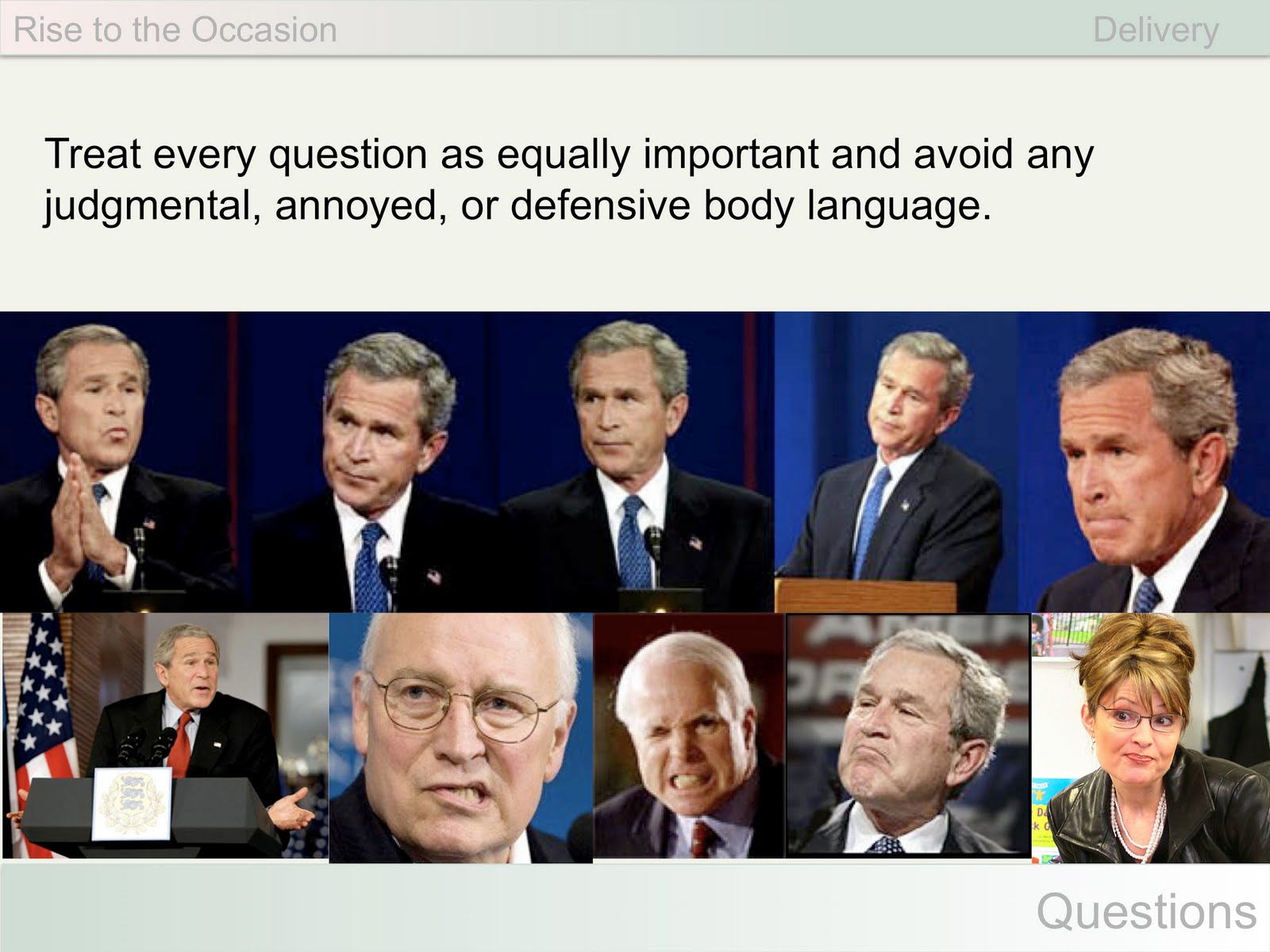
How to Deal with Aggressive Questions During Presentations
The final topic in this series on presentations is dealing with questions. This is the part of the presentation experience that people fear the most--or feel they handle poorly. Part of the reason is that while we are delivering our talk, we have control over things. We know what is coming next in each slide, and we've planned carefully what to say. However, when the audience is invited to participate, then we are no longer in complete control. We don't know what to expect precisely. Sometimes, we can anticipate questions, but often get questions that are rambling, incoherent, aggressive, or difficult to answer. We are basically put on the spot, but are expected to respond calmly and authoritatively. Dealing with different types of questions may require a slightly different approach, but there are a few things to keep in mind.
First off, listen carefully to the question and make sure you understand what is being asked before answering. If you are having trouble hearing or understanding the person, move closer to them if possible and ask them to repeat the question. You might also want to repeat the question if the audience was unable to hear it.
Second, you want to remain poised and respectful of your questioner and avoid any judgmental, annoyed, or defensive body language.
The latter point is especially important if you get an aggressive question--one that is clearly challenging your work or even a personal attack. How do you handle a challenging or aggressive question? Basically, your goal is to defuse the situation. Do not act aggressively or defensively or try to invalidate your questioner. This is difficult, I know, but if you can remain respectful, it will make your questioner look even worse than if you attack them. What you then want to do is turn their negative question or statement around and restate it in a more positive or neutral way. Focus in on the key words or phrases that they use.
Here is an example of an aggressive question (the negative words are highlighted in red, key words to reuse are in bold):
"That was an interesting presentation, but you failed to discuss how your experimental treatments might affect this plant community in the long-run or explain the exact mechanism that led to the changes you observed. I'm wondering why you've ignored such important issues."
Here is a possible response that rephrases the question in a neutral way:
"My presentation today focused on community shifts in response to key factors important in this system. I am continuing this research in another study that is looking at these and other factors in an effort to track long-term responses and to identify key mechanisms, but that work is not complete. I hope to report on those findings in the near future."
Note that the response contains no defensive or aggressive language. It is neutral and simply restates what the speaker presented and what the speaker is currently working on (and is not yet ready to discuss). The negative, challenging words (failed, ignored) are addressed indirectly by saying that the important issues raised by the questioner have not been ignored because they are being investigated in an on-going study. The response also re-uses two key words from the question (long-run, mechanism), which further adds to the impression that you've previously considered these important points and are addressing them with follow-up study. Finally, by pointing out that your work is incomplete and that you hope to reveal those findings in the future tells the questioner and the audience that you are on top of the issue, but are not prepared to reveal your results just yet.
Almost as difficult to handle is the rambling question or statement, especially one that clearly is off-track and made by someone unfamiliar with the topic of your talk. You should be humble enough to recognize that if someone is confused about something in your talk, it's probably because you failed to explain it adequately. In your response, you can say that perhaps you did not make that clear in your description or that you did not include that information because it is a well-known procedure. Then proceed to give a brief explanation. If the questioner persists in asking about a well-known technique or concept, then suggest that you talk with them at the break. The audience will recognize that you are trying to spare the questioner any embarrassment and will appreciate your actions.
As in most of the previous posts on this topic, your goal as the speaker is to put your audience at ease and to leave them with a good impression of you and your skills as a speaker and scientist.
First off, listen carefully to the question and make sure you understand what is being asked before answering. If you are having trouble hearing or understanding the person, move closer to them if possible and ask them to repeat the question. You might also want to repeat the question if the audience was unable to hear it.
Second, you want to remain poised and respectful of your questioner and avoid any judgmental, annoyed, or defensive body language.
The latter point is especially important if you get an aggressive question--one that is clearly challenging your work or even a personal attack. How do you handle a challenging or aggressive question? Basically, your goal is to defuse the situation. Do not act aggressively or defensively or try to invalidate your questioner. This is difficult, I know, but if you can remain respectful, it will make your questioner look even worse than if you attack them. What you then want to do is turn their negative question or statement around and restate it in a more positive or neutral way. Focus in on the key words or phrases that they use.
Here is an example of an aggressive question (the negative words are highlighted in red, key words to reuse are in bold):
"That was an interesting presentation, but you failed to discuss how your experimental treatments might affect this plant community in the long-run or explain the exact mechanism that led to the changes you observed. I'm wondering why you've ignored such important issues."
Here is a possible response that rephrases the question in a neutral way:
"My presentation today focused on community shifts in response to key factors important in this system. I am continuing this research in another study that is looking at these and other factors in an effort to track long-term responses and to identify key mechanisms, but that work is not complete. I hope to report on those findings in the near future."
Note that the response contains no defensive or aggressive language. It is neutral and simply restates what the speaker presented and what the speaker is currently working on (and is not yet ready to discuss). The negative, challenging words (failed, ignored) are addressed indirectly by saying that the important issues raised by the questioner have not been ignored because they are being investigated in an on-going study. The response also re-uses two key words from the question (long-run, mechanism), which further adds to the impression that you've previously considered these important points and are addressing them with follow-up study. Finally, by pointing out that your work is incomplete and that you hope to reveal those findings in the future tells the questioner and the audience that you are on top of the issue, but are not prepared to reveal your results just yet.
Almost as difficult to handle is the rambling question or statement, especially one that clearly is off-track and made by someone unfamiliar with the topic of your talk. You should be humble enough to recognize that if someone is confused about something in your talk, it's probably because you failed to explain it adequately. In your response, you can say that perhaps you did not make that clear in your description or that you did not include that information because it is a well-known procedure. Then proceed to give a brief explanation. If the questioner persists in asking about a well-known technique or concept, then suggest that you talk with them at the break. The audience will recognize that you are trying to spare the questioner any embarrassment and will appreciate your actions.
As in most of the previous posts on this topic, your goal as the speaker is to put your audience at ease and to leave them with a good impression of you and your skills as a speaker and scientist.
Tuesday, July 20, 2010
Distractions
Speakers who are nervous engage in distracting behavior. Most of us know not to jingle the change in our pockets, rock back and forth, or do other things that distract the audience from what we are saying.
So it's no surprise that people misuse laser pointers, which seem to have taken the place of jingling change. If your hand shakes so much that you cannot hold the beam steadily on a point, then you should not use one. If the beam is jumping all around the screen, the audience is definitely not paying attention to you and is instead wondering if you are nervous or perhaps have some dreaded neurological disorder.
I've seen some people try to compensate by using the other hand to steady the hand holding the laser pointer, but this just calls attention to the fact that the speaker is nervous and trying to hide it.
Another misuse of laser pointers is when the speaker constantly circles various points on the screen...endlessly circling... and even pointing to things that don't need highlighting. It's just nervous activity, but is distracting to the audience.
I suggest using animation to highlight important points on your slide. Animation frees you from fumbling around with a laser pointer and is more effective, in my opinion, to emphasize a point.
Another distraction, also due to nervousness, is hesitant speech. Some people tend to say uh and um a lot when under stress. I've talked about this habit in a previous post and some ways to minimize or overcome this tendency. This impediment can be annoying to an audience when it happens frequently enough to be noticeable. Also, excessive pauses and uhs can signal to the audience that you are not knowledgeable about your subject. So it would be worthwhile to break the habit.
Another behavior that is distracting is rocking or pacing. These are soothing behaviors that nervous speakers use to calm themselves. Both behaviors divert attention away from your slides or what you are saying. Becoming aware that you engage in this type of behavior will help you stop it.
As I've stated in previous posts on the topic of giving presentations, your goal is to make your audience comfortable. Eliminating or minimizing nervous or distracting behavior will help your audience to feel at ease with you.
So it's no surprise that people misuse laser pointers, which seem to have taken the place of jingling change. If your hand shakes so much that you cannot hold the beam steadily on a point, then you should not use one. If the beam is jumping all around the screen, the audience is definitely not paying attention to you and is instead wondering if you are nervous or perhaps have some dreaded neurological disorder.
I've seen some people try to compensate by using the other hand to steady the hand holding the laser pointer, but this just calls attention to the fact that the speaker is nervous and trying to hide it.
Another misuse of laser pointers is when the speaker constantly circles various points on the screen...endlessly circling... and even pointing to things that don't need highlighting. It's just nervous activity, but is distracting to the audience.
I suggest using animation to highlight important points on your slide. Animation frees you from fumbling around with a laser pointer and is more effective, in my opinion, to emphasize a point.
Another distraction, also due to nervousness, is hesitant speech. Some people tend to say uh and um a lot when under stress. I've talked about this habit in a previous post and some ways to minimize or overcome this tendency. This impediment can be annoying to an audience when it happens frequently enough to be noticeable. Also, excessive pauses and uhs can signal to the audience that you are not knowledgeable about your subject. So it would be worthwhile to break the habit.
Another behavior that is distracting is rocking or pacing. These are soothing behaviors that nervous speakers use to calm themselves. Both behaviors divert attention away from your slides or what you are saying. Becoming aware that you engage in this type of behavior will help you stop it.
As I've stated in previous posts on the topic of giving presentations, your goal is to make your audience comfortable. Eliminating or minimizing nervous or distracting behavior will help your audience to feel at ease with you.
Subscribe to:
Posts (Atom)