Showing posts with label cinema. Show all posts
Thursday, April 7, 2011
An Awful Waste of Space
Remember these lines from the movie, Contact?
Eleanor Arroway (as a young girl): "Dad, do you think there's people on other planets?"
Ted Arroway (Ellie's dad): "Don't know, Sparks. But I guess I'd say if it is just us... seems like an awful waste of space."
The idea is that the Universe holds many worlds that support life, including intelligent beings. Carl Sagan, of course, was the scientist and science communicator extraordinaire who promoted this message. The concept is sometimes called the "principle of mediocrity", i.e., that Earth is a common rocky planet in a typical solar system, positioned in a typical galaxy...hence, there are likely many other such planets in many galaxies scattered throughout the Universe. The SETI (Search for Extraterrestrial Intelligence) program featured in the movie Contact exists based on the assumption that someone is out there listening. Of course, this message resonates with the UFO and alien abductee crowd (who never seem to question the wisdom of aliens who return these witnesses to Earth after their "physical exams"....and other illogical alien behavior).
I think something like 50% of Americans believe we have already been visited by aliens, despite the absence of a single piece of evidence. A corollary belief is that when we finally deplete the resources on Earth, we will simply move to some other Earth-like planet...again, despite there being no evidence that such a planet exists. Hollywood (and science fiction) has contributed to these beliefs. Recent films such as Avatar create imaginary worlds so realistic that it's hard for some young viewers to separate fantasy from reality. The idea that there are many civilizations out there in the Universe has become ingrained in our culture.
In this post, I'd like to explore these ideas from the standpoint of how it influences our decisions about protecting the Earth and its resources. In particular, are there other viewpoints that would influence people to be more appreciative of what we have on our little planet.
In fact, there is an opposing hypothesis: the "rare earth hypothesis", which states the alternative that Earth is instead a rare anomaly in the Universe. I've just finished reading "Rare Earth: Why Complex Life Is Uncommon in the Universe" (2000) by Ward and Brownlee. It's been around for a while, but I had never read it. The authors argue that the emergence of complex life, particularly sentient life, has a low probability due to the combination of astrophysical, geological, and evolutionary events required to facilitate it. Obviously, that rare combination can occur...here we are. The point is that life on Earth arose from a series of serendipitous events, without which, complex life would not have evolved or would have been extinguished prematurely (the probability of worlds with microbial-level life is higher).
There are convincing arguments to support both hypotheses. You can read Rare Earth or get the Cliffs Notes version on Wikipedia. (For another viewpoint, see What Does a Martian Look Like? The Science of Extraterrestrial Life).
However, what catches my attention about the rare earth hypothesis is the notion that life can be easily snuffed out by any one of a variety of cosmic occurrences. The geologic record documents at least 5 major events in the Earth's past in which mass extinctions have taken place. Some scientists estimate that 99% of species that once existed are now extinct. Some extinctions are attributed to cosmic collisions; others to huge climate swings. You see where I'm going with this...
At this point in time, we know only one planet that can support life--Earth. There may be others out there, but no evidence so far...and even if there are, we don't have the technology to reach them in the event Earth becomes uninhabitable. We know that mass extinctions are part of Earth's history and that some were caused by climate extremes (Snowball Earth, Runaway Greenhouse). We also know that human activities are altering the Earth's atmosphere and biosphere.
I'm sure that Sagan, in proposing the large estimate of habitable planets, was thinking mostly of supporting space exploration and astrobiology...not about the possible effect such a belief might have on how we view Earth and its resources. Yet here we are facing some serious questions about climate change and other issues.
Hollywood movies typically have happy endings with groups of humans surviving apocalyptic events in subterranean shelters or some other ark-like system (Deep Impact, 2012), humans colonizing other planetary systems (Avatar), or more advanced alien civilizations sending blueprints for transport of humans across the Universe (Contact). These are entertaining stories that convey a compelling message about human resilience and persistence. We naturally identify with the survivors, not those unfortunate people who succumb to the meteor impact. Government plans for response to such events also send the message that these catastrophes are survivable. However, one only needs to consider how we handled lesser events (Hurricane Katrina, the Gulf oil spill, Japan tsunami) to see the reality that our current abilities are insufficient to meet a global-level disaster.
Are there people on other planets? Don't know. But I guess I'd say if it is just us... seems like we should treat our planet (and each other) better.
Image Credits: Film clip (introductory sequence) and modified stills from the movie, Contact (Warner Bros.)
Sunday, April 3, 2011
You Are Not in Kansas Anymore
I mentioned in earlier posts that I had been doing fieldwork recently in a remote location (think jungle, mosquitoes, scorpions, bucket latrines, no refrigeration, no TV or internet). Spending time in a tropical forest and away from "civilization" is an experience that simultaneously makes one appreciate the variety and abundance of life on our planet as well as the comforts that we in developed countries tend to take for granted. A single hectare of tropical forest may contain hundreds, even thousands, of species of plants, animals, fungi, and bacteria. Walking through the forest and stopping in front of a massive old tree, I was reminded of the movie, Avatar.
If you've been following this blog, you've read my previous review of Avatar and sexism in movies by James Cameron. I was pretty critical in those reviews, but there's another aspect of Avatar that I've wanted to explore.
In the months after the release of Avatar, a number of people began posting comments on various forums about how the movie affected them. Some said it changed their lives and how they view the world. Others became sad or depressed, presumably because their lives did not live up to the fantasy world created in the movie. Some posters even stated that they'd contemplated suicide (it's hard to tell if these are real or fabricated statements). Although a lot of those who had strong reactions to the movie were very young and impressionable, some were adults. Their words indicated that they yearn for the life of the Na'vi, the imaginary indigenous people of Avatar. The depressed are being advised to shed modern conveniences that harm the environment and to live "closer to nature". That way, they can take an active role in creating their own world (instead of sulking in a dark room in front of the TV or computer).
In case you haven't seen the movie, the Na'vi live close to Nature; they are 10 foot tall, blue, cat-like humanoids with "bones reinforced with carbon fiber", and have coming-of-age rituals in which the inductee acquires a flying dragon, which becomes their steed for life. At the beginning of the movie, we see that life on Pandora is quite dangerous. The evil antagonist, Colonel Quaritch, eloquently describes the situation to new recruits:
"You are not in Kansas anymore. You are on Pandora, ladies and gentlemen. Respect that fact every second of every day. If there is a Hell, you might wanna go there for some R & R after a tour on Pandora. Out there beyond that fence every living thing that crawls, flies, or squats in the mud wants to kill you and eat your eyes for jujubes."
This message is driven home as Jake Sully, the human protagonist, is almost killed four times during his first day in the jungles of Pandora. He survives, of course, to become one of the Na'vi, fall in love with a Na'vi princess, and ultimately shed his paralyzed human body for a new, Na'vi-like avatar body. Later brushes with death are presented as exciting adventures, which only add to the fantasy of a perfect world. The movie experience thus yields a sense of adventure, wonder, and happy endings and never hints at reality.
Perhaps it's for the best.
Real life in the gritty, parasite-infested tropical forest is somewhat less pleasant than one would guess from watching Avatar. Most people I know would not last two minutes in the bush before they would run screaming back to air conditioning, iced drinks, bug-free manicured lawns, entertainment on demand, and all the other trappings of civilization.
What movies like Avatar do accomplish is to get young people excited about nature and about preserving the natural world.
On the one hand, I'm sad that it takes a fantasy world (patterned after the Amazon rain forest) to make people care about the only world we know that has life--Earth. On the other hand, I'm glad that people are moved by the environmental message. I'm with Cameron in believing that people don't get motivated by just talking or reading about Nature. They need to vicariously experience it without all the danger and discomfort. People are especially affected by stories that touch them emotionally.
And Avatar accomplishes this.
The technological breakthroughs that allowed the creation of a believable world populated by fantasy creatures are quite simply amazing. The reactions to the movie reveal how effective such a story-telling approach is...especially with generations who never knew a world before CGI.
One might wonder if such fantasies simply set young people up for disillusionment. However, I recall being excited and fascinated by the original Star Trek TV series. My imagination was fired up about what life might be like on other worlds and whether I might one day travel to those worlds and study the life found there. And Star Trek had very clunky special effects; even I thought they were corny at the time. Nevertheless, the series influenced a generation of young viewers. Even though our original, idealistic expectations about space travel were never realized, some of us succeeded in achieving our dreams of becoming a different type of explorer--a scientist.
With its incredible special effects, Avatar may have a profound impact on the current generation.
Avatar's success in this regard also has a message for those of us who are concerned about attracting young people (especially girls) to science. People pay attention to compelling stories that 1) they can understand, 2) are memorable, and 3) affect them emotionally. I'll bet young fans of Avatar can answer correctly more questions about the ecology of Pandora than about our Earth. What do you think?
Photo Credit: Avatar, 20th Century Fox; AnotherBigDamnTree, DrDoyenne
If you've been following this blog, you've read my previous review of Avatar and sexism in movies by James Cameron. I was pretty critical in those reviews, but there's another aspect of Avatar that I've wanted to explore.
In the months after the release of Avatar, a number of people began posting comments on various forums about how the movie affected them. Some said it changed their lives and how they view the world. Others became sad or depressed, presumably because their lives did not live up to the fantasy world created in the movie. Some posters even stated that they'd contemplated suicide (it's hard to tell if these are real or fabricated statements). Although a lot of those who had strong reactions to the movie were very young and impressionable, some were adults. Their words indicated that they yearn for the life of the Na'vi, the imaginary indigenous people of Avatar. The depressed are being advised to shed modern conveniences that harm the environment and to live "closer to nature". That way, they can take an active role in creating their own world (instead of sulking in a dark room in front of the TV or computer).
In case you haven't seen the movie, the Na'vi live close to Nature; they are 10 foot tall, blue, cat-like humanoids with "bones reinforced with carbon fiber", and have coming-of-age rituals in which the inductee acquires a flying dragon, which becomes their steed for life. At the beginning of the movie, we see that life on Pandora is quite dangerous. The evil antagonist, Colonel Quaritch, eloquently describes the situation to new recruits:
"You are not in Kansas anymore. You are on Pandora, ladies and gentlemen. Respect that fact every second of every day. If there is a Hell, you might wanna go there for some R & R after a tour on Pandora. Out there beyond that fence every living thing that crawls, flies, or squats in the mud wants to kill you and eat your eyes for jujubes."
This message is driven home as Jake Sully, the human protagonist, is almost killed four times during his first day in the jungles of Pandora. He survives, of course, to become one of the Na'vi, fall in love with a Na'vi princess, and ultimately shed his paralyzed human body for a new, Na'vi-like avatar body. Later brushes with death are presented as exciting adventures, which only add to the fantasy of a perfect world. The movie experience thus yields a sense of adventure, wonder, and happy endings and never hints at reality.
Perhaps it's for the best.
Real life in the gritty, parasite-infested tropical forest is somewhat less pleasant than one would guess from watching Avatar. Most people I know would not last two minutes in the bush before they would run screaming back to air conditioning, iced drinks, bug-free manicured lawns, entertainment on demand, and all the other trappings of civilization.
What movies like Avatar do accomplish is to get young people excited about nature and about preserving the natural world.
On the one hand, I'm sad that it takes a fantasy world (patterned after the Amazon rain forest) to make people care about the only world we know that has life--Earth. On the other hand, I'm glad that people are moved by the environmental message. I'm with Cameron in believing that people don't get motivated by just talking or reading about Nature. They need to vicariously experience it without all the danger and discomfort. People are especially affected by stories that touch them emotionally.
And Avatar accomplishes this.
The technological breakthroughs that allowed the creation of a believable world populated by fantasy creatures are quite simply amazing. The reactions to the movie reveal how effective such a story-telling approach is...especially with generations who never knew a world before CGI.
One might wonder if such fantasies simply set young people up for disillusionment. However, I recall being excited and fascinated by the original Star Trek TV series. My imagination was fired up about what life might be like on other worlds and whether I might one day travel to those worlds and study the life found there. And Star Trek had very clunky special effects; even I thought they were corny at the time. Nevertheless, the series influenced a generation of young viewers. Even though our original, idealistic expectations about space travel were never realized, some of us succeeded in achieving our dreams of becoming a different type of explorer--a scientist.
With its incredible special effects, Avatar may have a profound impact on the current generation.
Avatar's success in this regard also has a message for those of us who are concerned about attracting young people (especially girls) to science. People pay attention to compelling stories that 1) they can understand, 2) are memorable, and 3) affect them emotionally. I'll bet young fans of Avatar can answer correctly more questions about the ecology of Pandora than about our Earth. What do you think?
Photo Credit: Avatar, 20th Century Fox; AnotherBigDamnTree, DrDoyenne
Saturday, January 22, 2011
Objective = Emotionless
I've been reviewing the female stereotypes in the movie, Avatar. I made the point in previous posts that inclusion of token women who display superficial male characteristics (physically tough, abrasive, verbally offensive, knowledgeable of weaponry, etc.) does not address the lack of "strong female characters" in movies and are certainly not suitable role models for girls. The fact that some of these characteristics were also assigned to the female scientist in Avatar is particularly disturbing, but not surprising given the track record of Hollywood. I'd like to explore this point a bit further in this post.
I've previously described six female scientist stereotypes found in film: the old maid, the male woman, the naive expert, the evil plotter, the assistant or daughter, and the lonely heroine. Dr. Grace Augustine is the scientist in Avatar who heads the research program on Pandora and who literally wrote the book on the native Na'vi. She is a combination of several stereotypes, including the old maid, the male woman, and the lonely heroine. Augustine has apparently been on Pandora for at least ten years, is unmarried and with no apparent emotional attachments, and has been given some typical "aggressive male attributes". She has an abrasive personality and a confrontational (or patronizing) style of interaction with male characters who get in her way; she additionally smokes like a chimney, cusses, and uses derogatory name-calling when challenged:
At the opposite extreme are the scientists who are emotionally out of control or downright nuts: Dr. Frankenstein, Dr. Jekyll and Mr. Hyde, and my favorite, Dr. Strangelove with the brilliant Peter Sellers as the mad scientist.
Kubrick and Sellers poked fun at the mad scientist stereotype as well as male fantasies about women in the following clip from Dr. Strangelove:
These fears about evil geniuses go back to ancient times...shaman with their knowledge of magic and healing. Later in history, women who were herbalists and midwives were often charged with witchcraft and executed. In the 20th century, science and technology contributed to human advancement, but also introduced real or potential dangers: atomic bombs, pollution, genetic engineering, artificial intelligence. It's scary to imagine that the same scientists who are changing the world with their inventions and discoveries might be Dr. Jekyll and Mr. Hyde clones or amoral androids.
Fiction and screen writers love these conflicted characters, which is another reason why they've persisted into modern times. They make great antagonists and archenemies of the heroes in novels and cinema.
And, as long as we have filmmakers who can make $2 billion by catering to the adolescent male audience, I'm afraid we won't be seeing the "strong female" or the "mad scientist" stereotype disappear anytime soon.
Photo/video credits: still from Avatar (Twentieth Century Fox); video (ColbertPhilosopher on YouTube); clip from Dr. Strangelove (Hawk Films/Columbia Pictures)
I've previously described six female scientist stereotypes found in film: the old maid, the male woman, the naive expert, the evil plotter, the assistant or daughter, and the lonely heroine. Dr. Grace Augustine is the scientist in Avatar who heads the research program on Pandora and who literally wrote the book on the native Na'vi. She is a combination of several stereotypes, including the old maid, the male woman, and the lonely heroine. Augustine has apparently been on Pandora for at least ten years, is unmarried and with no apparent emotional attachments, and has been given some typical "aggressive male attributes". She has an abrasive personality and a confrontational (or patronizing) style of interaction with male characters who get in her way; she additionally smokes like a chimney, cusses, and uses derogatory name-calling when challenged:
Statements made to no one in particular:
Dr. Grace Augustine: [Emerging from her avatar pod] Where's my goddamn cigarette? What's wrong with this picture!
===
Dr. Grace Augustine: They're pissing on us and not even giving us the courtesy of calling it rain.
Interactions with superiors and equivalents:
Dr. Grace Augustine: Parker. You know, I used to think it was benign neglect, but now I see that you are intentionally screwing me.
Selfridge: Grace, you know, I enjoy our little talks.
====
Col. Quaritch: Shut your pie hole!
Dr. Grace Augustine: Or what, *Ranger Rick*? You gonna shoot me?
Interactions with subordinates:
Dr. Max Patel: Grace, this is Jake Sully.
Jake Sully: Madame.
Dr. Grace Augustine: Yeah, yeah, I know who you are and I don't need you. I need your brother. You know, the PhD who trained for 3 years for this mission.
====
Dr. Grace Augustine: Hey Marine!
Jake Sully: [Turns and sees Grace's Avatar] Damn. Grace?
Dr. Grace Augustine: Well who'd you expect, numbnuts?
====
Dr. Grace Augustine: Don't play with that. You'll go blind.
You get the picture. The message is that to be a successful, strong female scientist in charge of a large research program, a woman must be unmarried (except to her work) and lonely (ten years on a distant moon in the Alpha Centauri system, four light years from Earth--that's about as remote as one can get!), have no friends or admirers, feared by her staff, and despised by her military and corporate associates. An abrasive, disrespectful, and haughty manner are the characteristics that apparently led to both her success as a scientist and her dismal personal life.
Classic portrayal of the female scientist stereotype: Women can't be successful in a male profession unless they sacrifice personal happiness.
One of the scenes cut from the final film version of Avatar provides an interesting bit of insight into the decision-making process of the director, James Cameron, in the portrayal of Dr. Grace Augustine. As I was double-checking some of the dialog (above), I stumbled across a video trailer that showed one of the scenes with her and Jake Sully that never made it to the final cut. The scene (see Extended Cut) is interesting because it provides a different, more sympathetic and complex view of Augustine and explains what happened to the Na'vi school that she established and ran for ten years (it was shut down after Na'vi students who vandalized company equipment were shot and killed). Then she says something interesting:
"A scientist stays objective. We can't be ruled by emotion."
Ah ha. There we have it. The confusion over scientific objectivity and the scientist's emotions. This assumption that a scientist's need for logic and objectivity in their work somehow requires an innate lack of emotion in all aspects of life is a common thread in Hollywood portrayals of scientists.
Scientific detachment and lack of emotion in cinema is epitomized by the Star Trek character Spock (see video below) and in later films by androids (Ash in Alien, Data in Star Trek Generations).
At the opposite extreme are the scientists who are emotionally out of control or downright nuts: Dr. Frankenstein, Dr. Jekyll and Mr. Hyde, and my favorite, Dr. Strangelove with the brilliant Peter Sellers as the mad scientist.
Kubrick and Sellers poked fun at the mad scientist stereotype as well as male fantasies about women in the following clip from Dr. Strangelove:
These fears about evil geniuses go back to ancient times...shaman with their knowledge of magic and healing. Later in history, women who were herbalists and midwives were often charged with witchcraft and executed. In the 20th century, science and technology contributed to human advancement, but also introduced real or potential dangers: atomic bombs, pollution, genetic engineering, artificial intelligence. It's scary to imagine that the same scientists who are changing the world with their inventions and discoveries might be Dr. Jekyll and Mr. Hyde clones or amoral androids.
Fiction and screen writers love these conflicted characters, which is another reason why they've persisted into modern times. They make great antagonists and archenemies of the heroes in novels and cinema.
And, as long as we have filmmakers who can make $2 billion by catering to the adolescent male audience, I'm afraid we won't be seeing the "strong female" or the "mad scientist" stereotype disappear anytime soon.
Photo/video credits: still from Avatar (Twentieth Century Fox); video (ColbertPhilosopher on YouTube); clip from Dr. Strangelove (Hawk Films/Columbia Pictures)
Wednesday, January 19, 2011
"I See You"
This post is a continuation of an analysis of James Cameron’s portrayal of women in film and whether his movies celebrate the equality of women, or instead perpetuate the stereotypical view of women as subordinate to men. In the previous post, I reviewed several of Cameron’s movies, including Terminator, Aliens, True Lies, The Abyss, and Titanic. They mostly failed two litmus tests designed to assess whether a film (in which women appear) tells a story from a female point of view or depicts women as something other than secondary to a male.
In this post, I now turn to Cameron’s latest blockbuster: Avatar. I doubt there is anyone out there who hasn’t seen this movie or if not, plans to at this late date; but just in case, there will be many spoilers ahead.
Here goes.
Oh. My. God. (or should I say: Eywa, help us?) I hardly know where to begin to articulate how this movie sets new lows in terms of Hollywood stereotypes. Many bloggers and reviewers have excoriated Avatar and J. Cameron for the multiple “isms” in this film: racism, sexism, anthropocentrism… But the ultimate insult is that Cameron and the film’s promoters pretend just the opposite…that the movie is sensitive to the plight of indigenous people (the Noble Savage who is one with nature), women as equals to men (who kick ass as well as the men), and the amazing flora and fauna of an alien world (which reveal how great nature is and how much we should appreciate it).
Before we dive into the sexism aspects of Avatar, let’s briefly consider a few of the other “isms” because they reveal a broader picture of how duplicitous this movie is.
Racism: the Avatar story is about a white male (Jake Sully….sully, mar, defile, get it?) who starts out in the role of the bad, conquering human who falls in love with a Na'vi female, sees the light (that the alien world is wonderful and should be saved), becomes the leader of the indigenous people, and shows them how to expel the human invaders. The movie pretends to be sensitive to native people (of color…literally blue color) and admiring of their spiritual connectedness to nature. What rubbish. If this were really a story about indigenous people and their fight to save their land from invaders, it would be told from a very different viewpoint.….say, Neytiri, the female protagonist. But noooo. The story is told from the viewpoint of a white, male human who wins the heart of the most desirable female native, passes the test of manhood, is accepted in a matter of months into their alien society, becomes their leader in a single daring move (by figuring out how to capture and control the most dangerous and iconic animal on the planet—something none of the current crop of aliens has managed to do), overcomes his human nemesis (Colonel Quaritch), and finally sheds his crippled, human body for a better one.
Sounds a lot like what someone with a large male ego would like to experience, even if vicariously, by making a movie of it. Nothing wrong with that. Just don’t claim that it’s about something else.
Anthropocentrism: The movie was also initially praised by animal rights groups for its depiction of wondrous flora and fauna and reverent treatment of all creatures, even those killed for food. But was Avatar really showing sensitivity for the natural world and its creatures? Several reviewers have pointed out that the “interconnectedness” between the Na’vi people and their domesticated animals was just an extension of the white, male domination fantasy that pervades the film. This point is driven home in the scene in which Jake, in his avatar persona, takes the final test of “manhood” by overpowering, “breaking the spirit of”, and physically bonding with (by connecting genital-like appendages!!!!) a protesting creature—the dragon-like, flying banshee. This essay does a brilliant job of dissecting this scene and illuminating the parallels between this male fantasy scene and rape. When you look at this scene from the viewpoint of domination (dominion over all creatures, women, etc.), it makes the scenes in which Jake shows “reverence” toward other animals seem pretty shallow and unbelievable.
Militarism/corporatism: One message of Avatar is supposed to be about denouncing the militaristic takeover of lands from indigenous people, in this case, to acquire a ridiculous mineral, "unobtanium", which we are never told exactly what it's used for. The greedy CEO, Parker, and his attack dog, Colonel Quaritch, are set up as the villains for Jake to fight and defeat. They are cardboard characters reminiscent of those in previous Cameron movies (Terminator 2, Aliens). I actually had some respect for Quaritch's character who made no attempt to hide his motives or his racist tendencies and strove to do the job he was hired for. He was brutal, but honest. Contrast him with Jake who deceives his employer, his "adopted" native clan, and his Na'vi lover (who sulks for only a day or so, then forgives Jake once he's revealed as the "true" leader of the Omaticaya). And in the end, Jake turns on his own people (humans), ousting them from Paradise, I mean Pandora, to return to their devastated and doomed Earth. No one feels sorry for them? Jake gets to stay on lush Pandora in his stolen avatar body (built at a cost of $millions to the company that hired him)....to live happily ever after.
I could go on about the innumerable other “isms” in this film: dualism, environmentalism, holism, idealism, immortalism, mysticism, naturalism, spiritualism, utopianism, and vitalism.
But the one that I'm most interested in is sexism. A number of movie reviewers, the movie’s advertisers, and especially J. Cameron himself seem to think that the movie aligns with feminist ideals and does a dandy job of it. What is this belief based on? Primarily, it’s the inclusion of several so-called “strong women” characters in the film. There’s Neytiri, the Na'vi princess I’ve already mentioned, who is strong physically and mentally, brave, destined to lead her people (or was until Jake showed up), and, of course, also beautiful, sexy, and sensual. Her mother, Mo’at, is the clan’s spiritual leader who has special knowledge/powers to tap into Pandora’s energy field. The scientist leading the research team on Pandora is a woman, Dr. Grace Augustine, who takes on any and all (men) who try to interfere with her work. Finally, there’s Trudy, the marine helicopter pilot who defies orders and can fly and shoot as well as the guys. So based on the presence of these "strong female" characters, we are supposed to buy the claim that Avatar is sensitive to women's issues and breaks with the Hollywood portrayal of female stereotypes?
I don’t think so. It miserably fails the two tests: the Bechdel test and the Feminist Film Test. I was not surprised that the two strong human females (Grace, the scientist and Trudy, the pilot) who both defied male authority were killed off. The two Na'vi females (Neytiri and Mo'at) who are needed to fulfill the male fantasy (Jake's love interest and his permanent transfer to the avatar body) both survive. This view of women as important only because they serve the needs of the male protagonist is perfectly captured in a single scene about halfway through the movie. This is the scene where Jake and Neytiri are walking together the evening after he has just passed his “manhood” test.
Here is the dialog:
Neytiri: You are Omaticaya now. You may make your bow from the wood of Hometree. And you may choose a woman. We have many fine women. Ninat is the best singer.
Jake Sully: I don't want Ninat.
Neytiri: Peyral is a good hunter.
Jake Sully: Yes, she is a good hunter. But I've already chosen. But this woman must also choose me.
Neytiri: [smiles] She already has.
Jake Sully: I don't want Ninat.
Neytiri: Peyral is a good hunter.
Jake Sully: Yes, she is a good hunter. But I've already chosen. But this woman must also choose me.
Neytiri: [smiles] She already has.
Whoa. Back up. “And you may choose a woman.” ???What??? The prize for passing the manhood test is a female mate? The men get to choose? Women have no say? Sounds suspiciously like a practice from our human past, not the imaginary Omaticaya, who in all other respects appeared to be pretty egalitarian. And Jake goes on to give Neytiri a lesson in feminism: “but this woman must also choose me”. Aarrgh. What a patronizing statement. But this conversation is exactly what a self-centered male would like to hear. It’s unclear whether this statement was calculated (to appeal to the adolescent male audience) or simply reflects Cameron’s view of how things should be (or wishes things would be).
A couple of other things to know about how Cameron developed the character of Neytiri: He’s admitted in several interviews that from the beginning, he knew she had to have breasts (although he used a different, derogatory term) despite the obvious fact that the Na’vi are not mammals and have no need for mammary glands. He also brought in experts to create the Na’vi morphotype so that they would be appealing to the audience, especially men. Large, expressive eyes—a Disney trick. Plus cool animal features—the cat-like nose and prehensile tail.
Would Jake have fallen for Neytiri if she looked like the creature in District 9, instead of a sensual, blue, cat-like humanoid?
Imagine the dialog with Neytiri as the creature depicted above right:
Neytiri: You are Omaticaya now. You may make your bow from the wood of Hometree. And you may choose a woman. We have many fine women. Ninat is the best singer.
Jake Sully: Huh? What did you say? A woman?
Neytiri: Peyral is a good hunter.
Jake Sully: Uuhhh….well, is that required? Taking a woman?
Neytiri: It is part of the ritual of becoming one with the Omaticaya people....choosing a mate for life.
Jake Sully: [gulping] For life?
Neytiri: Yes. You know, I am not yet taken. You must choose soon [wiggling her mouth parts suggestively].
Jake Sully: I think I hear Colonel Quaritch calling me.
So to summarize, Avatar is not, by any stretch of the imagination, a movie that aligns with feminist ideals or that projects a valid image of what a "strong female character" is. Tossing in a few token women who can fly a helicopter, shoot a gun, or cuss is not what we have in mind when we say that movies could use more strong female characters. It seems that Hollywood writers, directors, and producers think that "strong female" literally means physically strong, abrasive, defiant, or some other one-dimensional characteristic....rather than what is really required: a strong character [played by a female]. Instead of the simplistic definition of "strong" as being physically powerful or behaviorally aggressive, a strong character might be especially capable, authoritative, smart, complex, resilient, or moral.
As I noted in the first post in this series, Avatar has so far grossed over $2 billion and has been seen by millions. This film and others like it are extremely popular with adolescents. What an opportunity to overturn some stereotypes! Too bad it didn't.
In the Na'vi culture, the greeting "I see you" means "I see into you and all you are--a complex being that deserves my respect". In other words, "I see your real nature, beyond just the superficial, physical attributes". Pretty ironic.
Photo Credits: Stills from Avatar (20th Century Fox) and District 9 (TriStar Pictures)
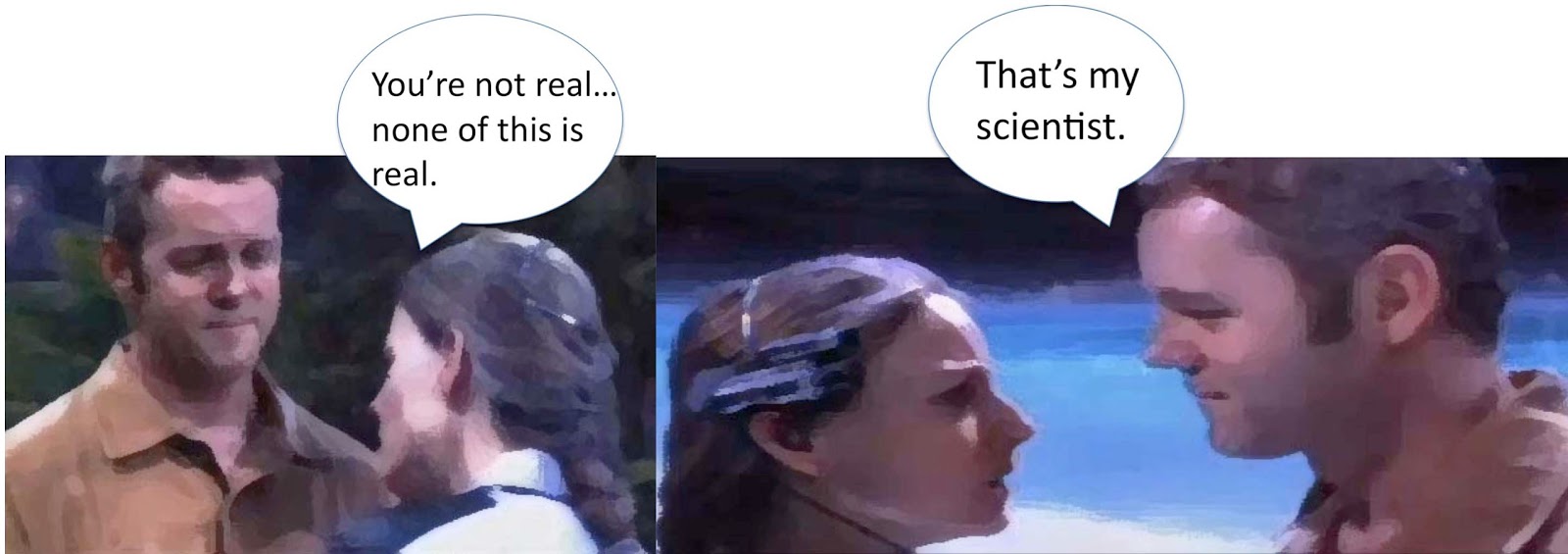
So to summarize, Avatar is not, by any stretch of the imagination, a movie that aligns with feminist ideals or that projects a valid image of what a "strong female character" is. Tossing in a few token women who can fly a helicopter, shoot a gun, or cuss is not what we have in mind when we say that movies could use more strong female characters. It seems that Hollywood writers, directors, and producers think that "strong female" literally means physically strong, abrasive, defiant, or some other one-dimensional characteristic....rather than what is really required: a strong character [played by a female]. Instead of the simplistic definition of "strong" as being physically powerful or behaviorally aggressive, a strong character might be especially capable, authoritative, smart, complex, resilient, or moral.
As I noted in the first post in this series, Avatar has so far grossed over $2 billion and has been seen by millions. This film and others like it are extremely popular with adolescents. What an opportunity to overturn some stereotypes! Too bad it didn't.
In the Na'vi culture, the greeting "I see you" means "I see into you and all you are--a complex being that deserves my respect". In other words, "I see your real nature, beyond just the superficial, physical attributes". Pretty ironic.
Photo Credits: Stills from Avatar (20th Century Fox) and District 9 (TriStar Pictures)
Tuesday, January 18, 2011
More Feminism and the Movies
We are discussing the movies of James Cameron and how they stack up in terms of positive portrayals of women. See the previous post for background.
There are a couple of litmus tests one can apply to films to determine whether female characters are central to the story and are also portrayed as in control of their own destiny. One is called the Bechdel Test, which requires the movie to have 1. Two women (who have names), 2. who talk to each other, 3. about something other than a man. This site lists movies and how they rate according to the Bechdel Test.
The second test is one I made up many years ago, called “The Feminist Film Test”. Here’s how it works. For the movie to pass the test, it must (1) have a female lead, (2) who survives or succeeds, (3) without the intervention of a man (saving her, dying so she can live, giving her a job, etc.).
Let’s apply these two tests to Cameron’s films and see how they fare.
First, we have The Terminator with one strong female character, Sarah Connor. It fails both tests. There is a minor conversation between Sarah and her roommate, but it mostly revolves around men and dates and is superficial. Sarah is ultimately saved from the Terminator (Arnold Schwarzenegger) by Kyle Reese (Michael Biehn), so it fails The Feminist Film Test. Terminator 2: Judgment Day also fails both tests. Sarah and son John Connor are both saved by a second cyborg (Terminator 2) who sacrifices itself to save them.
Next is Aliens. Now, don’t confuse Aliens with Alien, the first movie in the series and directed by Ridley Scott, not James Cameron. Alien passes both tests (two women talk about something other than a man and Ripley saves herself without any help from a man). Aliens does barely pass the Bechdel test because two females talk about something other than a man (but is minor to the film’s story). It only partially passes my test because Ripley is helped at various critical junctures by a man (Hicks shows her how to use a weapon, saves her from the creature, and backs her up when she’s challenged; Bishop (male android) saves Ripley and Newt from the exploding processing facility by piloting a dropship to pick them up in the nick of time).
In the Abyss, we have a strong female scientist! Unfortunately, this film fails both tests also. Dr. Lindsay Brigman has no meaningful conversation with the one other woman character and is saved by her ex-husband, who still loves her.
True Lies barely passes the Bechdel test (Helen Tasker does trade insults with the female villain), but fails my test (Arnold saves both Helen and Dana Tasker and then recruits Helen as his spy side-kick in the end).
Similarly, Titanic barely passes the Bechdel test (Rose and her mother have a few conversations about something other than men, although these do relate to men), but fails my test (Rose is, of course, saved by Jack, who ultimately sacrifices himself so she can live).
So far, Cameron’s films are not living up to the idea that his movies buck the Hollywood tradition of portraying women in stereotypical roles, typically subservient to a male character or exists only to enhance a male character.
The problem is not that a few movies by Cameron fail to be about women or women’s issues or even that there are a few misogynists who conspire to prevent women from playing central roles in film. The problem is with an entire industry that makes movies that mostly cater to or are about men, mainly white men (unless they are Will Smith or Denzel Washington). I enjoy films that are told from a male’s point of view or are about a man’s life or accomplishments. What I take issue with is when someone makes a movie that is clearly told from a male (often puerile) viewpoint, but tries to dress it up as being modern-thinking, progressive or pro-feminist by throwing in a few female characters who can fight, cuss, do science, or whatever (like a man). Such superficial tokens may even do more harm than good.
I’ll save my analysis of Avatar for the next post.
Sunday, January 16, 2011
Feminism and the Movies
There was a lot of talk back in 2009 and 2010 about James Cameron being sympathetic to feminist ideals and that his blockbuster movie, Avatar, was Exhibit A in support of this characterization. (Those of you who have been following this blog know that I like to analyze how women are portrayed in film and TV—especially female scientists. As I’ve pointed out in previous posts, most people never meet a scientist and generally get their impressions of scientists and women in science from the movies and TV.)
I’d like to revisit Avatar and Cameron’s supposedly “feminist” leanings. Part of the reason is that I just saw the movie again (on cable), and as much as I tried to view it again as “an entertaining fantasy”, I could not help analyzing it from various standpoints: the biology of Pandora, how scientists and women are portrayed, etc. Next I stumbled across a pre-release review of Avatar called “Is Avatar’s James Cameron a Feminist Ally?” That got me thinking again about Hollywood’s portrayal of women and whether Avatar breaks with tradition (as claimed) or is instead business as usual.
Why is this even worth thinking about? It’s just a movie, right? Well, when you consider the numbers of people who have seen it worldwide and the enormous amount of money it made, it seems possible that it has had an impact beyond the typical, run-of-the-mill film. Since its release on December 18, 2009, it has grossed $2,781,835,502 in theatre sales and another $183,484,783 in DVD sales (US only). Adjusted for inflation, these numbers make Avatar the fourth highest grossing film of 1977-2010 (after Star Wars Ep. IV, ET: The Extra-Terrestrial, and Titanic (also a Cameron film)). The numbers of people who’ve seen it are harder to come by (many have seen it more than once), but we can assume it’s a lot.
The target audience was young and impressionable teens for the most part. Did it have an effect on these viewers? Apparently, it had a big impact on some viewers. So much so that some young fans have experienced depression and suicidal thoughts after seeing the film (because their real worlds do not live up to the fantasy world of Pandora). There is even a site for such suffering fans where they can get advice on coping with their depression. Despite the fantastical premise, the movie and its CGI characters seemed to have created a very believable world for many movie-goers. If people experienced such emotional and mental changes upon seeing this movie, it seems plausible that they also were influenced to some degree by the various depictions of corporate greed, indigenous societies, science, and women.
So on to Cameron and his track record relative to portrayal of women. Here’s a list of his major films (*wrote screenplay, ^directed): The Terminator* (1984), Aliens*^ (1986), The Abyss*^ (1989), Terminator 2: Judgment Day (1991)*^, True Lies (1994)^, Titanic (1997)^*, and Avatar (2009)*^.
You’ll recognize that most of these films featured “strong women”. There’s Sarah Connor (Linda Hamilton) from the Terminator movies. Ripley (Sigourney Weaver) and Vasquez (Jenette Goldstein) in Aliens. Dr. Lindsey Brigman (Mary Elizabeth Mastantonio) in The Abyss. Helen Tasker (Jamie Lee Curtis), Juno (Tia Carrere), and Dana Tasker (Eliza Dushku) in True Lies. Rose (Kate Winslet) in Titanic. Cameron seems to have outdone himself with Avatar, including no less than four strong female characters: Neytiri (Zoe Saldana), Dr. Grace Augustine (Sigourney Weaver), Trudy Chacon (Michelle Rodriguez), and Mo’at (CCH Pounder).
Does having strong female characters qualify these movies as being feminist, supportive of women’s issues, or simply good portrayals of women? Of course not.
There are a couple of litmus tests one can apply to films to determine whether female characters are central to the story or shown to be in control of their own destinies. One is called the Bechdel Test, which requires the movie to have
1. Two women (who have names),
2. Who talk to each other,
3. About something other than a man.
This site lists movies and how they rate according to the Bechdel Test.
The second test is one I made up many years ago, called “The Feminist Film Test”. Here’s how it works. For the movie to pass the test, it must
1. Have a female lead,
2. Who survives or succeeds,
3. Without the intervention of a man (saving her, dying so she can live, etc.).
Very few Hollywood films pass this test.
In the next post, I’ll apply these two tests to Cameron’s films and see how they fare. In the meantime, you can think about some of your favorite movies and see if they pass these tests.
Subscribe to:
Posts (Atom)