Thursday, April 7, 2011

An Awful Waste of Space


Remember these lines from the movie, Contact?

Eleanor Arroway (as a young girl): "Dad, do you think there's people on other planets?"

Ted Arroway (Ellie's dad): "Don't know, Sparks. But I guess I'd say if it is just us... seems like an awful waste of space."

The idea is that the Universe holds many worlds that support life, including intelligent beings. Carl Sagan, of course, was the scientist and science communicator extraordinaire who promoted this message. The concept is sometimes called the "principle of mediocrity", i.e., that Earth is a common rocky planet in a typical solar system, positioned in a typical galaxy...hence, there are likely many other such planets in many galaxies scattered throughout the Universe. The SETI (Search for Extraterrestrial Intelligence) program featured in the movie Contact exists based on the assumption that someone is out there listening.  Of course, this message resonates with the UFO and alien abductee crowd (who never seem to question the wisdom of aliens who return these witnesses to Earth after their "physical exams"....and other illogical alien behavior).

I think something like 50% of Americans believe we have already been visited by aliens, despite the absence of a single piece of evidence.  A corollary belief is that when we finally deplete the resources on Earth, we will simply move to some other Earth-like planet...again, despite there being no evidence that such a planet exists. Hollywood (and science fiction) has contributed to these beliefs. Recent films such as Avatar create imaginary worlds so realistic that it's hard for some young viewers to separate fantasy from reality. The idea that there are many civilizations out there in the Universe has become ingrained in our culture.

In this post, I'd like to explore these ideas from the standpoint of how it influences our decisions about protecting the Earth and its resources. In particular, are there other viewpoints that would influence people to be more appreciative of what we have on our little planet.

In fact, there is an opposing hypothesis: the "rare earth hypothesis", which states the alternative that Earth is instead a rare anomaly in the Universe. I've just finished reading "Rare Earth: Why Complex Life Is Uncommon in the Universe" (2000) by Ward and Brownlee. It's been around for a while, but I had never read it. The authors argue that the emergence of complex life, particularly sentient life, has a low probability due to the combination of astrophysical, geological, and evolutionary events required to facilitate it. Obviously, that rare combination can occur...here we are. The point is that life on Earth arose from a series of serendipitous events, without which, complex life would not have evolved or would have been extinguished prematurely (the probability of worlds with microbial-level life is higher).

There are convincing arguments to support both hypotheses. You can read Rare Earth or get the Cliffs Notes version on Wikipedia.  (For another viewpoint, see What Does a Martian Look Like? The Science of Extraterrestrial Life).

However, what catches my attention about the rare earth hypothesis is the notion that life can be easily snuffed out by any one of a variety of cosmic occurrences. The geologic record documents at least 5 major events in the Earth's past in which mass extinctions have taken place. Some scientists estimate that 99% of species that once existed are now extinct. Some extinctions are attributed to cosmic collisions; others to huge climate swings. You see where I'm going with this...

At this point in time, we know only one planet that can support life--Earth. There may be others out there, but no evidence so far...and even if there are, we don't have the technology to reach them in the event Earth becomes uninhabitable.  We know that mass extinctions are part of Earth's history and that some were caused by climate extremes (Snowball Earth, Runaway Greenhouse).  We also know that human activities are altering the Earth's atmosphere and biosphere.

I'm sure that Sagan, in proposing the large estimate of habitable planets, was thinking mostly of supporting space exploration and astrobiology...not about the possible effect such a belief might have on how we view Earth and its resources.  Yet here we are facing some serious questions about climate change and other issues.

Hollywood movies typically have happy endings with groups of humans surviving apocalyptic events in subterranean shelters or some other ark-like system (Deep Impact, 2012), humans colonizing other planetary systems (Avatar), or more advanced alien civilizations sending blueprints for transport of humans across the Universe (Contact).  These are entertaining stories that convey a compelling message about human resilience and persistence.  We naturally identify with the survivors, not those unfortunate people who succumb to the meteor impact. Government plans for response to such events also send the message that these catastrophes are survivable.  However, one only needs to consider how we handled lesser events (Hurricane Katrina, the Gulf oil spill, Japan tsunami) to see the reality that our current abilities are insufficient to meet a global-level disaster.

Are there people on other planets? Don't know. But I guess I'd say if it is just us... seems like we should treat our planet (and each other) better.
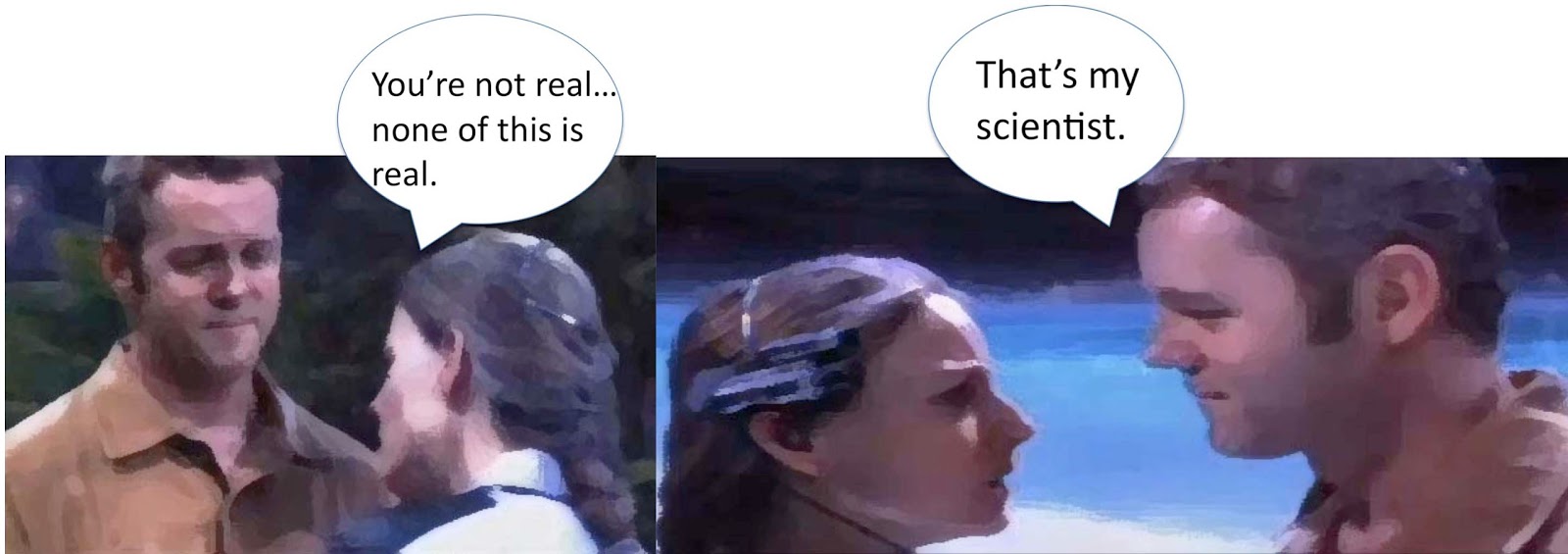

Image Credits: Film clip (introductory sequence) and modified stills from the movie, Contact (Warner Bros.)

Sunday, April 3, 2011

You Are Not in Kansas Anymore

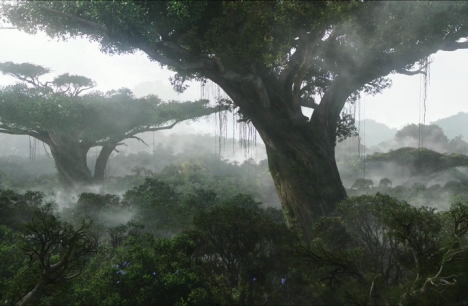
I mentioned in earlier posts that I had been doing fieldwork recently in a remote location (think jungle, mosquitoes, scorpions, bucket latrines, no refrigeration, no TV or internet).  Spending time in a tropical forest and away from "civilization" is an experience that simultaneously makes one appreciate the variety and abundance of life on our planet as well as the comforts that we in developed countries tend to take for granted.  A single hectare of tropical forest may contain hundreds, even thousands, of species of plants, animals, fungi, and bacteria. Walking through the forest and stopping in front of a massive old tree, I was reminded of the movie, Avatar.

If you've been following this blog, you've read my previous review of Avatar and sexism in movies by James Cameron. I was pretty critical in those reviews, but there's another aspect of Avatar that I've wanted to explore.

In the months after the release of Avatar, a number of people began posting comments on various forums about how the movie affected them.  Some said it changed their lives and how they view the world. Others became sad or depressed, presumably because their lives did not live up to the fantasy world created in the movie. Some posters even stated that they'd contemplated suicide (it's hard to tell if these are real or fabricated statements). Although a lot of those who had strong reactions to the movie were very young and impressionable, some were adults.  Their words indicated that they yearn for the life of the Na'vi, the imaginary indigenous people of Avatar.  The depressed are being advised to shed modern conveniences that harm the environment and to live "closer to nature".  That way, they can take an active role in creating their own world (instead of sulking in a dark room in front of the TV or computer).

In case you haven't seen the movie, the Na'vi live close to Nature; they are 10 foot tall, blue, cat-like humanoids with "bones reinforced with carbon fiber", and have coming-of-age rituals in which the inductee acquires a flying dragon, which becomes their steed for life.  At the beginning of the movie, we see that life on Pandora is quite dangerous. The evil antagonist, Colonel Quaritch, eloquently describes the situation to new recruits:

"You are not in Kansas anymore. You are on Pandora, ladies and gentlemen. Respect that fact every second of every day. If there is a Hell, you might wanna go there for some R & R after a tour on Pandora. Out there beyond that fence every living thing that crawls, flies, or squats in the mud wants to kill you and eat your eyes for jujubes."

This message is driven home as Jake Sully, the human protagonist, is almost killed four times during his first day in the jungles of Pandora.  He survives, of course, to become one of the Na'vi, fall in love with a Na'vi princess, and ultimately shed his paralyzed human body for a new, Na'vi-like avatar body.  Later brushes with death are presented as exciting adventures, which only add to the fantasy of a perfect world. The movie experience thus yields a sense of adventure, wonder, and happy endings and never hints at reality.

Perhaps it's for the best.

Real life in the gritty, parasite-infested tropical forest is somewhat less pleasant than one would guess from watching Avatar. Most people I know would not last two minutes in the bush before they would run screaming back to air conditioning, iced drinks, bug-free manicured lawns, entertainment on demand, and all the other trappings of civilization.

What movies like Avatar do accomplish is to get young people excited about nature and about preserving the natural world.

On the one hand, I'm sad that it takes a fantasy world (patterned after the Amazon rain forest) to make people care about the only world we know that has life--Earth.  On the other hand, I'm glad that people are moved by the environmental message.  I'm with Cameron in believing that people don't get motivated by just talking or reading about Nature.  They need to vicariously experience it without all the danger and discomfort. People are especially affected by stories that touch them emotionally.

And Avatar accomplishes this.  

The technological breakthroughs that allowed the creation of a believable world populated by fantasy creatures are quite simply amazing.  The reactions to the movie reveal how effective such a story-telling approach is...especially with generations who never knew a world before CGI.

One might wonder if such fantasies simply set young people up for disillusionment.  However, I recall being excited and fascinated by the original Star Trek TV series. My imagination was fired up about what life might be like on other worlds and whether I might one day travel to those worlds and study the life found there.  And Star Trek had very clunky special effects; even I thought they were corny at the time. Nevertheless, the series influenced a generation of young viewers. Even though our original, idealistic expectations about space travel were never realized, some of us succeeded in achieving our dreams of becoming a different type of explorer--a scientist.

With its incredible special effects, Avatar may have a profound impact on the current generation.  

Avatar's success in this regard also has a message for those of us who are concerned about attracting young people (especially girls) to science.  People pay attention to compelling stories that 1) they can understand, 2) are memorable, and 3) affect them emotionally.  I'll bet young fans of Avatar can answer correctly more questions about the ecology of Pandora than about our Earth.  What do you think?   


Photo Credit: Avatar, 20th Century Fox; AnotherBigDamnTree, DrDoyenne

Sunday, March 27, 2011

Well Behaved Women Seldom Make History

The title of this post is a widely-repeated statement made by a feminist historian, Laurel Thatcher Ulrich. This saying is from an obscure scholarly article Ulrich published years ago and has appeared on T-shirts and bumper stickers over the years. It caught my eye recently...as the title of a book in which Ulrich tries to explore the topic in greater depth (Vintage Press, 2008). I've not read the book, but apparently it focuses on three prominent women in history plus shorter anecdotes about other women who've made contributions to society, but remain relatively unknown.

Anyway, seeing Ulrich's statement made me think about the pressures on girls and women to be "well-behaved".  What do I mean by this?

Men are expected to misbehave (at least occasionally) and are quickly forgiven; we even have phrases that acknowledge this expectation: "boys will be boys".  Boys and men can be rowdy, aggressive, impolite, arrogant, sloppy, etc., and no one holds it against them. They may be shameless self-promoters, bragging about their accomplishments, no matter how minor.  It's in their nature. We forgive them...and even find their misadventures endearing.

Women, on the other hand, are pressured to "behave well" under all circumstances. I'm not talking here about misbehavior of the type depicted in spring-break videos, e.g., "Girls Behaving Badly", but about women who speak up when faced with sexism or other unfair treatment, who don't remain quiet when their contributions are overlooked in favor of a male colleague's, who don't politely wait for someone to acknowledge them or their accomplishments, or who even fight back when treated inappropriately.

As I've described in previous posts, women of my generation (growing up in the 50's and 60's) were held to a certain standard of behavior (and career choices). We were expected to be modest, quiet, polite, submissive, and well-groomed at all times. A single indiscretion could have long-lasting repercussions.

I don't think things have changed that much.  Yes, women can now participate in activities and have rights that were not ours in the past, but we are still bombarded with advertisements and images of what is expected of girls and women...both physically and behaviorally.  Much of this information is internalized early in our development, and we willingly police ourselves to conform to what is apparently expected of us as females.

Those of us working in a traditionally male profession find ourselves in a Catch-22 situation. If we behave modestly and politely, our work is overlooked, and recognition goes to those who are not similarly burdened. If instead, we are assertive, strong-willed, independent, tenacious, out-spoken, and proud (positive attributes of our male colleagues), we risk being branded as being "difficult", "uncooperative", "stubborn", "overbearing", "angry", or (horrors) not a "team-player".

Our experiences in this regard vary dramatically among workplaces.  This, I suspect, is often the reason for the very divergent experiences of women in science fields. Some laboratories are populated by supportive superiors, colleagues, and staff who view women as being equally capable as men.  Other workplaces have one or more individuals who believe otherwise and can make life miserable for female scientists, especially if they happen to be successful and productive.

Sometimes I wonder if such misogynists see women (who succeed in a male-dominated field) as ill-behaved (and thus need to be reprimanded)? Girls were once taught that they should not outshine their brothers, boyfriends, or husbands. A woman should do her job... but not so well that she outperforms her male colleagues?  If she succeeds by adopting behaviors acceptable in male colleagues, is she viewed as somehow violating social standards?  I'm only speculating here, as it's difficult to put myself into the minds of such men (and some women) who hold a double standard.

Anyway, since this is Women's History Month, it seems appropriate to resurrect Ulrich's prediction about good behavior and its outcome...as well as a reminder of those women (Susan B. Anthony) who did "misbehave" and in so doing, garnered the rights we enjoy today.

Tuesday, March 22, 2011

Why Scientists Are Never Certain


Scientifically-proven is an oxymoron. In most scientific fields, it is impossible to prove something, e.g., that all birds fly.  We might survey a thousand species throughout the temperate zone and conclude that, yes, all birds fly.  Unless we’ve examined every bird that exists in the world, we cannot say that we’ve proven anything.  Instead, we proceed by trying to falsify a scientific hypothesis. This approach encourages scientists to design rigorous experiments. We search for environments in which birds might not fly and soon discover penguins, ostriches, and other flightless birds. So we amend our hypothesis that “all birds fly” to “most birds fly”.  The discovery of flightless birds raises further questions about bird evolution and adaptation to certain habitats.  Other hypotheses are less easily falsified.  Complex systems, such as ecosystems, and their workings are more challenging. We chip away, a few data points at a time. Sometimes a pattern emerges, which may become the basis of a generalization.

We never stop trying to disprove even widely-accepted concepts. Scientists attempt to replicate previous findings, and in the process sometimes overturn the original result or uncover new information, which adds to the overall picture.  In the process, we continually gain new knowledge, which allows us to modify our initial conceptual model. If instead, we announce that something is finally proven and that we are certain, knowledge stops accumulating. Scientists know that their knowledge about a certain topic is limited and that there are many unknowns yet to be revealed.

The average person rarely understands these concepts and is frustrated when scientists don't express certainty about a subject and equivocate in their answers to questions.  They assume that the scientist, who does not convey certainty about a topic, simply does not know or is confused, is not competent, and/or lacks confidence in their knowledge.  However, the good scientist is prepared to shift her viewpoint when new evidence is unveiled.  This flexibility does not necessarily mean that what scientists thought before was incorrect.  It means that what was previously correct, given the state of knowledge at the time, may be modified in the future with new data.

Scientists state their level of certainty based on statistical probabilities.  We are 95% certain that an observed phenomenon is caused by human activity.  There's a 5% chance that our observation is due to some other process. The average person interprets the lack of absolute, 100% certainty as a weakness...as evidence that scientists don't really know the cause of a particular phenomenon.  However, what if an average person was told that without surgery to remove a malignant brain tumor, there is a 95% chance they would be dead in 6 weeks.  Would a person gamble on the probability that there is a 5% chance that they won’t die and refuse surgery?  I doubt it. 

Such confusion by the public is often exploited by certain interest groups. 

The book, “The Merchants of Doubt” describes how special-interest groups raise doubts in the public’s mind about climate change by highlighting disagreements among scientists about specific points, the lack of complete data on a specific topic, or changes over time in what scientists accept as a valid explanation for some phenomenon. Interestingly, the authors document that the people (some are former scientists) who are behind the climate denial machine are the same people who worked for the tobacco industry (smoking is not harmful) and who were behind the denial of the existence of the ozone hole as well as acid rain. Their basic approach is to plant the idea that there are data on both sides of the issue (neglecting to mention that one side has failed to publish their research in refereed journals and/or was funded by the very industry being investigated).  This strategy creates confusion over issues by a public that is scientifically illiterate. 

When scientists remain silent in response to unscientific claims by doubt-mongers, the public may conclude that the non-scientific viewpoint is correct.  Or worse, that the scientific community is perpetrating a hoax on the public. It’s difficult to convince scientists to speak out—for various reasons, not the least of which is the possibility of becoming a target.

Wednesday, March 16, 2011

Symposium for Early-Career Women

Still in the jungle feeding the bugs, but here's another link to an announcement for a workshop for early-career women in science:

"WEBS (Women Evolving Biological Sciences), an annual three-day symposium aimed at addressing the retention of female scientists and issues related to the transition of women from early career stages to tenure track positions and leadership roles in academic and research settings. Past WEBS symposium in 2007, 2008 and  2010 were huge successes. Early career participants as well as our senior scientist panelists reported feeling inspired and equipped with new connections and tools that they expect will help them in their career in the years to come."

Monday, March 14, 2011

Movers and Shakers

I'm in the jungle doing field research and have intermittent internet access, which is why my posting has fallen off of late.

However, you might be interested in this link at the website of the International Society of Ecological Economics, Solutions, which is running a special issue on Women Shaping Our World.

Friday, March 4, 2011

Constraint Satisfaction


The concept of constraint satisfaction concerns the constraints that must be taken into consideration when solving a problem or making a decision...the satisfaction occurs when these constraints are met, which leads to a satisfying solution.  Stephen M. Kosslyn, the author of Image and Mind, discusses this concept and provides examples.

The insight that this concept holds is that there are usually just a few ways that a problem may be solved--due to the constraints.  It turns out that by imposing constraints, you can increase creativity in reaching a solution. The reason is that your options become so limited by the constraints that you are forced to seek creative solutions to the problem.  An example might be seen in a TV show on the Food Network...shows in which chefs compete with each other to create the best dish.  The contestants often are given challenges in which they are restricted to certain ingredients (sometimes quite strange ingredients such as mango, octopus, and cornmeal). Similarly, TV shows feature fashion designers who are given challenges to, for example, create a cocktail dress out of plants (leaves, flowers, etc.).

The audience is intrigued because they think, "How can anyone possibly make something that tastes good or is fashionable out of that?" In fact, some of the most delicious or spectacularly beautiful creations come from these challenges in which the contestants are restricted to a few ingredients or materials. I sometimes watch these shows because the process the chefs or fashion designers go through to realize their creations is fascinating. You don't have to be particularly interested in cooking or fashion to learn something about creativity.

There is a lesson here for those of us in science. When our options are greatly restricted, we are forced to get creative, which may lead to an elegant solution. Perhaps we even may discover a new method to address a particular problem.  Those of us who conduct fieldwork in remote locations are often faced with constraints.  We plan ahead, of course, and bring whatever instruments, supplies, and so forth that we anticipate will be required to accomplish our research.  But then, an instrument breaks down, your assistant falls ill, your original experimental design does not address the actual situation, or any other number of constraints. If you are in a remote rain forest, you cannot run to the local Home Depot or Radio Shack to purchase replacement parts. You are forced to improvise, to rethink your research plan, to seek out local guides...to be creative in arriving at a solution to the problem. You think to yourself, "My original plan is unworkable.  What can I do given the constraints of the situation?"

It's quite amazing to be in this situation and to think of a creative solution, which eventually leads to a result that far exceeds what you had originally anticipated. I can think of several studies that I conducted under such constraints...situations in which the original plan had to be completely scrapped.  The end result was an insight that would have otherwise never been realized.  The journal articles that resulted from these situations are some of my most popular (based on citations) and with which I am most satisfied.

I can imagine a new TV show in which scientists are dropped into a remote setting and given a bag of miscellaneous, everyday items and a scientific question to answer.  I realize there have been other shows of this nature, but the participants were typically given unlimited resources to solve the problem.  The difference with my example is that the challenges would occur under very constrained conditions so that contestants would have to be creative.  An interesting twist might be to have a team of Ph.D. scientists competing with a team of non-scientists.  You might think that the scientists would have an unfair advantage, but not necessarily.  Studies show that a diverse group of people (with different educational backgrounds) often out compete a group of Ph.D.s.  The losing team would be forced to vote off one of its members (would it be the weakest link or the strongest?).  It would be interesting to see if the teams evolve to produce groups that are more or less creative, more or less cooperative, and more or less successful in the long-run.  An added benefit would be that the audience would realize that science is not just about high-tech instruments or can only be conducted by highly-trained scientists, but is accessible to anyone who grasps the scientific method and is creative.

Video credit: Moseguaards Cloth Simulation (Alexandra Institute), which involves something called iterative constraint satisfaction (about which I know nothing, but the video was neat).