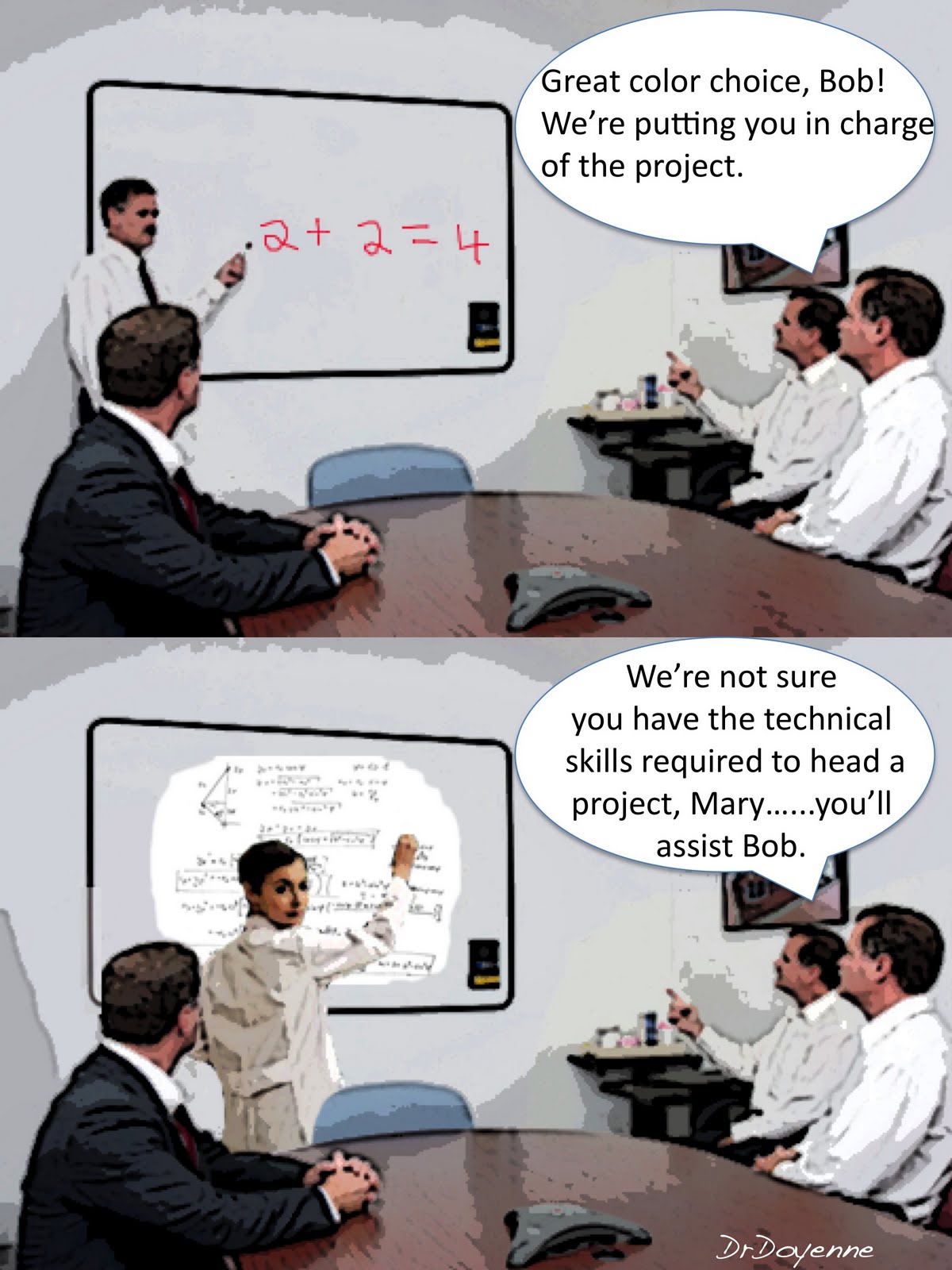
Showing posts with label mindset. Show all posts

Tuesday, May 24, 2011

Quest for Equality

I often wonder about our ancient ancestors and what were the real roles of men and women in ensuring survival of early humans.  I was reminded of this recently when I saw an ad for a film I watched many years ago (1981)--one that was quite interesting and entertaining.  It remains one of the most unusual and thought-provoking depictions of prehistoric humans (although one can quibble about the science and postulated interactions between humans and pre-humans). 

In the film, "Quest for Fire", a group of prehistoric tribesmen (Homo neanderthalensis) embark on a search for fire.  Lacking fire-making knowledge, primitive humanoids depended on finding natural sources of fire or stealing it from other clans.  After being attacked by another group (Homo erectus), their official fire tender (an especially clutzy guy) loses their fire source.  Consequently, three other male clan members are selected to find or steal another fire source.  During their adventure, they barely survive encounters with sabre-tooth cats, mastodons, cave bears, and cannibalistic groups. Eventually, they meet up with a female (Ika) from another, more advanced group (Homo sapiens).  The trio rescue her from the cannibals, and she tries to persuade them (non-vocally, since they have no common language) to return with her to her tribe. One of the males (Naoh) decides to follow her....

To make a long story short, Naoh discovers that this tribe knows how to make fire. The scene in which he realizes that it's possible to start a fire by "rubbing two sticks together" is pretty touching. The trio eventually return to their clan. One of the most hilarious scenes occurs when they hand over a new fire source, carefully packaged in a hollowed-out piece of wood, to the fire tender. Unfortunately, the clan has been hanging out in a marsh, and the clumsy fire tender, in his extreme excitement over getting a new fire source, stumbles into the water and douses the embers. One wonders how many times this has happened over human history: an incompetent man in charge of an extremely important task (see previous posts about the Dunning-Kruger effect).

Not to worry. Our hero proceeds to show his clan how to make fire.  Drumroll....   Unfortunately, Naoh never actually practiced the fire-making technique--he only saw it done by the Homo sapiens tribesmen.  After an unsuccessful and embarrassing attempt, he is about to give up, when Ika (who has followed him) takes over and makes the fire. They live happily ever after.

I was impressed that this film actually had such a scene and others--in which a woman was shown to be superior to a man (in more ways than one). If you've read my previous posts about Hollywood depictions of women, you know that such films are rare.

Some anthropologists suggest that the Paleolithic was the most gender-equal time in human history. Archeological evidence indicates that male and female members of prehistoric groups both participated in decision-making and that some females were of high status. That makes sense to me. For a group to survive, all the members would have to have multiple skills, especially basic survival skills, and to be flexible in allowing anyone who was especially good at some task to use that talent to promote the success of the group.  That egalitarian approach should have provided an edge over groups that may have had more restrictive gender roles in which an individual's inherent skills were not necessarily realized (lowering their overall competitiveness with other groups). 

Anyway, it makes one think about gender roles in modern human cultures, the future survival of our species, and whether our Paleolithic ancestors have something to teach us with respect to the advantages of an egalitarian society.

Image Credits: modified images from "Quest for Fire", International Cinema Corporation (Trivia: this film won an Oscar for best makeup).

Friday, May 20, 2011

Lie to Me

In the previous post, I posed a hypothetical situation in which a post-doc, Jim, suffers from overconfidence in his abilities, and despite Jim's obvious deficiencies, the lab director thinks he's a valuable contributor to the research project you lead. 

If you've read previous posts, you will recognize that Jim (and possibly the lab director) suffer from the Dunning-Kruger effect. People with this condition are unskilled and incapable of accurately assessing their abilities as well as those of others. The reason is that the skills required to be competent are often the same skills required to evaluate that competence.  They tend to greatly overinflate their performances relative to those of others.  The more ignorant they are, the greater their confidence in themselves.

In the hypothetical situation described above, the project leader is caught between a rock (Jim) and a hard place (lab director).  You have laid out Jim's deficiencies, backed up with ample data, for both Jim and the director...only to have both of them ignore your logical argument and restate their illogical position about Jim's competence.  Their reaction is due to their overall inability to make logical judgments and to recognize that they have this problem.....a vicious cycle that is difficult to break. The more logic you throw at them, the more firmly they adhere to their mistaken opinion and confidence in that decision.

Most of us in science are pretty logical people; so when confronted with such illogical behavior, we go a little nuts.  We simply cannot understand how someone can totally ignore the evidence in front of them.  We make the mistake of thinking that if we just produce enough evidence or a clear-enough argument, that we'll prevail.  However, that is not going to happen with people like this. Think about religious zealots or climate deniers....nothing you say is going to change their minds.  You have to approach such people with a clear understanding of their psychology, not based on your preconceived notions that everyone is as logical as you are.


What does work?  Research has shown that training, for example in social reasoning, helps improve Dunning-Kruger folks' cognitive abilities.  How does that help you, as a project leader? You're not a psychologist; nor do you have time to be training someone who should already have skills in logic.  Quite a conundrum. I don't think there is a really good solution to this situation.

If I had control over this person's position, i.e., was Jim's supervisor, I would place him on probation and clearly outline what outcomes are expected for all tasks, set deadlines for those outcomes, and spell out the consequences of failure. The plan would be detailed in such a way as to leave no wiggle-room for Jim to blame external factors, if he fails.  Both of us must sign this performance plan, acknowledging our understanding of what's expected and the consequences.  If he protests, I would reply that since he is so confident in his abilities, he should have no problem meeting these basic expectations (which I have set up for all others on the team).  If Jim manages to improve and meets his responsibilities, then things will have been improved for the team, and everyone wins.  If Jim fails, then I have documentation to take steps to dismiss him; but I won't feel badly because I've been totally fair and upfront with him.

However, in the hypothetical situation posed, I would not have control over Jim's position, and I also have to deal with the director who suffers from the same cognitive deficit as Jim. In this situation, I would want to get Jim off my team so that his performance no longer harmed me or others.  Here is one possible tactic:  I would suggest to Jim that he should have his own project to run and that he should run the idea by the director.  I would support Jim's proposal when the director asks my opinion.  Convincing the director should not be difficult, given his lack of logic skills and being Jim's biggest fan.

The key will be to have Jim report directly to the director rather than to me.  If the director tries to make me oversee Jim's project, I have two possible responses: 1) I cannot be in charge of Jim's performance unless I'm made his official supervisor (in which case, I can put the previous plan in motion), 2) I state that I have my hands full leading my own project and cannot be expected to handle a second project, and/or 3) I remind him that making me responsible for Jim's project defeats the purpose of giving Jim his own project.  Hopefully, this would not be too much logic for the director to handle.

Assuming I can pull this off, I will no longer have Jim on my team.  Even if this means more work for the team...well, we already were having to redo his work. And the director will eventually see for himself Jim's incompetency. If not, then I might want to start looking for another job--because the director is probably not judging my performance well either.

Some might feel that the above plan is unfair or underhanded.  Actually, this problem with Jim is due entirely to Jim's incompetence and to the director's failure to deal with it.  The two people responsible for the problems the research project is experiencing (mistakes, slow progress, low morale) should have to deal with them, not me and not the other productive team members. The latter situation is what is unfair.  My plan takes the false beliefs of Jim and the director and forces the two of them to deal with the consequences.

So to summarize how to deal with someone suffering from the Dunning-Kruger effect:

1. Don't make the mistake of assuming they think like you do. Trying to use logic doesn't work because they do not think logically.
2. Focus on their overinflated beliefs and take advantage of them in formulating your strategy.
3. Don't cover for them when their incompetency causes problems.
4. Find a way to make them responsible for the consequences of their incompetency.

Image Credit: Jon Wilkins 2011; Creative Commons; http://www.darwineatscake.com

Wednesday, May 18, 2011

Lost in Translation

What would you do if faced with the following situation?

You are part of a research team that is involved in a large project. One of the team members, a post-doc, is very enthusiastic and outgoing. Jim exudes confidence in his abilities and contributions to the project. Unfortunately, Jim is a total disaster in the lab, and his writing is abysmal.  Worse, he is blissfully unaware of his incompetence, despite repeatedly being shown his mistakes.  As project leader, it falls upon you to clean up Jim's mistakes, reassign work (that has been compromised) to other team members, and revise his reports.  Jim's manuscripts have to be completely rewritten from scratch, but he still expects to be listed as first author and behaves as if the revised version is his work.  The other team members have become resentful of Jim and complain to you often. 

You cannot replace Jim because you do not have the authority; only the lab director can dismiss someone.  The lab director is totally enamored with Jim, whose overconfident behavior has convinced the director that he is one of the most valuable members of the research team. The director is also a person who lacks the metacognitive skills (or time) to accurately assess Jim's real competency.  You have tried to convince the director that Jim's performance is substandard and is hurting the group's progress, but he remains adamant in his confidence that Jim is competent.  The director believes Jim has just made a couple of mistakes, which could happen to anyone.

What would you do?  See the next post for how I would respond. In the meantime, take a look at the video below for a nice explanation of the Dunning-Kruger effect...and see if it suggests any solutions.


Saturday, May 14, 2011

How I Learned to Stop Worrying about Being an Impostor


 This post is a continuation of the previous discussion of the "impostor phenomenon" and the "Dunning-Kruger effect". To review, people suffering from the former condition don't believe themselves to be qualified, despite ample evidence as to their skills and qualifications, and worry about being uncovered as an impostor.  The latter condition is characterized by over-confidence, completely out of proportion to actual skills (the greater the incompetence, the higher the confidence).  For more details, see the previous two posts. 
You can also test yourself as to your "impostor" tendency here.

In this post, I'd like to explore how someone with a tendency toward "impostor phenomenon" (IP) might learn to avoid such negative feelings and associated behavior.  The basic problem, according to psychologists, is that such people fail to internalize their accomplishments and skills, and so view themselves as less capable than others.  I can imagine that this condition might arise through various personality traits and environmental factors during childhood.  One particular interaction that occurs to me is how much a person depends on the approval and affirmation by others--too much reliance on accolades from others might predispose someone to the condition, for example. 

Even if you are thinking that you don't have this problem, consider this: our self-image changes over time and in response to our surroundings and how others treat us.  One thing is certain in life, and that is change.  I think most people can remember one time or another when they felt inadequate and were worried about being able to accomplish a task, do well on an exam, or live up to expectations (of parents, advisers, employers). I pointed out in the previous post that students are susceptible to IP upon being thrust from school into a job where they are expected to be fully competent (after years of being told they are not yet competent).  I experienced this feeling upon completing my Ph.D., but it faded with time.  I can imagine this could strike anyone at any point in their career--going from one job to a new job, for example.

There may be a couple of ways to deal with IP--both of which helped me.

I mentioned above the reliance on others for affirmation of one's skills.  Therein lies one possible source of help: surround yourself with people who are supportive, who reaffirm a positive image of yourself, and who encourage you to view yourself realistically (by pointing out your obvious skills and accomplishments when you express doubts, for example).

Obviously, it would be better if you were not reliant on others to avoid feeling like a fraud, but it's not likely to be easy for you to change this aspect of your personality without extensive therapy.  However, you can avoid people who make you feel worse and seek out people who are supportive.  However, that will likely get you only part-way to squashing any impostor feelings.

Another method that I found helpful was to remind myself often about my own accomplishments. I've read about accomplished scientists (with IP) who would frequently reread one of their best papers to remind themselves just how good it was (therefore, how good they are).  People with IP tend to be highly accomplished, so having such reminders is usually not a problem.  I've also done this on occasion when I was feeling wobbly about starting a new and challenging writing project. By reading something I had previously written, which was published in a good journal, helped me internalize the fact that if I was capable of doing it once, I could do it again--no sweat. Anyone can use this approach --with a paper they've written, an exam they aced, or a great blog post they wrote that got a lot of positive comments!

For more on stories of female scientists suffering from IP and strategies for overcoming IP, see this article at Naturejobs.

Image credit: modified photo from davcorp.com

Tuesday, April 26, 2011

A Perfect Storm

This post continues the discussion of the Dunning-Kruger effect--a condition in which a person who is incompetent is unable to recognize their deficiencies and tends to hold an over-inflated view of their skills.  I contrasted Dunning-Kruger with the "imposter syndrome" in which the person is unable to internalize their accomplishments and fears being discovered to be incompetent or unqualified.  

Feminists have focused on the imposter syndrome as an unfortunate reaction suffered by some women working in fields dominated by men (although either gender may experience it, e.g., as students).  It occurred to me that the contrasting syndrome--Dunning-Kruger may also pose a problem for women in STEM fields.

As a woman in science (especially government science), I encounter people who suffer from the Dunning-Kruger syndrome--or something that seems very close to it. Their performance is woefully sub-standard, yet they exude supreme confidence in their abilities.  In the past, I was completely mystified as to how such people could maintain such an elevated opinion despite being told repeatedly that their performance was poor (these are the students who insist that they are "A" students despite scoring consistent "Cs" on exams).  I now understand that their overall gross incompetence includes the lack of skills needed to accurately evaluate their performance and that of others.  Once these people get into the workforce, they continue to over estimate their capabilities and contributions, as well as the performance of people they work with. Despite explicit evidence to the contrary (lack of progress on projects, inability to write or publish anything of substance, lack of creativity), some manage to get ahead (or at least avoid being fired), in large part due to their overconfident behavior and/or the inaccurate assessment by others who also lack the necessary skills to recognize their incompetency.

So how might someone with Dunning-Kruger, who is poor at assessing competence in themselves and others, have an impact on women in STEM fields?

Lacking the necessary cognitive skills to accurately judge competency, Dunning-Kruger sufferers look for other signals to guide their opinions of themselves and others.  One easy option is to put people into neat categories to which certain general attributes can be ascribed (race, religion, age, gender, sexual orientation, marital status)...in other words, stereotypes. Stereotypes make it much easier for such people to judge people and their performance.  Gender X is good at skill A, but poor at skill B.  Younger people are better at skill C than old people. Members of a specific group may rate others of their group highly (because of their own high opinion of themselves). 

We can see this behavior in action among members of the "old boy network" (I don't for a second believe that this entity has gone extinct...only underground).  Implicit in the "old boy network" is the acceptance of other males as worthy of perks, recommendations, and support.  A male, who acts confident, is typically gauged to be competent--regardless of his actual performance. If one fails at a task, it's rationalized that he "just had a bad day" or that some external event caused the failure.  All the members of the "old boy network" talk in glowing terms about each other, further enhancing their self-images.  If a male newcomer is somewhat less grandiose in his self-diagnosis, the persistent back-slapping by other males may lead to a more pompous attitude ("if everyone thinks I'm so great, it must be so!").

The combination of coworkers who have overinflated views of themselves and superiors who cannot adequately assess other people's skills creates a "perfect storm" situation for a woman in science.

Someone unable to accurately evaluate other people's competencies may be more likely to make a mistake about the performance of a woman who is working in a non-traditional field.  Evidence as to her superior abilities may be completely ignored, because their erroneous perception is based on something else (e.g., stereotypes).  If she makes a mistake, she's automatically judged to be incompetent, because a single error is easier to focus on than putting it into the larger context of her overall skill set and previous performance.  If she has a tendency toward imposter syndrome, then this unrealistic treatment will greatly exacerbate her condition.  If she is surrounded by an old boys network, then she'll have to be very strong indeed to avoid feeling diminished and marginalized.

On the other hand, if this same female finds herself mostly surrounded by people who are skilled at assessing true capabilities, then she will likely be accepted as highly competent and will be less affected by those colleagues who hold exaggerated views of themselves. 

Thursday, April 14, 2011

Beyond the Imposter Syndrome

I came across a blog post at "On Becoming a Domestic and Laboratory Goddess" in which the blogger, Isis, announces that the "imposter syndrome" is a scam.  In case you've not heard of it, this condition is one in which the person secretly feels like an imposter in their field, despite being highly competent and successful.  They are afraid that eventually everyone will find out that they are not a real scientist. Graduate students (in general) and women in STEM fields seem to suffer disproportionately from this problem.

Anyway, Isis expresses frustration over how many women are moaning about suffering from this condition. I think the concern here is that women will attribute any failure (to land a grant, to publish a paper) to this syndrome and this behavior will, consequently, enhance the belief that they are imposters.  I also suspect that those who have read or written a lot about the imposter syndrome have become weary of it and think that there is nothing new to be learned.

However, I think there is more to be understood about imposter syndrome and its opposite, the Dunning-Kruger effect, which I think of as the "overinflated ego syndrome".  The Dunning-Kruger effect is one in which the person overestimates their abilities...and the more incompetent they are, the higher their level of confidence in their abilities. At first glance, it seems incomprehensible that people who constantly make mistakes or fail to meet performance expectations would paradoxically believe that they are competent or skilled. However, the mental skills required to be competent at any task (e.g., ability to assess what steps to take to accomplish the task, to gauge standards of performance) are the same skills needed to accurately evaluate one's own competence.

Kruger and Dunning summarize the key features of such people:
  1. They tend to overestimate their own level of skill;
  2. They fail to recognize genuine skill in others;
  3. They fail to recognize the extremity of their inadequacy

Thus, people who are generally incompetent are unable to gauge their own performance correctly and tend to over-inflate their performance (in their minds) relative to the performance of others.  Ehrlinger et al. provide the following example:

"..to produce a grammatically correct sentence, one must know something about the rules of grammar. But one must also have an adequate knowledge of the rules of grammar in order to recognize when a sentence is grammatically correct, whether written by one's self or by another person. Thus, those who lack grammatical expertise are not in a position to accurately judge the quality of their attempts or the attempts of other people. In addition, because people tend to choose the responses they think are most reasonable, people with deficits are likely to believe they are doing quite well even when they are, in reality, doing quite poorly."

Sufferers of the imposter syndrome are just the opposite.  In psychological terms, imposter syndrome is a condition in which the sufferer is not able to internalize his or her accomplishments and skills.  They are highly critical of themselves and tend to over-inflate the performance of those around them.  If we use graduate students as an example, we can see the dynamics involved in creating the imposter mindset.  Students are in a subordinate position from virtually every standpoint. They interact with people who are obviously competent and superior (professors) and who constantly tell the student (in various ways) that they are not yet competent at the skills required to succeed in their field of study.  When the student is thrust into a position of responsibility (they graduate and get a job), they may find it difficult to transition from the "incompetent" to the "totally competent" mindset.  They may go on to develop "imposter syndrome".

These two syndromes are neatly summarized in one of my favorite sayings: "Ignorance more frequently begets confidence than does knowledge." Charles Darwin.

Of course, these are two extremes along a wide spectrum of mental states. Most of us fall somewhere in the middle, perhaps with more women toward the imposter end and more men toward the inflated ego end (I have no data, just more than 40 years of observations). We may shift between these mental states over time, depending on our history and new situations.  I recall feeling like an imposter right after attaining my Ph.D., but this faded with time and experience. I can envision someone taking on a job in a new field and initially feeling like an imposter...at least until some experience in the new position is gained.  You can probably think of many other examples.

So what does all this have to do with women in science and does this information lead to any insights as to how we may solve some of the "challenges" we face?  More in the next post.

Saturday, February 26, 2011

Memory Overload

The other day, while working in my office, I had an experience that we all have from time to time.

I usually have my laptop open to a manuscript I'm writing and also have my desktop computer turned on to check email or to use the internet to search for information.  As I was writing a sentence on my laptop, I realized that I needed to do a quick fact check.  I turned and scooted my chair over to my desktop computer to search for the information I needed. As I moved to do this task, I glanced at my watch to gauge how much time I had until lunch...and had a few other random thoughts. This all happened in a span of 1 or 2 seconds. By the time I touched the mouse connected to my desktop computer, I had forgotten why I was switching from laptop to desktop. Annoyed, I turned back to my laptop and looked at the last sentence I had written...and this, of course, jogged my memory, and I quickly performed the necessary search.

When these things happen, I put them down to a "senior moment".  People often experience this when they are doing some activity in one room and decide to take a moment to do something else in another room.  By the time you reach the other room, you've forgotten why you went there in the first place. How often have you opened the refrigerator to get something and end up standing there staring, trying to remember what it was you wanted? 

These events happened to me when I was younger, but not frequently.  It still doesn't happen frequently, but when it does, it is scarier now.  From reading about the brain and cognition, however, I know that what is happening has to do with short-term memory and that it is not uncommon to fail to incorporate certain information into short-term memory---hence these memory lapses.  We are told not to worry if you forget where you put your keys; only if you forget what your keys are for is there likely a serious problem.

Some think that these little lapses increase as our memory system becomes overloaded with information.  With the vast amounts of information coming into our brains via digital communication systems and electronic toys, we are perhaps suffering from cognitive overload.  At least I hope that's the explanation. It certainly makes sense. I often feel that to learn some new fact....really learn it and retain it, get it into long-term memory...I need to make room for it by eliminating some other bit of information.  I don't remember feeling this way when I was a student, despite the fact that I was learning and memorizing lots of things.  There seemed to be lots of capacity in my brain.  But during my student years, the information overload we are now experiencing was still years away....

I've also noticed that older people sometimes have difficulty performing a task (e.g., driving) and talking about a complex topic. Their attention is split between two fairly complex operations, and they have trouble performing one or both well.  The term multi-tasking is often invoked as a positive process, i.e., the ability to multi-task is seen as being advantageous.  I doubt that it is. In fact, I would suggest that your short-term memory is being overloaded while multi-tasking so that whatever you are doing, especially if it depends on learning something new, is being negatively affected by the other distractions. It may not feel this way to you because the effect may be subtle, e.g., taking you ten percent longer to complete the primary task than if you had no other distractions.

Anyway, I've decided that I need to minimize the cognitive overload by focusing on one task at a time, paying attention to what I'm doing at that moment, and not mentally running in multiple directions.

Saturday, April 3, 2010

Mindset

Consider the following hypothetical day in the life of a hypothetical student (you) and imagine how you would react:

You go to one of your classes in which the mid-term exam is returned, and you receive a C grade, not something you expected at all.  You are shocked and disappointed. Later, you go to the lab to check on an experiment that has been percolating and find that you forgot to turn on a key piece of equipment. Your samples are lost and now you are going to have to start all over. At the end of the day, you pull out of your parking space and hit another car that you did not see because you were not paying close attention (you were thinking about your samples). You end up spending a couple of hours dealing with the situation before finally being able to go home.

How would you feel? Like a loser? A total klutz? Unlucky?

According to Dr. Carol Dweck, people tend to fall into two groups or mindsets: 

Those with a "fixed mindset" overreact to bad news and tend to see mistakes as a sign of imperfection or weakness. People with a "growth mindset" view mistakes as opportunities to learn; some thrive on turning setbacks into successes.  I see these two mindsets as products of inflexible vs. flexible brains.  The fixed mindset tells a person that talent, intelligence, or personality are fixed traits and cannot be changed. Therefore, any event that challenges their self-image (as a talented, intelligent, or popular person) leads to discomfort, and they try to rationalize their failures. Such people tend to dislike learning and avoid opportunities to learn (because it requires them to acknowledge that they are not as smart or as talented as their self-image).  They dislike challenges (because if they fail, their self-image will suffer).  They end up playing it safe; repeating things that they are good at and avoiding the ones that might show their weaknesses.

The person with a growth mindset reacts quite differently. They don't believe that such traits as intelligence are fixed, but instead can be improved with time and effort. They may not be happy after the hypothetical day described above, but their reaction to those events differs dramatically from that of the person with a fixed mindset.  They consider what went wrong, gather information (talk to the instructor to go over the exam questions; change their study habits), and develop a plan to avoid becoming distracted (leading to lab mistakes or accidents).  These people love learning and when faced with a setback throw themselves with relish into a program to acquire whatever skill is lacking. People with growth mindsets love challenges, because these are seen as opportunities to learn.

Some people fall into one or the other category, but others may be a mixture of the two (fixed mindset about intelligence, but growth mindset about athletic ability).  According to Dweck, it's possible to change your mindset.  Simply being aware of it and how it affects your behavior can help you begin to change.  The point is not that someone with average intelligence will become a genius, but that anyone can improve their skills with experience and effort.

A good example is artistic talent.  People who think they cannot draw believe that those who can are born with this talent and that it cannot be learned. This idea is false. Anyone can learn to draw--and quite well.  It's really a matter of learning to perceive relationships, lighting, edges, and this can be taught. See these examples of self portraits that people drew before and after a 5-day course in drawing. Those who seem to be naturally talented learned early about the relationship between seeing and drawing and simply improved with practice. I've always been good at drawing and often tell others that I can teach them.  Most react with disbelief and refuse to try.  They have a fixed mindset.

As Dweck puts it, "Just because some people can do something with little or no training, it doesn't mean that others can't do it (and sometimes do it even better) with training.

Wednesday, March 17, 2010

What's Luck Got To Do With It?

Since it’s St. Patrick’s day, I thought I would say a few words about luck.

One theme that I see in science blogs, particularly among those who are struggling with their science career (both moderators and respondents) is the idea that successful scientists are somehow luckier than everyone else. This is rarely true, and to believe that luck has anything to do with success (or lack of it) is self-defeating. The “golden child” types have been mentioned on some blogs as people who lucked into their wonderful situations (by knowing the right person, by accident of birth, etc.).

Maybe.

But perhaps they only seem to be “golden”. Maybe they’ve figured out how to work the system or maybe they just work really hard without letting on. I’ve heard people refer to me as being successful because I’m luckier than they are or have been “given” extra help or resources. My response was, “Whaaat?” I worked extremely hard for everything I’ve achieved—nothing came easy. My scientist husband has worked hard, too (although he did not face the same obstacles that I did). We stuck to it and are now a successful professional couple.

We didn’t start out that way, though. I faced some really negative situations (discrimination, vindictive bosses, harassment), and my husband was affected by my problems. So for someone to suggest that we’ve been “lucky” in our careers or been given special treatment is just naive.

There always will be challenges, especially in such a competitive field as science. If the challenges (both technical and political) are too much for you, it’s best to figure this out early and go into something more compatible and rewarding. But be forewarned. Those “issues” that you blame on your boss, your obnoxious co-workers, or The System, may follow you to your new endeavor.

The reason, of course, is that problems often result from an inability to handle challenges well or a failure to understand other’s expectations of us. Some people learn early, some late, and some never. If you consistently seem to have problems when everyone around you seems to be enjoying much better “luck”, then it’s time to reassess your approach.

Wednesday, February 3, 2010

The Future of Science Communication

In previous posts, I’ve mentioned the rapid changes that are taking place in how science is communicated. Some people think that we are at the cusp of a revolution in how science is reported by scientists. I described earlier how some scientists are beginning to delve into the use of video or similar approaches to showcase their research on websites or as a way to illustrate a scientific method rather than a text description.

When I mention such ideas to colleagues, I get three reactions: 1) I’m already using video to illustrate my work, 2) that’s neat--how do I learn to do that?, and 3) I don’t have time to fool with that stuff.

I remember when Powerpoint was first used at science conferences.  There was a lot of grumbling from participants about newfangled computer graphics and how their 35 mm slides (or overhead transparencies!!) were good enough. I can even remember when the first scientists switched from black text on white background to white text on blue background (diazo processing). That caused quite a stir!

There were always lots of skeptics who said these new ways of giving presentations were just fads and would never catch on.

I also distinctly remember trying to convince my spouse that he needed to get a computer. This was the early 80s and I was one of the first in the lab to get a computer (a Mac). His response was that he had a secretary to do his typing and in any case he thought personal computers were not going to catch on. A bit later, I recall going into his office and saying, “You know, I think this Microsoft company is going to be big. Maybe we should invest?” Eventually, of course, he got a computer, but dismissed the idea of investing in Microsoft (and now claims he does not remember these early conversations).

My point is that things are constantly changing. Some people have to be dragged into the future while others are madly sprinting ahead of the crowd. Scientists are natural skeptics (as they should be) about new ideas, methods, etc. However, things are changing so fast, that it’s easy to get left behind if you don’t make an effort to be somewhat open to new ways.

Probably most of you who read this blog are relatively young and are wondering what I’m talking about. But I imagine you know some dinosaurs in your departments who resist every single change that comes along. Don’t let them discourage you from trying new approaches to communicating your science.


Wednesday, May 20, 2009

What is The Number One Fear?


Based on some surveys, the top-ranked fear of modern humans is the fear of public speaking--even greater than the fear of dying.

Most of us probably have horror stories. This is what happened to me during my Ph.D. defense seminar. My advisor introduced me, I stood up and looked out at the audience, and I completely blanked on my opening statement. There was an uncomfortable pause. Just as I saw a few people beginning to look worried, I remembered what I wanted to say. Note that I did not feel unusually nervous beforehand; in fact, I was pretty confident when I stood up. So it was quite a shock to just blank out like that—at the worst possible moment. Fortunately, I did not panic; I finally glanced at my slide, which jogged my memory, and once I started speaking everything went smoothly. I managed to sound confident and authoritative throughout the talk. I also paused at various points in my talk (pretending to think about my next statement) so that my initial hesitation seemed to be part of my “style”.

If the above story about blanking out makes you cringe, you probably suffer from some level of performance anxiety (aka “stage fright”). My impression is that women tend to be more susceptible than men. Some men clearly love to get in front of an audience and never have the slightest twinge of nerves (although I can think of some exceptions). But I think most people experience this fear to some extent at some point in their career. Some overcome it eventually; others never do.

If you have this problem, you likely feel the need for crutches to get through a talk. The ultimate crutch is having the entire text of your speech in front of you. Having the text at hand is insurance against stumbling through a complicated explanation or even completely blanking out, as I did. It also allows you to avoid eye contact with the audience and puts you behind a podium, a barrier between you and your audience. For someone with performance anxiety, avoiding the audience is the whole point of these behaviors. However, one of the goals of a good speaker should be to connect with the audience and make them (not you) feel at ease. Speakers should make frequent eye contact with the audience and come out from behind the podium (if possible).

In some fields, it is standard practice to read entire papers--complete with footnotes—at conferences (e.g., in the field of law). But for most scientists, it is performance anxiety that underlies the decision to read. I once had a post-doc who insisted on reading her talks—that she could not remember what to say because of nerves. After much coaching and encouragement, she was finally convinced to give a talk without notes. She did extremely well and was ecstatic at the reaction she got from the audience.