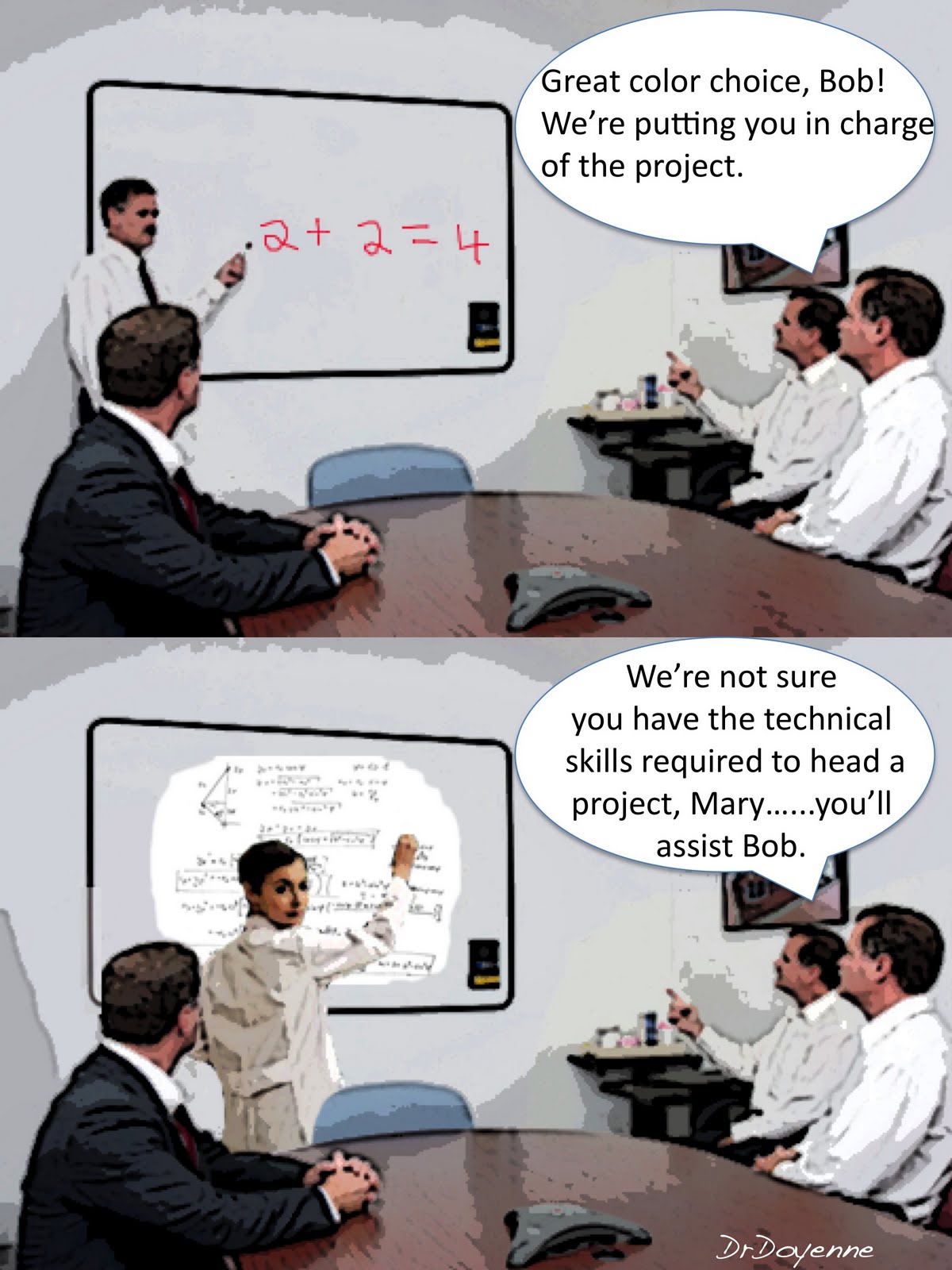
Showing posts with label female stereotypes. Show all posts

Tuesday, March 12, 2013

The Scientist Who Happens To Be a Woman

This month is Women's History Month, and last Friday was International Women's Day. Such celebrations are set to recognize and pay tribute to the contributions made by women throughout history. Many of those contributions were by women in science.

A growing number of women, however, are becoming increasingly uncomfortable with efforts to highlight women in science because such emphasis may lead to the conclusion that there is something unusual about female scientists or that we need "special help" to succeed (special awards, fellowships, grants).

The problem seems to be exacerbated by news stories in which the female gender of the story subject is emphasized over whatever it is she has accomplished. Articles about women scientists invariably talk about the fact that they are women (".....she's one of a handful of women to work on this topic.") and about family matters ("....she had to leave her three-year-old for a month to do field research in the Antarctic"). Some focus on special challenges they face as women in a male-dominated field ("....she had to accomplish twice that of her male colleagues to be acknowledged as competent").

I came across this post by Christie Aschwanden, who suggests the Finkbeiner Test for articles profiling women in science. It's similar to the Bechdel Test, which assesses gender bias in film, which I've described here previously. To pass the Finkbeiner Test, the article cannot mention any of the following:
  • The fact that she’s a woman
  • Her husband’s job
  • Her child care arrangements
  • How she nurtures her underlings
  • How she was taken aback by the competitiveness in her field
  • How she’s such a role model for other women
  • How she’s the “first woman to…”
I agree that over emphasis on gender can backfire and send the wrong message. But I also understand the journalists' viewpoint in trying to make a technical topic more attractive to readers (especially female readers) by emphasizing gender and/or the unusual. To get people interested in reading about a topic, the journalist has to find a "hook", and anything unusual works well to attract readers. Look at the recent media buzz about Danica Patrick, the first female NASCAR driver to win the pole position in the Daytona 500 competition. Even though media attention is focused mostly on her gender, she's edged out male competitors to become the most popular NASCAR driver, especially among female fans of the sport. Her crew chief said that he's given out "more lugnuts to young girls this week than he's given to anyone in his career". 

I do wish that we could just write and read about the accomplishments of a scientist or race car driver who just happens to be a woman. But that's not going to happen as long as the subject's gender is seen as something unusual. Journalists can help things along by de-emphasizing gender in articles about female scientists (as Aschwanden and Finkbeiner suggest). As scientists, we can decline to provide answers to gender-based questions in interviews and refocus attention on the science. 

Friday, June 22, 2012

Hell Hath No Fury...

Another blogger spotted this video put out by the European Commission, called "Science: It's a Girl Thing!":


I noticed that it's been viewed 2,645 times and that 2,572 people disliked it (only 66 liked it) (as of today at 1:30 pm); . The comments by both male and female viewers, scientists and non-scientists are worth reading: they find the video appalling and find very creative ways of expressing their disgust. A couple wanted to flag it as "inappropriate".

The reaction to it by real women in science (me, at least) is captured in an "Unofficial Response to the Official Teaser "Science: It's A Girl Thing!"":

Tuesday, May 1, 2012

Overturning the Stereotype

Recently, someone sent me a link to a website called This is What a Scientist Looks Like.  The site, which contains hundreds of photos posted by scientists, is part of a project designed to "challenge the stereotypical image of a scientist".

It's interesting to see what people submit. Some post photos of themselves at work; others at play. Some are serious and some are silly. Many show the scientists with their families. Some people noted in the description accompanying their photo that they have experienced how other people are surprised when faced with a scientist (them) who does not fit the stereotype (white, male, labcoated, nerdy). 

I've also occasionally encountered people who expressed incredulity upon being told my profession.  Some of these occasions were when I reentered the country and went through passport control. Because I carry an official passport (as a US government employee), I'm often asked what type of work I do for my agency. When I respond that I'm a scientist, I almost always get a double-take look from the passport officer.  Sometimes, they frown and question me further about exactly what I do science-wise, clearly not believing me. I can't imagine how they think I managed to get an official US passport using false information about my government job, but that's the implication. 

This third degree treatment always catches me off guard.  It's intimidating being questioned like this, and I automatically begin to feel guilty under the suspicious gaze of the US Customs agent.  Whatever I say sounds defensive and false.  Sometimes, the frown deepens, and the agent scrutinizes my documents some more.  I cringe and imagine the agent is going to next loudly announce to his supervisor and all my fellow travelers, "Hey, Joe, this lady here says she's a scientist.  Could you come over here?"  I briefly contemplate saying,  "Yes, I'm a real scientist who studies Important Scientific Topic and I'm just returning from a trip to Very Foreign Country where I gave the keynote address at a Major Scientific Conference."  However, I don't want to antagonize the agent and end up in one of those back rooms. So I just smile and confirm that what it says on my paperwork is correct. 

Later, I  fantasize about carrying around a copy of my doctorate diploma or my CV....to produce along with my passport and other travel papers.  Or perhaps I could just whip out my iPad already linked to my professional webpage describing my scientific credentials and activities? 

In the meantime, I hope the This Is What a Scientist Looks Like project will help change the public's perception of who can be a scientist.

Saturday, December 10, 2011

The Movie Heroine

I recently received a comment about the series I did a while back on how women are portrayed in Hollywood movies.  In one post (Feminism and the Movies), I used several examples of movies by James Cameron, including the Terminator series, and applied a couple of tests designed to gauge how central female characters are portrayed (as true heroines or as stereotypes designed to support a male protagonist).

One of these is called the Bechdel Test and the other is one I made up called (tongue in cheek) the Feminist Film Test.

It's been a while, so I'll repeat them here:

To pass the Bechdel Test, the movie must have:
1. Two women (who have names),
2. Who talk to each other,
3. About something other than a man.
The Feminist Film Test requires that the movie:
1. Have a female lead,
2. Who survives or succeeds,
3. Without the intervention of a man (saving her, dying so she can live, etc.). 


The commenter focused on the fact that I said Terminator II failed the two tests and argued that technically this movie passes both tests, pointing out how the lead female character (Sarah Connor) had matured from the helpless victim in Terminator I into an aggressive, militaristic woman with a violent plan (to save the world) in Terminator II.

Well, maybe Terminator II squeaks by on minor technical points (Sarah speaks briefly to another woman and does take charge of her destiny), but this comment misses the point of the litmus tests and my series on feminism and the movies. My purpose was not to identify "anti-feminist" films or to nitpick movie details, but to question the presumption that these are films that align with feminist ideals and/or provide useful role models of "strong female characters" simply because they have women who can shoot, cuss, and fight as well as a man.

The two litmus tests I described are meant to make people think about stereotypes and how women are portrayed in film.  One blogger, talking about the Bechdel test, emphasizes that "passing the test does not necessarily make it more feminist, or otherwise, positive-for-women." Nor does failing the test make it a bad movie.  This blogger goes on to explain that the test is a crude tool to begin examining sexism in movies.  If you look at the site that lists movies and whether they pass the Bechdel Test, you'll see lots of nitpicking about minor details; but it's not very productive to focus too closely on these tests (or try to find technical loopholes). 

Both tests are designed to uncover the glaring pattern of sexism in Hollywood movies.  When you have to really search and search for movies that portray true heroines, you have to conclude that there is something wrong somewhere.  Can you think of, say, just ten movies (out of the thousands made) in which there are two female characters who have meaningful conversations (about something other than a man) that advance the storyline (see end of this post for a few)?  Hollywood writers, directors, and producers seem to have difficulty in creating strong female characters without making them violent, gun-toting, and physically threatening (with a few exceptions, see below). In the past, women were routinely portrayed as weak victims (to be saved by a man).  Now it seems their only option to be "strong" is to adopt violent, masculine behavior.

Let's be realistic.  These are male fantasies:  the helpless woman (needing to be saved by a man) and the "I can be as tough as a guy" woman (a titillating sex object). Movies with such characters are not sincere efforts to portray strong women. They are in these films solely to sustain the male (mostly adolescent) viewpoint.  One can speculate as to the reasons: screenwriters/directors/producers are mostly male and, therefore, emphasize a male point of view; the target demographic is the young adolescent male, and action movies are geared toward their perspective. There's nothing wrong with this; the objective is to make money on these movies, after all. However, one wonders why Hollywood is ignoring half the population of movie-goers.

But back to the point.  What constitutes a strong female character who is the heroine of a film? She might be mentally and intellectually powerful, emotionally resilient, highly competent and skilled (in something other than gun play), of great moral character, and courageous...all without resorting to violence.  A heroine is defined as "a woman of distinguished courage or ability, admired for her brave deeds and noble qualities".  Is Sarah Connor a true heroine?  Do we admire her or feel repulsed by her adoption of violent methods to solve problems? Is her plan to kill the creator of Starnet (the computer network that will take over the future world and destroy humanity) courageous, noble, or admirable?  Was she a good mother (to John Connor)?  Is she a role model you would want your children to emulate? 

I'd say Sarah Connor is the anti-heroine.  Not that there's anything wrong with an anti-heroine character....just don't confuse it with a heroine. 

Can we think of other movies, even violent movies, in which a true heroine appears?

Yes.  There are very violent films that manage to depict strong female characters who are the antithesis of the Sarah Connor character (in T2). One example that comes to mind is Police Chief Marge Gunderson in "Fargo", played to perfection by Frances McDormand. She manages to solve an extortion/kidnapping/murder case and captures a killer (carefully shooting him in the leg, instead of blowing his head off)...all while pregnant and suffering morning sickness.

This film passes the Feminist Film Test (Marge succeeds without any male assistance), but fails the Bechdel Test (technically, Marge interviews a couple of female prostitutes, but the focus is on men [the killers]); she also talks briefly on the phone with a high school friend, but about a man who is stalking Marge).  Does that mean the movie is flawed from a feminist standpoint? Of course not.

In my view, this film provides a compelling portrait of a real heroine.  Marge is a down-to-earth, no-nonsense kind of woman who is successful in a very male-dominated profession.  She's a heroine, not because she catches a killer, but because of the courage, integrity, and humility she displays in her professional and personal life. 

Some other movies with well-developed female characters who talk to each other about something other than a man and whose interactions advance the storyline: 
Gone With the Wind (1939)
All About Eve (1950)
The Bad Seed (1956)
Whatever Happened to Baby Jane? (1962)
Julia (1977)
Nine to Five (1980)
Silkwood (1983)
Working Girl (1988)
Mermaids (1990)
Thelma and Louise (1991)
Enchanted April (1992)
Girl, Interrupted (1999)
Black Swan (2010)
The Help (2011)


Image Credits:
Still image from Terminator 2, TriStar Pictures
Still image from Fargo, Gramercy Pictures

Tuesday, April 26, 2011

A Perfect Storm

This post continues the discussion of the Dunning-Kruger effect--a condition in which a person who is incompetent is unable to recognize their deficiencies and tends to hold an over-inflated view of their skills.  I contrasted Dunning-Kruger with the "imposter syndrome" in which the person is unable to internalize their accomplishments and fears being discovered to be incompetent or unqualified.  

Feminists have focused on the imposter syndrome as an unfortunate reaction suffered by some women working in fields dominated by men (although either gender may experience it, e.g., as students).  It occurred to me that the contrasting syndrome--Dunning-Kruger may also pose a problem for women in STEM fields.

As a woman in science (especially government science), I encounter people who suffer from the Dunning-Kruger syndrome--or something that seems very close to it. Their performance is woefully sub-standard, yet they exude supreme confidence in their abilities.  In the past, I was completely mystified as to how such people could maintain such an elevated opinion despite being told repeatedly that their performance was poor (these are the students who insist that they are "A" students despite scoring consistent "Cs" on exams).  I now understand that their overall gross incompetence includes the lack of skills needed to accurately evaluate their performance and that of others.  Once these people get into the workforce, they continue to over estimate their capabilities and contributions, as well as the performance of people they work with. Despite explicit evidence to the contrary (lack of progress on projects, inability to write or publish anything of substance, lack of creativity), some manage to get ahead (or at least avoid being fired), in large part due to their overconfident behavior and/or the inaccurate assessment by others who also lack the necessary skills to recognize their incompetency.

So how might someone with Dunning-Kruger, who is poor at assessing competence in themselves and others, have an impact on women in STEM fields?

Lacking the necessary cognitive skills to accurately judge competency, Dunning-Kruger sufferers look for other signals to guide their opinions of themselves and others.  One easy option is to put people into neat categories to which certain general attributes can be ascribed (race, religion, age, gender, sexual orientation, marital status)...in other words, stereotypes. Stereotypes make it much easier for such people to judge people and their performance.  Gender X is good at skill A, but poor at skill B.  Younger people are better at skill C than old people. Members of a specific group may rate others of their group highly (because of their own high opinion of themselves). 

We can see this behavior in action among members of the "old boy network" (I don't for a second believe that this entity has gone extinct...only underground).  Implicit in the "old boy network" is the acceptance of other males as worthy of perks, recommendations, and support.  A male, who acts confident, is typically gauged to be competent--regardless of his actual performance. If one fails at a task, it's rationalized that he "just had a bad day" or that some external event caused the failure.  All the members of the "old boy network" talk in glowing terms about each other, further enhancing their self-images.  If a male newcomer is somewhat less grandiose in his self-diagnosis, the persistent back-slapping by other males may lead to a more pompous attitude ("if everyone thinks I'm so great, it must be so!").

The combination of coworkers who have overinflated views of themselves and superiors who cannot adequately assess other people's skills creates a "perfect storm" situation for a woman in science.

Someone unable to accurately evaluate other people's competencies may be more likely to make a mistake about the performance of a woman who is working in a non-traditional field.  Evidence as to her superior abilities may be completely ignored, because their erroneous perception is based on something else (e.g., stereotypes).  If she makes a mistake, she's automatically judged to be incompetent, because a single error is easier to focus on than putting it into the larger context of her overall skill set and previous performance.  If she has a tendency toward imposter syndrome, then this unrealistic treatment will greatly exacerbate her condition.  If she is surrounded by an old boys network, then she'll have to be very strong indeed to avoid feeling diminished and marginalized.

On the other hand, if this same female finds herself mostly surrounded by people who are skilled at assessing true capabilities, then she will likely be accepted as highly competent and will be less affected by those colleagues who hold exaggerated views of themselves. 

Tuesday, April 12, 2011

Hot Female Scientists

Just when we think we are making progress...toward a time when women are viewed as other than sex objects...we find that not much has changed.  Why do I say this?

I was recently reviewing the stats on this blog to see what people were most interested in. In the stats option, I can see what the top key phrase is that leads the most visitors to this blog. You guessed it: "hot female scientists".  Searching on those key words returns about 56 million hits.  My blog post (Are all female scientists white, skinny, and "hot"?) is number 9 on the hit parade.  One wonders what the guys who are searching for links to pics of hot women think of my post. I'm guessing they are puzzled for a brief moment and then click on the next link.

I did discover a post, in which a blogger apologizes for compiling a list of 15 sexiest female scientists (partly tongue-in-cheek...he included P.Z. Myers in the list). After readers complained, he took down the post and apologized.  His apology is eloquent and convincing--I recommend reading it. It affirms my impression that a lot of the sexist remarks and related behavior are perpetrated by guys who don't realize the impact of what they are doing. Not that that excuses them. It just puts them into a slightly different category from the misogynists who deliberately undermine women. I'm guessing that this blogger is young and inexperienced... and never stopped to think about what he was doing.

His reaction showed that we can change the minds and behavior of this group of men.  We can do this by not immediately jumping to conclusions about motives and taking the time to calmly explain the effect of their actions.

Saturday, January 22, 2011

Objective = Emotionless

I've been reviewing the female stereotypes in the movie, Avatar.  I made the point in previous posts that inclusion of token women who display superficial male characteristics (physically tough, abrasive, verbally offensive, knowledgeable of weaponry, etc.) does not address the lack of "strong female characters" in movies and are certainly not suitable role models for girls.  The fact that some of these characteristics were also assigned to the female scientist in Avatar is particularly disturbing, but not surprising given the track record of Hollywood.  I'd like to explore this point a bit further in this post.

I've previously described six female scientist stereotypes found in film: the old maid, the male woman, the naive expert, the evil plotter, the assistant or daughter, and the lonely heroine.  Dr. Grace Augustine is the scientist in Avatar who heads the research program on Pandora and who literally wrote the book on the native Na'vi.  She is a combination of several stereotypes, including the old maid, the male woman, and the lonely heroine.  Augustine has apparently been on Pandora for at least ten years, is unmarried and with no apparent emotional attachments, and has been given some typical "aggressive male attributes".  She has an abrasive personality and a confrontational (or patronizing) style of interaction with male characters who get in her way; she additionally smokes like a chimney, cusses, and uses derogatory name-calling when challenged:


Statements made to no one in particular:
Dr. Grace Augustine: [Emerging from her avatar pod] Where's my goddamn cigarette? What's wrong with this picture! 
===  
Dr. Grace Augustine: They're pissing on us and not even giving us the courtesy of calling it rain.
Interactions with superiors and equivalents:
Dr. Grace Augustine: Parker. You know, I used to think it was benign neglect, but now I see that you are intentionally screwing me.
Selfridge: Grace, you know, I enjoy our little talks. 
====
Col. Quaritch: Shut your pie hole!
Dr. Grace Augustine: Or what, *Ranger Rick*? You gonna shoot me?
Interactions with subordinates:
Dr. Max Patel: Grace, this is Jake Sully.
Jake Sully: Madame.
Dr. Grace Augustine: Yeah, yeah, I know who you are and I don't need you. I need your brother. You know, the PhD who trained for 3 years for this mission.
====
Dr. Grace Augustine: Hey Marine!
Jake Sully: [Turns and sees Grace's Avatar] Damn. Grace?
Dr. Grace Augustine: Well who'd you expect, numbnuts?
====
Dr. Grace Augustine: Don't play with that. You'll go blind.
You get the picture.  The message is that to be a successful, strong female scientist in charge of a large research program, a woman must be unmarried (except to her work) and lonely (ten years on a distant moon in the Alpha Centauri system, four light years from Earth--that's about as remote as one can get!), have no friends or admirers, feared by her staff, and despised by her military and corporate associates.  An abrasive, disrespectful, and haughty manner are the characteristics that apparently led to both her success as a scientist and her dismal personal life.  
Classic portrayal of the female scientist stereotype:  Women can't be successful in a male profession unless they sacrifice personal happiness.
One of the scenes cut from the final film version of Avatar provides an interesting bit of insight into the decision-making process of the director, James Cameron, in the portrayal of Dr. Grace Augustine.  As I was double-checking some of the dialog (above), I stumbled across a video trailer that showed one of the scenes with her and Jake Sully that never made it to the final cut. The scene (see Extended Cut) is interesting because it provides a different, more sympathetic and complex view of Augustine and explains what happened to the Na'vi school that she established and ran for ten years (it was shut down after Na'vi students who vandalized company equipment were shot and killed).  Then she says something interesting:
"A scientist stays objective. We can't be ruled by emotion."
Ah ha.  There we have it. The confusion over scientific objectivity and the scientist's emotions. This assumption that a scientist's need for logic and objectivity in their work somehow requires an innate lack of emotion in all aspects of life is a common thread in Hollywood portrayals of scientists.

Scientific detachment and lack of emotion in cinema is epitomized by the Star Trek character Spock (see video below) and in later films by androids (Ash in Alien, Data in Star Trek Generations).


At the opposite extreme are the scientists who are emotionally out of control or downright nuts:  Dr. Frankenstein, Dr. Jekyll and Mr. Hyde, and my favorite, Dr. Strangelove with the brilliant Peter Sellers as the mad scientist.

Kubrick and Sellers poked fun at the mad scientist stereotype as well as male fantasies about women in the following clip from Dr. Strangelove:


These fears about evil geniuses go back to ancient times...shaman with their knowledge of magic and healing.  Later in history, women who were herbalists and midwives were often charged with witchcraft and executed.  In the 20th century, science and technology contributed to human advancement, but also introduced real or potential dangers: atomic bombs, pollution, genetic engineering, artificial intelligence.  It's scary to imagine that the same scientists who are changing the world with their inventions and discoveries might be Dr. Jekyll and Mr. Hyde clones or amoral androids.

Fiction and screen writers love these conflicted characters, which is another reason why they've persisted into modern times.  They make great antagonists and archenemies of the heroes in novels and cinema.

And, as long as we have filmmakers who can make $2 billion by catering to the adolescent male audience, I'm afraid we won't be seeing the "strong female" or the "mad scientist" stereotype disappear anytime soon.


Photo/video credits: still from Avatar (Twentieth Century Fox); video (ColbertPhilosopher on YouTube); clip from Dr. Strangelove (Hawk Films/Columbia Pictures)

Wednesday, January 19, 2011

"I See You"


This post is a continuation of an analysis of James Cameron’s portrayal of women in film and whether his movies celebrate the equality of women, or instead perpetuate the stereotypical view of women as subordinate to men.  In the previous post, I reviewed several of Cameron’s movies, including Terminator, Aliens, True Lies, The Abyss, and Titanic.  They mostly failed two litmus tests designed to assess whether a film (in which women appear) tells a story from a female point of view or depicts women as something other than secondary to a male. 
In this post, I now turn to Cameron’s latest blockbuster: Avatar.  I doubt there is anyone out there who hasn’t seen this movie or if not, plans to at this late date; but just in case, there will be many spoilers ahead.
Here goes.   
Oh. My. God. (or should I say: Eywa, help us?)  I hardly know where to begin to articulate how this movie sets new lows in terms of Hollywood stereotypes.  Many bloggers and reviewers have excoriated Avatar and J. Cameron for the multiple “isms” in this film:  racism, sexism, anthropocentrism…  But the ultimate insult is that Cameron and the film’s promoters pretend just the opposite…that the movie is sensitive to the plight of indigenous people (the Noble Savage who is one with nature), women as equals to men (who kick ass as well as the men), and the amazing flora and fauna of an alien world (which reveal how great nature is and how much we should appreciate it). 
Before we dive into the sexism aspects of Avatar, let’s briefly consider a few of the other “isms” because they reveal a broader picture of how duplicitous this movie is.
Racism:  the Avatar story is about a white male (Jake Sully….sully, mar, defile, get it?) who starts out in the role of the bad, conquering human who falls in love with a Na'vi female, sees the light (that the alien world is wonderful and should be saved), becomes the leader of the indigenous people, and shows them how to expel the human invaders.  The movie pretends to be sensitive to native people (of color…literally blue color) and admiring of their spiritual connectedness to nature.  What rubbish.  If this were really a story about indigenous people and their fight to save their land from invaders, it would be told from a very different viewpoint.….say, Neytiri, the female protagonist.  But noooo.  The story is told from the viewpoint of a white, male human who wins the heart of the most desirable female native, passes the test of manhood, is accepted in a matter of months into their alien society, becomes their leader in a single daring move (by figuring out how to capture and control the most dangerous and iconic animal on the planet—something none of the current crop of aliens has managed to do), overcomes his human nemesis (Colonel Quaritch), and finally sheds his crippled, human body for a better one.   
Sounds a lot like what someone with a large male ego would like to experience, even if vicariously, by making a movie of it.  Nothing wrong with that.  Just don’t claim that it’s about something else.
Anthropocentrism: The movie was also initially praised by animal rights groups for its depiction of wondrous flora and fauna and reverent treatment of all creatures, even those killed for food.  But was Avatar really showing sensitivity for the natural world and its creatures?  Several reviewers have pointed out that the “interconnectedness” between the Na’vi people and their domesticated animals was just an extension of the white, male domination fantasy that pervades the film.  This point is driven home in the scene in which Jake, in his avatar persona, takes the final test of “manhood” by overpowering, “breaking the spirit of”, and physically bonding with (by connecting genital-like appendages!!!!) a protesting creature—the dragon-like, flying banshee.  This essay does a brilliant job of dissecting this scene and illuminating the parallels between this male fantasy scene and rape.  When you look at this scene from the viewpoint of domination (dominion over all creatures, women, etc.), it makes the scenes in which Jake shows “reverence” toward other animals seem pretty shallow and unbelievable.   
Militarism/corporatism: One message of Avatar is supposed to be about denouncing the militaristic takeover of lands from indigenous people, in this case, to acquire a ridiculous mineral, "unobtanium",  which we are never told exactly what it's used for. The greedy CEO, Parker, and his attack dog, Colonel Quaritch, are set up as the villains for Jake to fight and defeat.  They are cardboard characters reminiscent of those in previous Cameron movies (Terminator 2, Aliens).  I actually had some respect for Quaritch's character who made no attempt to hide his motives or his racist tendencies and strove to do the job he was hired for.  He was brutal, but honest.  Contrast him with Jake who deceives his employer, his "adopted" native clan, and his Na'vi lover (who sulks for only a day or so, then forgives Jake once he's revealed as the "true" leader of the Omaticaya).  And in the end, Jake turns on his own people (humans), ousting them from Paradise, I mean Pandora, to return to their devastated and doomed Earth.  No one feels sorry for them?  Jake gets to stay on lush Pandora in his stolen avatar body (built at a cost of $millions to the company that hired him)....to live happily ever after.
I could go on about the innumerable other “isms” in this film: dualism, environmentalism, holism, idealism, immortalism, mysticism, naturalism, spiritualism, utopianism, and vitalism. 
But the one that I'm most interested in is sexism.  A number of movie reviewers, the movie’s advertisers, and especially J. Cameron himself seem to think that the movie aligns with feminist ideals and does a dandy job of it.  What is this belief based on? Primarily, it’s the inclusion of several so-called “strong women” characters in the film. There’s Neytiri, the Na'vi princess I’ve already mentioned, who is strong physically and mentally, brave, destined to lead her people (or was until Jake showed up), and, of course, also beautiful, sexy, and sensual.  Her mother, Mo’at, is the clan’s spiritual leader who has special knowledge/powers to tap into Pandora’s energy field.  The scientist leading the research team on Pandora is a woman, Dr. Grace Augustine, who takes on any and all (men) who try to interfere with her work.  Finally, there’s Trudy, the marine helicopter pilot who defies orders and can fly and shoot as well as the guys.  So based on the presence of these "strong female" characters, we are supposed to buy the claim that Avatar is sensitive to women's issues and breaks with the Hollywood portrayal of female stereotypes?
I don’t think so.  It miserably fails the two tests: the Bechdel test and the Feminist Film Test.  I was not surprised that the two strong human females (Grace, the scientist and Trudy, the pilot) who both defied male authority were killed off.  The two Na'vi females (Neytiri and Mo'at) who are needed to fulfill the male fantasy (Jake's love interest and his permanent transfer to the avatar body) both survive.  This view of women as important only because they serve the needs of the male protagonist is perfectly captured in a single scene about halfway through the movie.  This is the scene where Jake and Neytiri are walking together the evening after he has just passed his “manhood” test.   
Here is the dialog:
Neytiri: You are Omaticaya now. You may make your bow from the wood of Hometree. And you may choose a woman. We have many fine women. Ninat is the best singer.

Jake Sully: I don't want Ninat.

Neytiri: Peyral is a good hunter.

Jake Sully: Yes, she is a good hunter. But I've already chosen. But this woman must also choose me.

Neytiri: [smiles] She already has.
Whoa.  Back up.  “And you may choose a woman.” ???What???  The prize for passing the manhood test is a female mate?  The men get to choose?  Women have no say? Sounds suspiciously like a practice from our human past, not the imaginary Omaticaya, who in all other respects appeared to be pretty egalitarian.  And Jake goes on to give Neytiri a lesson in feminism: “but this woman must also choose me”.  Aarrgh.  What a patronizing statement.  But this conversation is exactly what a self-centered male would like to hear.  It’s unclear whether this statement was calculated (to appeal to the adolescent male audience) or simply reflects Cameron’s view of how things should be (or wishes things would be). 
A couple of other things to know about how Cameron developed the character of Neytiri:  He’s admitted in several interviews that from the beginning, he knew she had to have breasts (although he used a different, derogatory term) despite the obvious fact that the Na’vi are not mammals and have no need for mammary glands.  He also brought in experts to create the Na’vi morphotype so that they would be appealing to the audience, especially men.  Large, expressive eyes—a Disney trick.  Plus cool animal features—the cat-like nose and prehensile tail. 
Would Jake have fallen for Neytiri if she looked like the creature in District 9, instead of a sensual, blue, cat-like humanoid?  

Imagine the dialog with Neytiri as the creature depicted above right:
Neytiri: You are Omaticaya now. You may make your bow from the wood of Hometree. And you may choose a woman. We have many fine women. Ninat is the best singer.
Jake Sully:  Huh? What did you say?  A woman?
Neytiri: Peyral is a good hunter.
Jake Sully:  Uuhhh….well, is that required?  Taking a woman?
Neytiri:  It is part of the ritual of becoming one with the Omaticaya people....choosing a mate for life.
Jake Sully: [gulping] For life? 
Neytiri:  Yes.  You know, I am not yet taken.  You must choose soon [wiggling her mouth parts suggestively].
Jake Sully:  I think I hear Colonel Quaritch calling me.

So to summarize, Avatar is not, by any stretch of the imagination, a movie that aligns with feminist ideals or that projects a valid image of what a "strong female character" is. Tossing in a few token women who can fly a helicopter, shoot a gun, or cuss is not what we have in mind when we say that movies could use more strong female characters.  It seems that Hollywood writers, directors, and producers think that "strong female" literally means physically strong, abrasive, defiant, or some other one-dimensional characteristic....rather than what is really required:  a strong character [played by a female]. Instead of the simplistic definition of "strong" as being physically powerful or behaviorally aggressive, a strong character might be especially capable, authoritative, smart, complex, resilient, or moral.

As I noted in the first post in this series, Avatar has so far grossed over $2 billion and has been seen by millions.  This film and others like it are extremely popular with adolescents. What an opportunity to overturn some stereotypes! Too bad it didn't.

In the Na'vi culture, the greeting "I see you" means "I see into you and all you are--a complex being that deserves my respect".  In other words, "I see your real nature, beyond just the superficial, physical attributes".  Pretty ironic.

Photo Credits: Stills from Avatar (20th Century Fox) and District 9 (TriStar Pictures) 

Tuesday, January 18, 2011

More Feminism and the Movies


We are discussing the movies of James Cameron and how they stack up in terms of positive portrayals of women.  See the previous post for background.
There are a couple of litmus tests one can apply to films to determine whether female characters are central to the story and are also portrayed as in control of their own destiny.  One is called the Bechdel Test, which requires the movie to have 1. Two women (who have names), 2. who talk to each other, 3. about something other than a man.  This site lists movies and how they rate according to the Bechdel Test. 
The second test is one I made up many years ago, called “The Feminist Film Test”.  Here’s how it works.  For the movie to pass the test, it must (1) have a female lead, (2) who survives or succeeds, (3) without the intervention of a man (saving her, dying so she can live, giving her a job, etc.).  
Let’s apply these two tests to Cameron’s films and see how they fare.
First, we have The Terminator with one strong female character, Sarah Connor.  It fails both tests.  There is a minor conversation between Sarah and her roommate, but it mostly revolves around men and dates and is superficial.  Sarah is ultimately saved from the Terminator (Arnold Schwarzenegger) by Kyle Reese (Michael Biehn), so it fails The Feminist Film Test.  Terminator 2: Judgment Day also fails both tests.  Sarah and son John Connor are both saved by a second cyborg (Terminator 2) who sacrifices itself to save them.
Next is Aliens.  Now, don’t confuse Aliens with Alien, the first movie in the series and directed by Ridley Scott, not James Cameron.  Alien passes both tests (two women talk about something other than a man and Ripley saves herself without any help from a man).  Aliens does barely pass the Bechdel test because two females talk about something other than a man (but is minor to the film’s story).  It only partially passes my test because Ripley is helped at various critical junctures by a man (Hicks shows her how to use a weapon, saves her from the creature, and backs her up when she’s challenged; Bishop (male android) saves Ripley and Newt from the exploding processing facility by piloting a dropship to pick them up in the nick of time).
In the Abyss, we have a strong female scientist!  Unfortunately, this film fails both tests also. Dr. Lindsay Brigman has no meaningful conversation with the one other woman character and is saved by her ex-husband, who still loves her.
True Lies barely passes the Bechdel test (Helen Tasker does trade insults with the female villain), but fails my test (Arnold saves both Helen and Dana Tasker and then recruits Helen as his spy side-kick in the end).
Similarly, Titanic barely passes the Bechdel test (Rose and her mother have a few conversations about something other than men, although these do relate to men), but fails my test (Rose is, of course, saved by Jack, who ultimately sacrifices himself so she can live).
So far, Cameron’s films are not living up to the idea that his movies buck the Hollywood tradition of portraying women in stereotypical roles, typically subservient to a male character or exists only to enhance a male character.  
The problem is not that a few movies by Cameron fail to be about women or women’s issues or even that there are a few misogynists who conspire to prevent women from playing central roles in film.  The problem is with an entire industry that makes movies that mostly cater to or are about men, mainly white men (unless they are Will Smith or Denzel Washington).  I enjoy films that are told from a male’s point of view or are about a man’s life or accomplishments. What I take issue with is when someone makes a movie that is clearly told from a male (often puerile) viewpoint, but tries to dress it up as being modern-thinking, progressive or pro-feminist by throwing in a few female characters who can fight, cuss, do science, or whatever (like a man). Such superficial tokens may even do more harm than good.  
I’ll save my analysis of Avatar for the next post.

Sunday, January 16, 2011

Feminism and the Movies

There was a lot of talk back in 2009 and 2010 about James Cameron being sympathetic to feminist ideals and that his blockbuster movie, Avatar, was Exhibit A in support of this characterization.  (Those of you who have been following this blog know that I like to analyze how women are portrayed in film and TV—especially female scientists.  As I’ve pointed out in previous posts, most people never meet a scientist and generally get their impressions of scientists and women in science from the movies and TV.) 

I’d like to revisit Avatar and Cameron’s supposedly “feminist” leanings.  Part of the reason is that I just saw the movie again (on cable), and as much as I tried to view it again as “an entertaining fantasy”, I could not help analyzing it from various standpoints:  the biology of Pandora, how scientists and women are portrayed, etc.  Next I stumbled across a pre-release review of Avatar called “Is Avatar’s James Cameron a Feminist Ally?”  That got me thinking again about Hollywood’s portrayal of women and whether Avatar breaks with tradition (as claimed) or is instead business as usual.
Why is this even worth thinking about?  It’s just a movie, right?  Well, when you consider the numbers of people who have seen it worldwide and the enormous amount of money it made, it seems possible that it has had an impact beyond the typical, run-of-the-mill film.  Since its release on December 18, 2009, it has grossed $2,781,835,502 in theatre sales and another $183,484,783 in DVD sales (US only).   Adjusted for inflation, these numbers make Avatar the fourth highest grossing film of 1977-2010 (after Star Wars Ep. IV, ET: The Extra-Terrestrial, and Titanic (also a Cameron film)).  The numbers of people who’ve seen it are harder to come by (many have seen it more than once), but we can assume it’s a lot. 
The target audience was young and impressionable teens for the most part.  Did it have an effect on these viewers?  Apparently, it had a big impact on some viewers.  So much so that some young fans have experienced depression and suicidal thoughts after seeing the film (because their real worlds do not live up to the fantasy world of Pandora).  There is even a site for such suffering fans where they can get advice on coping with their depression.  Despite the fantastical premise, the movie and its CGI characters seemed to have created a very believable world for many movie-goers.  If people experienced such emotional and mental changes upon seeing this movie, it seems plausible that they also were influenced to some degree by the various depictions of corporate greed, indigenous societies, science, and women.   
So on to Cameron and his track record relative to portrayal of women.  Here’s a list of his major films (*wrote screenplay, ^directed):  The Terminator* (1984), Aliens*^ (1986), The Abyss*^ (1989), Terminator 2: Judgment Day (1991)*^, True Lies (1994)^, Titanic (1997)^*, and Avatar (2009)*^. 
You’ll recognize that most of these films featured “strong women”.  There’s Sarah Connor (Linda Hamilton) from the Terminator movies.  Ripley (Sigourney Weaver) and Vasquez (Jenette Goldstein) in Aliens.  Dr. Lindsey Brigman (Mary Elizabeth Mastantonio) in The Abyss.  Helen Tasker (Jamie Lee Curtis), Juno (Tia Carrere), and Dana Tasker (Eliza Dushku) in True Lies.  Rose (Kate Winslet) in Titanic.  Cameron seems to have outdone himself with Avatar, including no less than four strong female characters:  Neytiri (Zoe Saldana), Dr. Grace Augustine (Sigourney Weaver), Trudy Chacon (Michelle Rodriguez), and Mo’at (CCH Pounder). 
Does having strong female characters qualify these movies as being feminist, supportive of women’s issues, or simply good portrayals of women?  Of course not.  
There are a couple of litmus tests one can apply to films to determine whether female characters are central to the story or shown to be in control of their own destinies.  One is called the Bechdel Test, which requires the movie to have
1. Two women (who have names),
2. Who talk to each other,
3. About something other than a man.  
This site lists movies and how they rate according to the Bechdel Test.
The second test is one I made up many years ago, called “The Feminist Film Test”.  Here’s how it works.  For the movie to pass the test, it must
1. Have a female lead,
2. Who survives or succeeds,
3. Without the intervention of a man (saving her, dying so she can live, etc.).  
Very few Hollywood films pass this test. 
In the next post, I’ll apply these two tests to Cameron’s films and see how they fare.  In the meantime, you can think about some of your favorite movies and see if they pass these tests.

Tuesday, September 7, 2010

The Librarian Version of Angelina Jolie?

Why, oh why is it necessary to spruce up the image of a scientist by analogy to a celebrity known primarily for her beautiful, sexy image?

I read the above description of a colleague in an article written by a reporter for CNN. He was describing an interview with this colleague, who is at the forefront of research on the BP oil spill in the Gulf of Mexico. The article is accompanied by a photograph of my colleague on a ship during a research cruise to track the oil plume emanating from the Deepwater Horizon drill site.

Here we have a scientist who is doing important, interesting, relevant research on the worst environmental disaster in US history. She is chasing the underwater oil plume and questioning whether all the oil released by the damaged Deepwater Horizon rig has actually disappeared. She has testified before Congress in recent weeks about the oil spill. She is a scientist who also does research in the deep ocean and other extreme environments to learn, among other things, what it can tell us about alien life on other planets.

And this is not enough to get readers' attention and interest in reading about this scientist?

Apparently not.

Here's the actual quote (you can Google it and find the original article): "Four months after the BP oil spill, the wiry 45-year-old -- who looks like the librarian version of Angelina Jolie -- has been thrust into the uncomfortable position of defending this battered ocean against the perception that the environmental disaster is over."

I understand what the reporter was trying to do with his celebrity analogy. He probably thought that readers (especially male readers) would perk up and read the rest of the article if they thought it was about a sexy female scientist who looks like a movie star, albeit a bookish version.

As I read this statement, I tried to imagine a similar article written about a male scientist, say, Jim Hansen, the well-known and outspoken climate scientist. I Googled the many online articles and reports on the internet--for one in which he is described as a nerdy version of an aging celebrity hunk (e.g., Bruce Willis, Russell Crowe, Clive Owen, Viggo Mortensen)--to no avail.  The closest I could find was a comment on a blog along the lines of (I'm paraphrasing).."The eminent scientist James Hansen would likely be portrayed by Harrison Ford in a film entitled 'Cap and Trade: The Temple of Doom'".

Well, my point is that the need for such portrayals of scientists as nerdy versions of celebrities to boost interest in what these scientists are discovering about our world is...unsettling. The juxtaposition of scientists (who are making important contributions) and celebrities (who are not) sets up a subliminal comparison between the two in the readers' minds. I could understand if the article was not accompanied by a photograph of the scientist, that it might be of interest to describe what the scientist looks like....maybe. But that was not the case here. There was a prominent photo of my colleague as she looks when doing fieldwork. The reader can see for themselves what she looks like.

Instead, the reporter felt it necessary to "guide" the readers' impression. The article also contains a lot of other "fluff" that add further to the overall Hollywood tone of the piece.

A few of the reader comments to this article jumped at the chance to comment on her physical appearance:

InTheKnow9: "I really appreciate the important work that she's doing, but... can't she manage to put on a little makeup?"

taxfly: "That reporter is either blind, or has just insulted all librarians!"

Duckburner: "Librarian version of Angelina Jolie.......I don't think so. The southern end of a north bound moose - yes."


YYZinDFW: "The librarian version of... Gollum right? Not Angelina Jolie..."

However, a number of readers were not taken in...

Jester2you: "who looks like the librarian version of Angelina Jolie"....That's where I stopped."

jrm03063L: "Rather pathetic that someone with good science credentials gets a CNN write up like it came from "Hollywood Tonight" - and we wonder why science gets handled so badly by the media....:("

Thinks4self: "Do you think that the reporter talked about her appearance and all the bio BS maybe because there is no other story to tell here."

ApeHanger: "I see. Wearing makeup makes a woman more competent. Apparently she's more concerned with her work than with trying to impress shallow people who judge a woman on looks."

Unit34AHunt: "Where does CNN hire idiot reporters like this? "Looks like a librarian version of Angelina Jolie" ... yep, that's really material to the story. "Hopelessly nerdy and wiry as a tube worm." Oh yes, realy germane. "

ChePalle: "What a terribly-written article. And what's with that Angelina Jolie analogy?"

Seadancer: "It seems there a lot of people on here judging a person on looks. Everyone is not a reed thin drop dead gorgeous model. Take a look at the people around you. Everyone does not wear makeup in their jobs. Also, people do not get hired on how they look."

Maybe the media will eventually get the message that people who bother reading such articles are not impressed by shallow allusions to movie stars.

Sunday, August 1, 2010

Anyone Can Be a Scientist

A small study conducted ten years ago asked 7th graders to draw pictures of a scientist before and after a visit to Fermilab where they saw and talked to actual scientists.  There is renewed interest in this study, which is being discussed on several blogs.

If you take a look at the sketches reproduced on the study's website, you’ll see that before meeting a scientist, the students were more likely to depict a stereotypical male, mad scientist in a lab coat. They met both male and female scientists who clearly loved their careers.  After their field trip to Fermilab, their drawings changed, but there was an interesting divergence between male and female students:

Before the field trip, 36% of the girls drew female scientists. After the visit, 57% drew a female scientist.


For the boys…they drew 100% male scientists before their visit to Fermilab. Afterwards, 100%.....drew male scientists.

Leaving aside the point that perceptions may have changed in the last ten years, I was struck by the persistence of boys to envision scientists as male. Does this result indicate that boys cling to a belief about science being a male profession, despite evidence to the contrary? Or does it simply reflect their identification with the male scientists and are envisioning themselves or other boys becoming a scientist? Are girls better able to identify with others regardless of gender, whereas boys find it more difficult seeing women as role models?

The girls drew either male or female scientists before and after their visit with real scientists; one even changed her drawings from female to male. Boys consistently drew male scientists. Several of the boys mentioned that the scientists played sports and did other outdoors activities—which they seemed to identify with.

A common theme for both boys and girls was the revelation that scientists likable and interesting.  Most of the students mentioned how they learned that scientists are “regular people”.
Amanda: “ . . . . anyone can be a scientist. I saw people walking around in sweatshirts and jeans. Who knows? Maybe I can be a scientist.”

David: “The scientists are really nice and funny people. I first thought of the scientist as a nerdy person or someone walking around with a laptop. Now after I visited Fermilab I know what a real scientist is like. They are just like you and me.”

Beth: “My picture of a scientist is completely different than what it used to be! The scientist I saw doesn¹t wear a lab coat. . . . The scientists used good vocabulary and spoke like they knew what they were talking about.”

I liked this comment by Matt, which sums up how most scientists feel about their work: “With most jobs you might say, "When is it ever going to be five thirty?" But the scientists I talked to say, "Is it five thirty, already?"”

Some students were particularly articulate, like Marisa: “A scientist is hardworking, studious, detail-oriented, observant, intelligent, exacting, and patient. When I think of a scientist, I think of someone who sets out to find the facts without predetermining what the outcome is. During this process a scientist must be fair, honest and unbiased. A scientist must be exact by following all directions and recording every step and observation, so that the experiment can be reduplicated. He/she must check and double-check all of his/her work. A scientist is very important in our lives because all of the experiments he/she does in the lab can affect our health, environment, nutrition, and other aspects of our daily and future life.”

There are some interesting messages here:

1. The view of scientists as odd, nerdy, stuck indoors, not athletic....not “regular people”, seems to influence young people’s consideration of science as a career.

2. Girls accept either male or female role models, whereas boys may ignore/resist female role models.

3. A girl's view of science and scientists may be altered by seeing female role models.

Thursday, March 11, 2010

I Am A Scientist!

How are scientists viewed by the public?

Check out this hilarious video I stumbled across on YouTube:


A few stereotypes persist, but at least young girls now seem to believe they can be scientists...

Tuesday, November 17, 2009

"We're Still Collating"


OK, I lied.  One more post about how women are portrayed in popular film.

What started me on this series about women scientists in popular film was the announcement a couple of weeks ago that this year was the 30th aniversary of the movie Alien.  This gave me pause--Ripley (Sigourney Weaver) is now 60 years old, a year older than I am.  Wow.

In case you are unfamiliar with this film directed by Ridley Scott, I'll give a brief synopsis (spoiler alert).  When the space mining ship, Nostromo, lands on a planet to investigate a distress signal, an alien organism attaches itself to one of the crew members.  Later, the implanted embryo bursts from Kane's chest in one of the most memorable scenes in filmdom.  When the alien organism grows up, it proceeds to pick off the crew, one by one.  Ripley, the warrant officer, is the only one to survive. 


What's memorable about this film (for me) is that a female character in an action movie managed to save herself without the assistance of a man or a man sacrificing himself for her.

There are only a handful of films (from Hollywood) in which strong female characters survive, prevail, live happily ever after...etc., because of their skill, grit, and/or intelligence.  Alien is one of my favorite films for this reason.  

The Alien anniversary got me thinking about female scientists and how they are depicted in popular films.  My initial thought was to write about Hollywood's juvenile portrayal of women as window dressing, sex objects, victims that need saving, and other demeaning roles and use the character Ripley in Alien to discuss an exception. 

Ripley, however, is not a scientist.  Nonetheless, Ripley is clearly a skilled professional in a high-level position (second in command).  She is strong-willed, unafraid to challenge crew members who harass her, and to ultimately survive a disastrous mission through her own efforts. Ripley's character, though young, takes no crap from the male crew members. 

Ripley: "Ash. Any suggestions from you or Mother [computer]?"

Ash: "No, we're still collating."

Ripley: [laughing in disbelief] "You're what? You're still collating? I find that hard to believe."

Ash: "What would you like me to do?"

Ripley: "Just what you've been doing, Ash, nothing."

Director Ridley Scott, however, wanted to have the alien bite off Ripley's head in the end, but was vetoed by the film's producers.  Unfortunately, Scott did manage to insert a scene in which Ripley undresses, which reminds the audience that she may be a heroine, but she's still a sex object.  Guess even the director was intimidated by the idea of a strong woman overcoming a homicidal android and an alien monster on her own. 

The other female character, Lambert (Veronica Cartright--former child actress--e.g., who played the young girl in Hitchcock's Birds) is the more typical hysterical female depicted in action films.  Actually, she's the character who reflects and guides the audience's emotional reactions to the movie:

Lambert: "I can't see a goddamn thing."

Kane: "Quit griping. "

Lambert: "I like griping. "

[later during the search of the alien spaceship]

Lambert: "Why don't we get the hell out of here?"

Riiight.  

Interestingly, the scientist role is occupied by an android--and a defective one at that--although the crew and the audience are led to believe that he's a human.  Ash, played by Ian Holm, is the classic stereotype of the "mad scientist".  He is emotionless and focused only on his job--to bring back a specimen of an alien organism, even if it means sacrificing the human crew.  Ash ultimately goes berserk and tries to kill Ripley, who has challenged him on several occasions and clearly suspects him of ulterior motives.

Ash is ultimately incapacitated, but makes a final, parting statement:

Ash: "You still don't understand what you're dealing with, do you?  Perfect organism.  Its structural perfection is matched only by its hostility."

Lambert: [in a shocked tone] "You admire it."

Ash: "I admire its purity. A survivor... unclouded by conscience, remorse, or delusions of morality."

Hmmm.  The evil, but malfunctioning, android reveals something about what scientists admire.  The audience's conscience (Lambert) expresses our disapproval.

Another interesting gender aspect of Alien is the underlying message about sex (alien implantation) and birth (chest-bursting alien) that the writers and director wanted to convey.  The fact that these graphic, non-consensual acts involve a man plays on male fears of rape, pregnancy, and childbirth.  I can imagine how these scenes must freak out adolescent males.

So, Alien contains a number of interesting themes related to our previous discussion of the depiction of female scientists in popular film.  Assigning the scientist role in this film to a cold, heartless, and ultimately demented and evil android takes the "mad scientist" theme to the extreme.  The fact that Ash is ultimately revealed as non-human feeds the audience's belief that scientists are not to be trusted.  No way am I going to turn my back on a scientist--he's probably crazy and wants to implant an alien egg inside me in order to smuggle it past Earth quarantine!!  Pitting the evil android scientist against the film's heroine, Ripley, was quite effective. 

There was the possibility that Ripley might have been turned into the "female assistant" stereotype had the ship's captain, Dallas (Tom Skerritt), survived.  He would have been the one to save Ripley, with whom he appeared to be having a personal relationship.  Unfortunately (for him), the alien got him early in the film.  In the original, unedited version (Alien-Director's Cut), Ripley finds Dallas who is being cocooned by the alien, but these scenes were cut.

Alien created a real female heroine, who went on to appear in several sequels and inspired a new genre of female action hero.  Reading the history of the making of Alien, however, it's clear that her role was almost changed into the typical stereotype or killed off. This all reflects Hollywood's simplistic and juvenile (male) depiction of women.  Even in the film Contact (one of the better depictions of the challenges women face in science), the female scientist is helped by numerous male characters, so that her achievements are not hers alone. 

As discussed in the previous post, how women are depicted in film influences society's perception of traditional roles.  Changing that perception will require a change in the way women scientists and other professionals are portrayed in popular film and on TV. 

In the 30 years since Alien, I've been waiting for another Ripley, preferably a scientist.

Friday, November 13, 2009

A Shot in the Arm: Challenging Hollywood’s Portrayal of Women in Science

The previous posts have described the six stereotypes of women scientists in popular film: the old maid, the male woman, the naïve woman, the evil plotter, the daughter/assistant, and the lonely heroine (Flicker 2003). By studying the images of female scientists in the mass media (particularly popular films), we can gain a better insight into how these images influence adolescent girls’ perceptions of women in science and potential careers in science (Steinke 2005). Girls report a loss of interest in science in middle school (12 years of age) (AAUW 2000), which coincides with the age girls become aware of gender roles. An important source of information about feminine roles for girls at this age is popular film. Adolescent girls (and younger) are absorbing images of women portrayed in the movies and on TV and what is acceptable in our culture in terms of feminine behavior and career choices.

However, I think that girls must develop a strong interest in science before they reach the age when they become sensitive to how they are perceived by society (i.e., by boys). I recall that my interest in science began very early—at age 8 or 9 years. By the time I was 12, I had decided to become a scientist and even had my own little laboratory set up in my room and had conducted experiments with spiders and snakes (which unfortunately escaped in the house and terrorized my mother, but that’s another story). I clearly envisioned myself in a laboratory and understood that success in such a career required good grades, dedication, and even sacrifice. This was the time I began to be actively ridiculed by others for my science aspirations (this was the late 50s/early 60s). It was discouraging to see boys being counseled to go into science, while I was steered toward nursing and teaching. But I was already “immunized” against social pressure to conform to feminine roles. I loved biology and the idea of being a research biologist. Nothing was going to deter me. So I simply learned to stop talking about science around people who were critical. When I was 14, I saw a film on oceans and decided I wanted to be a marine biologist. When I began college, I was free to select my major (zoology) and thus embarked on the road to becoming what I had always dreamed of—a scientist.

What if I had not been so determined? I had few role models. I did have a glimpse of what a future world might be in the TV series, Star Trek (yes, I saw the original series from age 16 to 19). Uhura and the other women on the Enterprise were working alongside men, albeit in more subordinate positions. This show had a tremendous effect on me, along with science fiction books in which women enjoyed much more freedom in their career choices. By the time Star Trek came along, though, I had already decided to pursue a science career.

Today, women scientists appear in popular films and on TV, sometimes in equal numbers to male scientists, but the images often are stereotypical and convey conflicting messages about femininity and science. The previous posts have highlighted some of the most common stereotypes of women scientists in popular film. Although it’s interesting and even amusing to identify and analyze these stereotypes, this exercise is an important first step in changing cultural perceptions of science and scientists. By identifying and understanding stereotypical representations of women scientists in film, we can better develop strategies to counter bad stereotypes and to encourage interest in science by girls (and other minorities). We are not only facing a critical shortage of scientists (as Baby Boomers retire), but the representation of women in science fields still lags behind that of men, especially at higher career levels. A diverse workforce in science, technology, engineering, and math (STEM) fields will enhance our ability to solve the complex problems facing society in the 21st century. Consequently, anything we can do to attract women and minorities to the sciences will improve this capability.

Changing how women scientists are portrayed in the mass media by challenging the stereotypes perpetuated by Hollywood might serve as a “shot in the arm”—a way to immunize girls and young women against social pressures that turn them away from a career in science.
=======================

American Association of University Women. 1998. Gender gaps: Where schools still fail our children. Washington, DC: American Association of University Women.

Flicker, E. 2003. Between brains and breasts--Women scientists in fiction film: On the marginalization and sexualization of scientific competence. Public Understanding of Science 12 (4): 307-318.

Steinke, J. 2005. Cultural representations of gender and science--portrayals of female scientists and engineers in popular films. Science Communication 27 (1): 27-63.

Thursday, November 12, 2009

The CSI Effect--Good for Female Scientists?

A commenter to this blog raised the question of which stereotype the women of CSI represent.  This question anticipated a post I was writing about how CSI and related shows were influencing the image of female scientists.  I referred earlier to CSI (in the initial post on how female scientists are depicted by the media) as having had a positive effect on young people’s views of forensic science—leading to more students interested in pursuing forensics as a career. 

I first became aware of the popularity of CSI while on an international flight.  As I was waiting for a restroom at the rear of the plane, I looked forward across the rows of seats and noticed something very surprising (to me, at least).  Each seat had its own TV screen, and I could see what people were watching.  Although there were several popular movies available for free, I estimated that 60% of the screens were tuned to CSI (and it seemed that the younger the viewer, the more likely they were watching this program).  My curiosity peaked, I later checked out CSI and got hooked.  I was initially impressed with the representation of female characters in non-traditional roles as investigators and senior managers.  Gil Grissom (the lead male scientist) had been given some of the “mad scientist” characteristics: loner, odd hobbies (insect collecting), socially-awkward.  However, the female investigators (and younger males) were more grounded, socially-adept, attractive, well-dressed, and lacking in “odd” personalities (although not without flaws).  As I watched more episodes, I felt more uncomfortable with the portrayal of female characters (more about this below). 

The representation of women in non-traditional roles (in equal numbers to males) such as forensic scientists undoubtedly has increased on TV, and shows like CSI have influenced younger viewers’ perceptions about science career choices.  One study that reviewed the topic (Gender stereotypes of scientist characters in television programs popular among middle school-aged children) specifically focused on how recent TV shows like CSI have influenced how scientists are perceived in general, and female scientists specifically.  Steinke et al. examined several TV shows such as Bill Nye the Science Guy, Mythbusters, and CSI.  The authors concluded that progress has been made in equalizing the representation of male and female scientists in TV shows.  This finding differed among types of shows, however.  For example, cartoons and dramas tended to have more male than female scientist characters, while other shows, particularly educational programs (funded by NSF) had equal or more female characters in science positions.  They also found that in contrast to earlier studies, female scientist characters were just as likely to be found in high-status positions as males.  On CSI for example, Catherine Willows (pictured above) is a lead forensic investigator and manages a team of male and female scientists.  Other female characters (Sara Sidle and various lab techs and visiting forensic investigators) are depicted as capable and independent women working alongside male colleagues who appear to respect them. 

However, do the metrics used in such studies really tell the whole story?  Steinke et al. acknowledge the limitations of using only a few indices (six) to assess gender stereotyping.  Another critique by Ami Kleminski delves more deeply into the female characters of CSI and comes to a different conclusion. Kleminski’s analysis of the female scientists in CSI is very interesting and articulates my gut feelings about the show's depiction of women. 

In spite of improved gender equality in numbers, CSI is flawed in its portrayal of women.  In particular, the female cast members are dressed provocatively and inappropriately for such a serious profession.  This presentation of female characters has been described as being “objectified by the male gaze”.  This effect can be achieved in three ways: voyeuristic camera position/angle, actual gaze of male characters, and gaze of the audience.

The objectification of CSI females extends beyond the obvious low necklines and tight uniforms.  The senior female investigator (Catherine Willows) was once a stripper, information that causes the audience to imagine her undressed (rather than be impressed with her working class to professional transformation).  Why not make her a former waitress or store clerk?  She is also divorced and a single mother (i.e., alone/lonely).  Her work as supervisor is criticized by male colleagues and superiors and by female subordinates.  So her personal and professional roles both put her into the stereotype of "lonely heroine".

Another character, Sara Sidle, is a young (30s) loner who is clearly suffering from depression and job burnout.  Sidle's role is a blend of the “old maid” and “daughter/assistant” stereotypes.  The “old maid” is single, emotionally stunted, and not likely to have a family and live happily ever after.  The “daughter/ assistant” is young and/or fills a sexual role—typically to satisfy the needs of a male scientist character.  Sidle becomes the lover of the lead male scientist, Grissom, and also is his much younger subordinate/assistant.

Both CSI women are presented as being successful professionally and equal to their male counterparts, but failures in their personal lives. A twist in CSI is that the female characters also fulfill the sexual needs of the audience by wearing revealing clothing or stimulating male fantasies (stripper/divorcee).  And then there is the parade of female murder victims whose bodies are lasciviously scrutinized by the camera and whose lives are dissected by the investigators.  Talk about objectifying women….

So some progress has been made with respect to equal representation of female scientists in popular TV shows, but this progress is undermined by the subtle (and not so subtle) stereotyping reminiscent of older films.  In the next and final post on this topic, I’ll try to pull together some thoughts about how female scientists are depicted in popular film and TV and why we should care.

Tuesday, November 10, 2009

“CQ, this is W9GFO here. Come back?”

Dr. Eleanor Arroway (Jodie Foster) in the movie Contact is ridiculed for her work in SETI (Search for Extraterrestrial Intelligence), backstabbed by her former graduate advisor, repeatedly marginalized or challenged, betrayed by her lover, and ultimately subjected to a public grilling in which her professional competence (and mental stability) are questioned. Yet she perseveres and repeatedly outsmarts the males who try to derail her professional aspirations.


Executive: “We must confess that your proposal seems less like science and more like science fiction.”

Ellie Arroway:
“Science fiction. Well you're right, it's crazy. In fact, it's even worse than that, nuts.”
[angrily slams down her briefcase and marches up to the desk]

Ellie Arroway: “You wanna hear something really nutty? I heard of a couple guys who wanna build something called an "airplane," you know you get people to go in, and fly around like birds, it's ridiculous, right? And what about breaking the sound barrier, or rockets to the moon, or atomic energy, or a mission to Mars? Science fiction, right? Look, all I'm asking, is for you to just have the tiniest bit of vision. You know, to just sit back for one minute and look at the big picture. To take a chance on something that just might end up being the most profoundly impactful moment for humanity, for the history... of history.”

She gets her funding.

The “lonely heroine” is our final stereotype of female scientists portrayed in the cinema. She is a modern woman who outclasses the men around her. She has taken on some of the characteristics of males (assertiveness), but her main trait is an unfailing belief in herself and in her scientific research. Typically, she is attractive and unrealistically young. In Contact, there is an attempt to explain the latter by mentioning her accelerated schooling and early graduation. According to Eva Flicker, who studies how women are portrayed in film, the “lonely heroine” embodies all the positive qualities of science: an insatiable curiosity, job as a calling, moral integrity, modesty, strong belief in her vision. She is not a male woman scientist (being very attractive) and not an old maid scientists (being sexually emancipated). However, she’s often shown as being alone personally (without parents, husband, lover, etc.) and professionally (lacks recognition by colleagues and by those in power). Her success is dependent upon several male mentors: her father, her graduate advisor (Drumlin, who ultimately takes credit for her scientific discovery), a rich benefactor (S. R. Haddon), and her lover (Palmer Joss).


Another example of the “lonely heroine” is the character Smilla Qaaviqaaq (Julia Ormond) in Smilla’s Sense of Snow. Smilla (the daughter of a Greenland Inuit mother and a Danish physician) has an intuitive understanding of the various aspects of snow and once worked as a scientist who specialized in ice studies. She is a loner who is apparently struggling with her mixed heritage. Smilla becomes embroiled in a murder of a child and embarks on an investigation to find out why. She ultimately uncovers a conspiracy involving a meteorite, ancient parasites, and evil scientists.

The "lonely heroine" is the most positive stereotype we've covered, but still conveys a negative message that the choice of science as a career is incompatible with being a (real) female. In the next post, I'll consider some of the more recent portrayals of women scientists and whether there is any suggestion that we're moving away from the stereotypes discussed in this series of posts.