Samantha was nervous as she looked out at the audience. She thanked the organizer of the symposium and began her talk. Nothing in her delivery or sound of her voice gave away the fact that she was not only uncomfortable being on stage but was uncertain about how her paper would be received. She had carefully practiced her talk and so was able to articulate her points with a steady voice and only minor stumbles. A few minutes into her talk, however, she began wringing her hands. She did this unconsciously in between other nervous hand gestures: Wring, wring….wave at screen….wring, wring….push back hair…wring, wring….straighten blouse….wring, wring…. The audience for the most part did not "see" the hand-wringing and other fidgety gestures but sensed that Samantha was nervous and uncertain. A few people squirmed in their seats and looked at their watches, hoping it would soon be over.
I attended a conference a week ago and saw all the usual mistakes that presenters make, some of which I've talked about before here, here, and here. One issue that I've not addressed is what do you do with your hands while presenting? As my fictional example above indicates, your hand gestures can totally undermine an otherwise good speech and make the audience wish they had gone to that other talk in a competing session. I've heard people suggest clasping your hands or the podium to avoid fidgeting (the myth), but that prevents natural hand gestures, which can help you appear calm and confident.
Hand-wringing is a gesture that people engage in because it is a self-soothing behavior. Other people rock in place or jingle the change in their pockets (although I've not seen this one in years). If you tend to be a hand-wringer, then one easy solution is to hold something (the remote, for example) in one hand, which makes it more difficult to rub your hands together. However, this won't work if you fidget with whatever you are holding—another bad habit to avoid.
I know it's difficult to think about your hands and what you are doing with them while giving a talk, but paying attention to how and when you gesture can pay off. Most experts advise varying your gestures and then letting your arms fall to your sides (avoid smacking them, however). Here are a few more dos and don'ts:
1. Gesture with both hands, together and alternately, in a natural rhythm.
2. Vary how "broad" your gestures are, but don't overdo the arm-waving.
3. Avoid fidgeting with pens, laser-pointers, paper, phones, the remote, or other objects.
4. Don't touch your face, hair, or other body parts (!).
5. Don't cross your arms over your chest, clasp your hands in a "fig-leaf" posture, or keep your hands in your pockets.
6. Don't flap your hands unnecessarily; remain aware of why you are gesturing.
7. Practice gesturing in front of a mirror, particularly how it looks and feels to drop your hands at the end of a gesture.
Finally, here's a good video that shows how to manage your gestures when speaking:
Showing posts with label giving presentations. Show all posts
Showing posts with label giving presentations. Show all posts
Tuesday, June 3, 2014

Sunday, August 25, 2013
Presentation Myths: Tell a Joke to Lighten the Mood

There is nothing inherently wrong with being funny during a formal presentation, especially when the material being presented is deadly dull. God knows, the audience is likely desperate for something to break the monotony or seriousness of the meeting. The problem is that this is sometimes very difficult to pull off.
Some speakers are naturally funny or have a knack for telling amusing stories. I know colleagues (and students) who could easily become successful stand-up comedians. They are not the problem. It's the rest of us scientists who are so serious and, let's face it, deadly dull. Of course, it's always possible to be so dull as to be hilarious, e.g., Ben Stein in the movie Ferris Bueller's Day Off:
By the way, that stint as an economics professor in this movie launched Stein's career in film (before that, he was a speechwriter for Presidents Nixon and Ford, among other things).
But back to professional talks. The problem comes in when a speaker tells a joke or a funny story that really has no bearing on the speaker's topic. It almost always falls flat. Some even tell highly inappropriate jokes that worked on their beer-buddies (so everyone must like it, right?). The most recent, public example of of a joke-gone-wrong was the knock-knock joke told by one of George Zimmerman's attorneys during the opening statements.
The biggest sin is often not that the joke is inappropriate but that it isn't funny.
Sometimes it's just the wrong audience. A memorable example occurred at a botanical conference and during a talk about gravitropism in plant roots (how plant roots grow in a downward direction). The speaker explained that he had figured out that the chemical signal guiding root growth was dependent in part upon a mucous coating on the root tip (that facilitated ion movement, I think). He had tried all sorts of media in an attempt to replicate this mucous material, but the only one that seemed to work was the "personal lubricant", K-Y jelly (interestingly, the main ingredient is methyl cellulose). He then proceeded to describe his experience buying up large quantities of this product at his local Walgreens and the exchange he had with the checkout clerk. It was hilarious. However, no one laughed, except me, as I seem to recall. The audience was composed of mostly botanists (who are not known for their sense of humor). Upon further reflection, I suspected that this particular audience failed to find this story funny, not because they thought it was inappropriate but because they did not get the reference to K-Y jelly and what it is commonly used for. At least that's my working hypothesis. Perhaps some botanist readers would like to rebut?
The botany story might have gone over much better with another audience. But it was the high point of that meeting for me. In fact, it's been over twenty years since I heard that talk, and I still remember it (both the technical and the humorous aspects)....which relates to my previous post about telling a good story.
My own experience with using humor in professional talks is mixed. Humor only seems to work for me when it is unplanned. All the times I planned to tell an amusing story or make a humorous aside, the audience did not laugh. However, when I have added something on the spur of the moment, even when I was being serious, I've gotten a big laugh.
For example, I was once giving a talk at a conference on restoration of tropical forests and was describing my field site. It was located in Florida adjacent to a golf course. I showed an aerial photo of the site and described how I and my students had to trek across the golf course to get to our study site and were sometimes stopped by the groundskeeper who thought we were illegal aliens (we were dressed in field clothes and carried garbage bags). I thought that would get a laugh. It didn't. Then I later mentioned, off-handedly, that my students, on their first excursion to this site, always expressed fear of snakes, alligators, spiders, or some similar beast. I told the audience that I tried to allay their fears by telling the student that the most dangerous creatures out there were senior citizens lobbing golf balls into the forest. I was serious...getting beaned by a golf ball was much more likely than encountering a dangerous animal. It was a spur-of-the-moment statement that got a tremendous laugh. Go figure.
I suppose the take-home message is that humor can be used in a professional talk but it takes good timing, the right audience, and perhaps some comedic talent (but not always) for a successful outcome. If you have an example (successful or not), please share. We scientists need a good laugh now and then.
Monday, August 12, 2013
Presentation Myths: Tell a Good Story

Some would argue that a traditional format is the correct (and only acceptable) way to give a formal talk about scientific research. Here are my objectives: 1, 2, 3; here are my methods: 1, 2, 3; here are my results: 1, 2, 3; here are my conclusions: 1, 2, 3. Any questions? Anything else is unprofessional. I would like to play devil's advocate here for a moment and consider whether this viewpoint is totally justified and whether there is another approach that might work better–and that is to tell a story. This idea is not a new one. Many experts advise speakers that the best way to capture and hold an audience's attention is to tell a story. The idea of storytelling as a professional presentation device has become fairly widespread in business circles. Maybe even to the point of attaining myth status (hence, my title).
Audiences love stories–presumably even audiences composed of scientists. We enjoy a good story just as much as regular folks. But should we use a story to present scientific information? What kind of story are we talking about? Let's explore the idea a bit.
Some of you may have heard of Nancy Duarte, the guru of presentations. If not, you might want to check out her books, Slide:ology and Resonate. Anyway, she suggests that there are three things you must do to ensure a successful presentation: 1) keep the audience in mind, 2) understand your role as the presenter, and 3) tell a good story. Her point is that to really connect with an audience, a speaker needs to tell a compelling story...one that appeals to that particular audience and that ensures all audience members hear and understand the message. A good story helps a speaker connect with the audience and helps the audience understand the content of the presentation.
In a scientific presentation, we are presenting facts and figures, for the most part. I'm sure there are scientists out there who want to present only the facts and sneer at the suggestion that those facts might be presented in the form of a story or in a way that helps the audience follow the material being presented. You've probably heard such speakers. They jump right into their talk without providing any background or stopping to explain complex concepts or terminology; they assume that the audience understands why their research is important. If someone in the audience is not up to speed, then too bad. This example sits at one extreme along a continuum in the connection between speaker and audience. At the other extreme is the situation in which the speaker has made not only an intellectual connection with the audience, but an emotional one as well.
This is where storytelling comes in. Its purpose is to enhance the connection between speaker and audience. A story will elicit some type of emotional reaction: surprise, intrigue, laughter, curiosity, excitement. But does a more compelling, humorous, or interesting storyline really help make our information more appealing, understandable, or memorable for an audience?
I've been pondering this question and how to go about telling a good story in a scientific presentation for some time. For example, is it possible to make slight changes in the traditional format of scientific presentations so that the speaker addresses all three of Duarte's suggestions? The idea is to capture the audience's attention right from the beginning and make them pay attention through to the end. I don't think it requires much of a change in the traditional format to turn what could be a boring presentation into one that makes the audience sit up and pay attention. There are a few ways to do this. Some presenters tell a personal story, e.g., how they became interested in their topic or what their motivation was. Other speakers use humor, either by delivering a "tongue-in-cheek" talk or by telling an opening joke or amusing story (that relates to the topic; just telling a random joke usually falls flat).
Another approach is to spark the audience's curiosity by posing the work in the form of a broader question or a deeper mystery. You might even combine the mystery and personal story approaches by starting your presentation this way: "I was at my field site (or in the lab), finishing up measurements, and made an interesting observation.....I wondered what was going on....so I decided to conduct a little side-experiment....the results of that experiment turned out to be the most important discovery of my career."
That is telling a story....and one that will get the immediate attention of everyone in the room. They will want to hear how the story turns out.
If your research result is not so career-changing, you might say, "That experiment led to a most surprising conclusion about [insert research topic]." Or you might say, "That experiment led to the most interesting aspect of my dissertation research." Then you can proceed with the typical format of introduction, methods, results, and conclusions to describe your study. At the end, you would return to your "story" and perhaps explain how this has led you into an exciting new area of research or to new research collaborations. Variations on this theme might be: ...that experiment opened up a whole new area of research for me....that experiment led me to question my whole approach to [insert science topic]....that experiment made me question the well-known theory of [insert theory]...that experiment showed me how I had gone wrong in previous attempts....etc.
Most audiences will find such personal comments not only acceptable but will remember your talk because you injected some emotion into it (in contrast with all the dry, passionless talks they will attend at that conference).
You may have heard that there are only 7 (or 20 or 36, depending on the source) basic plots in storytelling. Here is a list of 20 (from 20 Master Plots by Ronald Tobias) that might be fun to ponder as a possible storyline for a scientific presentation (note: I'm not necessarily recommending these; this is just a mental exercise to get us thinking about story lines):
1) Quest
2) Adventure
3) Pursuit
4) Rescue
5) Escape
6) Revenge
7) The Riddle
8) Rivalry
9) Underdog
10) Temptation
11) Metamorphosis
12) Transformation
13) Maturation
14) Love
15) Forbidden Love
16) Sacrifice
17) Discovery
18) Wretched Excess
19) Ascension
20) Descension
The example I gave above might fall into the Riddle, Metamorphosis, Transformation, or Discovery type of plot. Some of these plots seem tailor-made for science (e.g., Rivalry, Sacrifice), whereas others may be inappropriate or inadvisable to use (e.g., Forbidden Love (although this might work for research on reproduction!)).
If you are a student, you might begin your talk by saying that you knew next to nothing about your topic or had a preconceived notion about it....then you conducted your research....and ultimately learned x, y, and z. This approach uses the "Maturation" story plot. If your research involved traveling to Antarctica or to a deep sea vent, then you might be able to use the Adventure plot and interject some interesting side notes about your experiences or the difficulties in acquiring your data. I know that such aspects appeal to scientific audiences because in my own presentations, I often get unexpected comments about the data that I've collected worldwide. The most common comment I get is not about how impressive my dataset (and scope of inference) is, but instead something along the lines of, "Wow, I'm impressed with all the exotic places you've traveled to and worked in." I'm always taken aback by such comments, but it tells me something about what people find interesting and memorable about my work (hopefully, they also find my results interesting).
Not everyone recommends this personal story approach, however, because it puts the speaker at the center of attention instead of the topic of the talk. As Duarte advises, "So many people feel like they’re the central figure — kind of like the hero of the story — because they’re the one talking the most. But in reality, your role is that of a mentor — you should be giving the audience a magical gift or a special tool, or helping them get unstuck in some way." I agree. In any professional presentation, the topic should be center stage–although it is possible to use a personal story that compliments or enhances the science story, as the examples above illustrate.
I think a much better (and safer) approach is to tell a story about the science. So how do you tell a story about your research using the science topic as the basis of the plot?
You might begin by considering your research question or hypothesis and then design your story around it. You likely conducted an experiment (or a series of experiments) to test some hypothesis. Try to think of a popular analogy that relates to your hypothesis and use it to introduce your talk. Let me give you an example...one that I saw someone use in a conference presentation. The topic was ecosystem restoration, and the title was something along the lines of "Field of Dreams: If You Build It, Will They Come?" The talk opened with a picture of a baseball field, and the speaker briefly referred to the movie, Field of Dreams, and then described how it related to her question about ecosystem restoration: whether recreating the physical landscape or framework of a particular habitat would naturally lead to colonization by plants and animals typical of that habitat and eventually to restoration of key ecosystem functions. Her research tested this idea. She used the baseball analogy to put a clear image in the audience's mind....one that most movie-goers could immediately relate to. The speaker then used a baseball diamond (and the bases) as a framework to make various points throughout the talk. It was very effective from several standpoints. First, the baseball analogy captured the audience's attention and told them that this was not going to be a typical talk....that the presenter had gone to extra effort to help the audience understand her topic (meeting Duarte's first point about keeping the audience in mind). Second, the baseball analogy provided a framework for the talk and put the speaker into the role of a guide or mentor who helped the audience understand the overall concept of her research (meeting Duarte's second point about the role of the speaker). And third, the baseball analogy created an effective storyline (meeting Duarte's third point about telling a good story).
Another effective way to tell a good science story is simply to describe how the research relates to humans. For example, imagine that you conduct research on how to model sea-level rise. Start off by explaining how sea-level rise will impact human communities living along the world's shorelines and how your research will lead to more accurate identification of the most flood-vulnerable areas. That's a story that causes an emotional reaction or emotional connection between the audience and your topic–and only takes a few seconds to relate. Now, people in the audience will understand at a gut level why your research is important, even if they cannot follow all the technical details of your modeling work. Everyone should be able to use this human-interest approach to tell a story about their research. It just takes a bit of effort to make the connection for your audience. Don't assume they will know it; and even if they do, they will appreciate your pointing it out, especially if you tell it well.
You can also tell a story by putting your research into a historical perspective. Describe how previous discoveries or insights have led up to your question or hypothesis. The audience will then wonder how your story will turn out. Will your work add to that history? Will it overturn long-held dogma? Audiences always appreciate having things put into a historical perspective, even those who are intimately familiar with the topic (and especially those who contributed to that history).
Similar to the historical perspective approach, you can also present what is known and what is not known about your topic and then explain how your research attempts to fill that information gap. You can use facts and figures to support your story, but it will still be a story. How will it turn out? Will your data be sufficient to bridge the gap or will more work need to be done?
So does the advice about telling a good story extend to scientific presentations? Or is it just a myth? Well, think about which presentations you've heard that really stuck with you. Did they tell a good story?
Sunday, July 21, 2013
Presentation Myths: I Need a Laser Pointer

Actually, the laser user I describe above is only one of several categories and subcategories. The category I call Unsteady Hands includes people who are nervous and are literally shaking from fear; people whose hands have a modest, involuntary tremor (either pathological or not); and those unfortunates who suffer from both. There is really not much these groups can do to eliminate the shaking. You would think that such people would say to themselves that this bit of technology just isn't working for them. But you'd be wrong. Instead, they resort to maneuvers such as holding the pointer with both hands or steadying the hand holding the pointer against the podium. This often doesn't work and draws attention to the fact that they can't manage with one hand.
Then there are the speakers who use the laser pointer as a reading aid by running the light along the text on the screen while they read the text to the audience. Let's call them the Readers. This group not only commits the sin of filling up their slides with a bunch of text, they add to the audience's suffering by painstakingly reading what the audience members are already perfectly capable of reading...AND they highlight the torture with their laser pointer.
Related to the Readers are the Circlers, who endlessly circle points on their slides while they are talking. Sometimes, they circle things for no good reason. I recall a colleague once commenting during a presentation that he didn't know why he was circling a particular point. Seriously? I imagine the answer is because this is a self-soothing behavior similar to the distracting habit of some speakers who jingle the change in their pockets or who rock back and forth. It's just a visual distracting behavior instead of aural.
The most dangerous are the Wavers, who wildly wave their laser light around the room like Obi Wan Kenobi, sometimes pointing at the ceiling, the walls, or directly into the audience's eyes. My husband is one of these. He's totally oblivious to the fact that he's doing it. He gets carried away with what he's talking about, excitedly points out some key piece of data on the screen with the laser point, then turns to the audience for their reaction....unfortunately while keeping his finger pressed on the laser button. Does he wonder why the audience is ducking?
I'm sure there are other types and variants, but these are the main ones that come to mind. The remote controllers that are used by a speaker to advance to the next slide are often outfitted with laser pointers, which only encourages these laser-challenged users. I say, get rid of them. Or at least invent one that automatically shuts the light off if the laser pointer is moved too erratically or for too long. Any inventors out there?
In the meantime, those of you who cannot hold the laser light point rock-steady should use another means to emphasize your point. For example, use animation to highlight things on your slides. An animated arrow or circle is an effective way to point out a key datapoint. Or animate in important numbers or text in a contrasting color. Don't get carried away, though, or my next post will be about overuse of animation. You should be designing your slides so that it is rarely necessary to point out a key piece of data or text. Important information or data should already be obvious without additional emphasis. If it's extraneous, it shouldn't be on the slide in the first place.
Stay tuned for more presentation myths....
Friday, May 10, 2013
Myths About Giving Presentations: Imagine Your Audience Is Naked

This is one recommendation, however, that I've never even considered following, even though it has been suggested to me on a number of occasions throughout my career. I've also heard well-meaning teachers and advisors give this advice to students. First off, it sounds incredibly silly. I have enough trouble trying to remember what I should be saying without the extra mental effort that would be required to envision the audience without their clothes on. I could see myself walking onto the stage, turning to face the audience, trying to picture a roomful of naked people, and then blanking out completely on my speech as my head filled with unsavory images of my colleagues in their birthday suits. How would I face them later and carry on a conversation with a straight face?
No, no, no. This is bad advice not only because it's disrespectful of your audience but because it puts a barrier between you and them. Just the opposite of what you should be doing: Connecting with your audience. If you are afraid or contemptuous of your audience, then you are not connecting with them. If you are not connecting, then it's likely they are not paying much attention to what you are saying. Putting up barriers between you and your audience (huddling behind a podium, reading your speech and never looking up, looking at the screen with your back to your audience) makes for a bad presentation. Audience members will understand at a gut level that you are not confident about yourself or your message. People are incredibly skilled at reading body language, even if they are not quite aware of it at an intellectual level.
Along these same lines, I've heard about another "trick" that some speakers use to avoid looking into the audience members' eyes (but appear to be doing so). The trick, apparently, is to look at people's foreheads instead of their eyes. They supposedly cannot tell that you are faking eye contact. I'm not so sure that's true. If you are faking eye contact, you likely are giving off other subtle hints that you are afraid or insincere, which the audience will spot. Avoiding eye contact tells another person that you are not trustworthy and have something to hide. Faking eye contact is also bad advice because it means that you are missing important feedback from your audience. If you are not looking, you don't know if your audience can hear you, can understand you, or is interested in what you are saying. If you see negative expressions, maybe you can't do anything during that speech but it will be valuable information to help you improve your next talk.
Whenever I see someone in the audience frown or shake their head–it is disturbing–but I try not to dwell on it. I continue to look around the room until I see someone nodding or smiling. Another thing to keep in mind is that the audience members could be mirroring your expressions and body language. If you are exhibiting nervous tics or even fear, your audience is going to be uncomfortable and fidgety. If you are relaxed, smiling, and looking straight into your audience's eyes, they will likely feel comfortable and good about themselves and you.
Being nervous is no excuse for failing to make a connection with your audience. In fact, on the few occasions when I've heard a really nervous speaker admit to the audience that they were terrified of speaking, the audience immediately became sympathetic and encouraging. Most people want you to succeed and can empathize with your nervousness. If you have to imagine your audience in any condition, imagine that they admire you and are there to learn something from you.
Wednesday, April 3, 2013
Myths About Giving Presentations: Never Apologize for a Bad Slide

One recommendation I often hear is, "Never apologize for a bad slide." Yet many of my colleagues seem not to have ever heard this one. They continue to put up slides with long tables filled with data in font so small that it's impossible to read even from the front row. These presenters apologize for the busy slide, then say that they just want to point out one or two data points and that the audience should just ignore the rest.
Well then why not just create a slide with those one or two important data points in large font? It's easy enough in PowerPoint. The audience will be able to read the values and can concentrate on them. Better yet, add a graphic or photo that emphasizes the relevance of those data to the point you are trying to make. See the following example.

Much more effective than a dense table. So why do people persist in presenting bad slides? Part of the reason is sheer laziness. They cut and paste the table, graph, or diagram from one of their papers (or someone else's paper). They think that to do anything else requires more time and effort (which is usually not true). The other reason is that they collected all those other data and so must show it....right? Wrong. The audience will be aware of the effort you went to to get to that key data point. Showing extraneous data has the opposite effect of annoying, rather than enlightening your audience.
Showing a slide that is impossible to read or understand is also insulting to the audience. It sends a clear message that you don't care about them. And if you apologize, it means that you are well aware of the poor quality of the slide but didn't care enough about the audience to fix it.
The advice about never apologizing for a bad slide suggests that it's OK to use bad slides as long as you don't acknowledge it. Actually, most of us realize that this advice means never use a bad slide. No slide is better than a bad slide. However, it's easy for novices to misinterpret this advice....which is why I bring it up. I should mention here that using tables and complicated graphs or diagrams in posters is OK (because the viewer has the time to digest them and likely wants to see the data), but you should still design them well so that your point is clearly made.
I would amend this recommendation to be, "You should never HAVE to apologize for a bad slide. If, while practicing your presentation, you find yourself saying, "Now, I realize you can't see the data on this slide, but I just want you to focus on this number...", delete that slide and create a new one. Your audience will thank you.
Thursday, November 29, 2012
More Gender Bias Uncovered: Conference Symposia Organizers

Turns out, there is now some evidence that the gender of session organizers has a significant influence on who ends up speaking in the more prestigious symposia sessions.
A recently published paper in PLOS One, "Stag Parties Linger: Continued Gender Bias in a Female-Rich Scientific Discipline", examined participation by women and men at conferences in a field in which women are in the numerical majority. Based on an analysis of 21 annual meetings of the American Association of Physical Anthropologists, they found that in the subfield of primatology:
1. Women gave more posters than talks; men gave more talks than posters.
2. The proportion of female participants was lower in symposia organized by men (29%) compared to those organized by women only (64%) or by both men and women (58%).
They found the same pattern for 12 annual meetings of the American Society of Primatologists.
Primatology is a field that has had more female than male participants since the early 1970s and where women have achieved substantial peer and popular recognition for their achievements (Jane Goodall, Dian Fossey). The results of this study suggest that even numerical dominance by females in a scientific field does not prevent gender bias. By looking at symposia participation, which is typically by invitation of the organizer, in relation to the gender of the organizer(s), the authors were able to say something about whether the underrepresentation by women at conferences might be due to lack of assertiveness by females or to bias. Whereas posters and regular talks are self-motivated, the more prestigious symposia reflect a choice made by the organizer. The results suggest that when men are the organizers, fewer women are invited to participate, but that men and women are equal participants in symposia organized by women (despite the larger numbers of women in the field).
Such bias may be unconscious on the part of the male symposia organizers. I'm just guessing that this is the case as the authors have no data either way. The authors of this paper, however, do state that they "cannot rule out" the possibility that male primatologists are more homophilic (homophily is preferential interaction with others who have similar attitudes, beliefs, or personal characteristics) than women. The idea is that male symposia organizers have to spend more time interacting with their invitees, both before and after the symposium (e.g., to jointly prepare a conference proceedings) and simply prefer to work with other males. Perhaps. The jury is still out on that one. But my guess is that this behavior is not restricted to male primatologists.
The finding that women gave more posters than talks and men the reverse is troubling and suggests the possibility that women are preferring the less visible presentation mode. Although the study indicated that men were 12% more likely to request an oral talk over poster than women, which might explain the gender difference, the authors suggest that there still might be some bias occurring at the presentation selection/assignment stage (by the conference organizers). Their data were pretty weak on this point, however.
In any case, this is yet another example of why it is important for women to be assertive in promoting themselves and their science. We may need to encourage female students to give oral presentations. As for bias in inviting speakers, one solution is for more women to organize conference symposia and ensure that women are well represented in the speaker lineup.
Tuesday, July 10, 2012
Compelling Distractions

As I mentioned, this distraction was not obvious to the audience because their view of this fellow was blocked by the cloth-covered tables at the front of the room. As far as they knew, everything was going smoothly. After my initial statement, I briefly blanked out on what I wanted to say next. My mind was whirling as to what this guy was doing, why the moderator (who could see I was distracted by the activity at my feet) was not interceding, and why this was happening to me. I wondered whether I should just stop speaking and stand there waiting or if I should proceed and try to ignore this guy. All these thoughts flashed through my brain in a second or two.
I ultimately decided to ignore him and proceed with my talk...as best I could. I figured that if I continued having difficulties, I could always stop and tell the moderator that I could not continue until the distraction was stopped. I'm not sure if this was the best choice, but it's what I did.
I've given many presentations at conferences when people were wandering in and out of the room, or talking, or clinking glassware. Although annoying, I've learned to ignore all but the most distracting activities. If you are going to be giving conference presentations, you will have to learn to deal with such distractions. I generally find that I can ignore most of these routine distractions. This recent experience has to go to the top of my list of distraction challenges, however.
As I said, I could have stopped talking and refused to continue until the moderator removed the offender. This, however, would have caused an interruption that most of the audience would not understand. I think my main motivation for not stopping and complaining, though, was how this would look to colleagues and especially to all the younger attendees: a senior, respected scientist whining about less-than-perfect conditions during a presentation. Especially when previous presenters had gamely dealt with various other logistical glitches during their presentations.
Once I made up my mind to proceed and got into my talk, I found it easier to ignore this guy's bizarre behavior. I focused my view on a section of the audience so that my line of sight did not directly include the distraction, only occasionally glancing in that direction. I also spent a bit more time than I normally would have looking at my slides on the projector screen, which helped me focus more on my talk and block out the distracting images at my feet. It also helped to focus on particular (friendly) faces in the audience (which is a good practice anyway if you are nervous).
As it turned out, this was one of my best presentations. Literally dozens of people told me afterwards how much they enjoyed it. It seemed to particularly strike a chord with students. No one noticed anything unusual, and several people commented on how calm and professional my delivery was (a surprise to me because I felt quite flustered). I questioned a close colleague as to whether he noticed anything unusual during my talk. He was completely baffled and amazed when I described what was going on at my feet during the talk. He said that he had no clue anything like that was happening.
In the end, I was happy that I did not interrupt my talk to deal with this distraction and that I was able to give a good talk in spite of it. I'm not necessarily recommending that a speaker keep quiet when something is wrong. There are limits to what a speaker should have to bear. However, my choice to ignore rather than react turned out to be the right one for me...in this particular instance.
In general, it's always a good idea to have some experience in ignoring distractions because in many instances there is nothing that one can do to avoid them. So when faced with a particularly bizarre distraction, as I was, you will not be totally discombobulated. Interestingly, I am reading a book that discusses two basic modes of thinking (involuntary and voluntary): Thinking, Fast and Slow. The author, Daniel Kahneman, explains that your attention can be moved away "from an unwanted focus, primarily by focusing intently on another target". Which is exactly what I did during my presentation. It's a useful strategy to keep in mind when something unexpected, offensive, and/or distracting interferes with an important task (giving a presentation, taking an exam).
Thursday, July 5, 2012
How To Handle (Or Not) Distractions During Presentations

In cases where I've been invited to give a presentation and especially if my expenses are being covered by the hosts, I feel obligated to put some effort into developing and delivering my talk. Consequently, I prepared my presentation carefully and tried to strike a balance between showing some interesting data for those familiar with the specific topic and providing background for those less familiar. My timing was planned so that I did not go over my allotted time. I also included some "inspiring" words of encouragement/challenge to students and early-career attendees. In other words, I took pains to prepare as much as possible to ensure I met the expectations of my hosts and the attendees for a plenary talk.
However, there are things that no amount of planning can foresee or avoid. Such was the case here, which I will use to discuss possible options when things go wrong.
Before I get to the main problem, I'll mention a minor, but potentially disastrous problem that arose. My plenary was scheduled for the second day of the meeting at 9 am. I conscientiously provided my presentation for upload the afternoon before and checked through it to ensure the slides were all there and viewable. I should mention here that the conference was held in a foreign (to me) location and at a venue somewhat remote from my hotel; getting to and from the meeting location was somewhat problematic and required some effort. The morning of the talk, I arranged for a taxi to ensure I arrived on time and not drenched in sweat. So far, so good. The conference hall was filling up with the attendees (many of whom were coming to me to tell me how much they were looking forward to hearing me speak).
Then, about fifteen minutes before my talk, the IT person who helped me load my presentation the day before comes to me and says, "Do you have another copy of your presentation with you; we switched computers and no longer have the one we used yesterday?" Fortunately, I had thought to again bring my flash drive, containing a copy of my presentation, with me that day. If I had not, there never would have been time for me to return to my hotel and then travel back to the meeting venue before the scheduled start of my talk. We quickly loaded my presentation, and I thought that this was my one glitch successfully overcome.
Not so fast. Now we come to the real glitch and the conundrum I want to talk about.
As I was sitting there gathering my thoughts and waiting for the session to begin, another attendee comes bustling in with a bunch of gear. He proceeds to set up a computer and large-screen monitor on the table in the front of the room, partially blocking the audience's view of the projector screen. He also begins unplugging the computer with my presentation on it and connecting his computer with the onscreen projector. As I watch, it becomes clear that he is one of the later presenters....someone just giving a short contributed talk...but who has some special thing he's doing that requires his own computer. He is oblivious to the fact, however, that he's interfering with talks that come before his.
Finally, someone asks him to move his monitor so that it is not blocking the view and to disconnect his computer so that we can proceed with the plenary. That should have been the end of it, but it wasn't.
The session chair proceeded to introduce me, and I walked to the front of the room. I should mention here that there have been issues with the clip-on microphone so that everyone was forced to use a hand-held microphone. This means that to speak, I will have one hand occupied with holding a bulky mic and also must be cognizant of the fact that as I turn my head to look at the screen or the audience, my voice will drop out unless I keep the mic perfectly positioned in front of my mouth. The other unfortunate development was that I was coming down with a sore throat and cold and was afraid my voice would not last for an hour. All of these distractions were beginning to weigh on me as the time for my talk approached. But they were nothing compared to the main distraction.
As I turned to face the audience, I noticed that the fellow I mentioned before was on the floor at my feet fooling around with his computer, which was still connected to the large-screen monitor. The audience could not see him or his monitor because he and his gear were on the floor in front of a row of tables (the room was arranged with chairs and long tables with tablecloths reaching to the floor). I was basically the only person who could see him. He was literally at my feet--within one or two feet of my position.
I began by thanking my hosts and started with my opening statement about what I would be presenting, when this guy begins gyrating around on the floor, scrolling through his slides, which are blaringly obvious (to me) on his large-screen monitor. He is not sitting still, quietly looking at his computer screen. Instead, he's agitatedly shifting from sitting to kneeling to lying on the floor. Graphs, text, and various images are flashing on his monitor screen.
I faltered, having completely lost my train of thought, at the sight of the images flashing at my feet. As much as I try to ignore this distraction, I can't. What should I do? What did I do? In the next post, I'll describe what I did and whether I would do anything differently if I had a second chance.
Sunday, June 17, 2012
What Jurassic Park Can Teach Us about Giving Presentations
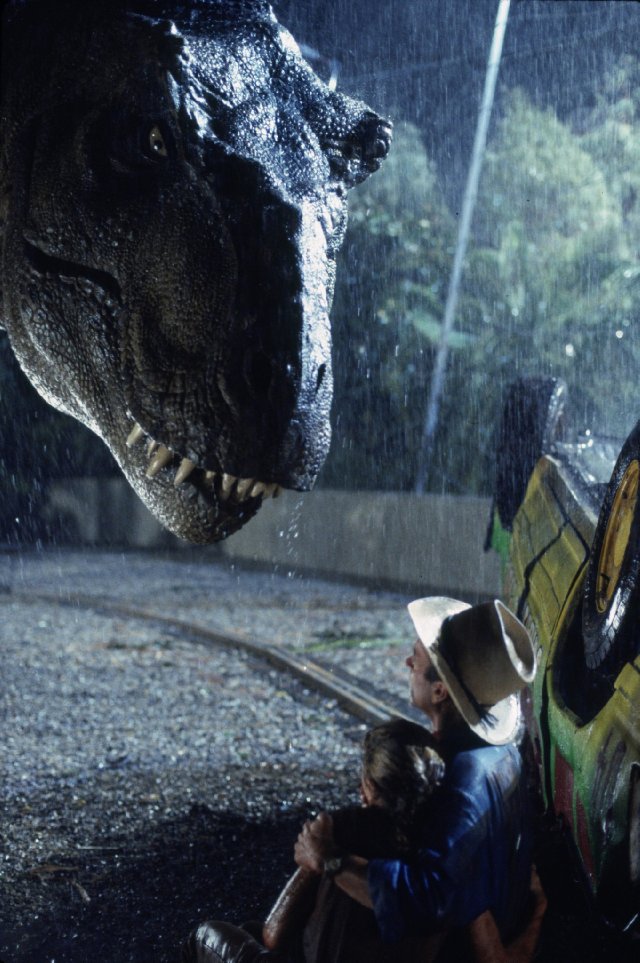
Let me explain. I was attending a conference a couple of weeks ago, and someone remarked to me how they were impressed with how I used animation in my presentations to introduce elements in a complex slide one at a time instead of showing a complicated diagram or graph all at once. I nodded, satisfied that someone had noticed how I strive to help the audience understand what I'm talking about and avoid bombarding them with too much information too fast. Then, this person said, "I would do this in my presentations, but I just don't have time to learn how to do that animation stuff in Powerpoint."
I did not say this, but thought, "So you expect your audience to do all the work and also pay attention to what you are showing them?"
Humans evolved on the African savannah and survived by responding quickly to threats or opportunities for food....anything that moved captured their attention. Early humans (and other predators) were sensitive to motion and mostly ignored objects that did not move such as trees or rocks. Something flitting through the grass or hopping behind a tree caught their immediate attention. You see where I'm going with this....
Modern humans have changed very little in their visual attentiveness to motion. An audience at a scientific conference is not unlike a band of early humans scanning the horizon for that bit of movement that tells them something of interest is going on. Granted, the changing of slides (or introduction of text line by line) does satisfy that motion-directed focus to some extent. However, when we show a complicated graph or diagram in its entirety, the audience basically reacts as if they were faced with a complex landscape in which nothing is moving. Their instinct is to feel that there's nothing of interest on the screen.
You need to show them that there is something of interest and where to look for it. Introduce the slightest motion or contrast: an arrow zooming in on a datapoint, a number suddenly highlighted in a contrasting color, or a key value increasing in size to fill the screen, and you instantly have the audience's attention. Their eyes focus like lasers on that point. If those objects move (appear/disappear, wipe in/out, move across the screen), then it's almost impossible for your audience to avoid paying attention to it. Not only that, but you have guided their attention to the bit of information that you wish them to understand and remember. If it moved, they will remember it.
If you really want to get people's attention and have them remember your point, illustrate it with a photograph that is introduced by animation. Think about how the audience perks up when you show a photo of your fieldsite or your laboratory setup after having sat through innumerable text and data slides. I think some very basic instinct is triggered when we are shown a scene, especially a landscape or some other natural setting. Suddenly, we are back on the African savannah. Our eyes scan the image looking for something of interest: a predator or a prey, an enemy or a potential mate (subconsciously, of course). Your audience will remember those photos longer than your data slides. When I give my summary or list of conclusions at the end of my talk, I don't just provide a bulleted list of items. With each item, I attach a photo or diagram from earlier in the talk to drive home a visual image that links back to a key piece of information I discussed. Sometimes, I only show the image without text. I always animate these lists so that the items are introduced one by one.
Yes, you can carry the animation thing too far. Powerpoint provides a tempting array of entrance and exit motions that you can apply to your objects. Don't be tempted. Stick with the simplest: appear/disappear, dissolve in/out, wipe. Once in a while, you might use a zoom or spiral motion, especially if it makes sense to the object you are introducing. Don't animate just to be animating something. There must be a reason to add motion to your slides.
Going back to my conversation with my colleague....I find that the most effective use of animation is to explain complex concepts or illustrate conceptual models. Typically, I am trying to show the complex interrelationships among the components of an ecosystem. I start with a photo of the ecosystem and overlay a diagram in which components and arrows are grouped; then each component can be introduced in sequence so that the audience is guided along a logical path to eventually see the whole system. Most presenters simply show the diagram in its full complexity and then proceed to explain it (usually badly). The audience is turned off long before the presenter gets to the point.
So, if you are faced with a T. rex at some point, then it makes sense to avoid making any movements and hope s/he ignores you. On the other hand, if you are speaking to an audience and want them to pay attention to and remember your talk, you might want to imagine them as a band of early humans wandering the vast, ancient plains of Africa and looking for some signs of movement in the distance...
Photo Credit: Still image from Jurassic Park, Universal Picture and Amblin Entertainment
Friday, August 26, 2011
American Translation

What should one do in such an instance? Just deliver in English and hope for the best? Read a foreign translation of your talk?
I had briefly considered reading my talk in the native language of the host country, but finally decided that my pronunciation/accent might not be understood. Also, reading a talk is boring, in any language. I decided I had to deliver in English and have a translator. I've done this before, but it was not a simultaneous translation. Instead, the translator stood beside me and translated after each sentence or two. Simultaneous translation is much better, but requires more preparation.
I initially relied on the conference organizers, who invited me, to make whatever arrangements might be necessary. The plan was to have a simultaneous translator and to give out headphones to those who needed them. However, I learned after arriving at the conference venue that only 100 or so headphones would be rented, but that they were expecting around 600 participants (turns out around 350 or so attended the day of my presentation).
After meeting a few people who spoke so little English that I was forced to use what little I knew of their language to communicate, I realized that this would not be like a typical international conference where the official language is English and most people understand it. I began to be concerned that some people would not be able to follow my presentation. So in addition to the translator (more about that later), I made a few adjustments to my Powerpoint presentation.
First of all, I asked a former student from that country to help me translate key phrases on my slides into their language. I know enough of the language to get by, but cannot carry on a conversation or trust myself to do an accurate job of translation. However, knowing some basic vocabulary and conjugation was a big help. We also made use of online translators to check for alternate definitions and to look up technical words. This all worked well. Each slide had the title translated. I also inserted a sentence on key slides that summarized the main point. Most of my slides were very visual, with photos, graphs, and diagrams--to facilitate understanding without a verbal description. I also used a lot of animation with arrows or circles to emphasize key aspects of the data (and minimize the need for additional verbiage).
It took us about an hour to go through the presentation and do all the translation. I later added some more slides to the presentation and was able to use the online translator by myself to fill in the text translation.
As I mentioned above, they also hired a simultaneous translator, and the conference hall was set up for this with a booth and microphones. Prior to leaving home for the meeting, I sent the translator the script of my presentation so she would have plenty of time to do the translation. She took the script and wrote all of it out in the native language. The day of my presentation, I met with her to go over the talk and to answer any questions she had about technical terms. I was very impressed with her professionalism and how much she understood of the science. I answered her questions, and we went over last-minute changes in the order of slides.
Then it was time for my talk. I hesitated to start off by apologizing for speaking in English, but decided to do so. However, I made a joke about it, which seemed to be appreciated. During the talk, I made a point to speak slowly and to enunciate my words carefully. I also paused frequently and looked directly at different sections of the audience (to make eye contact). I tried to gauge how well people were understanding, but it was impossible (I find this difficult anyway with most audiences, who tend to sit with blank expressions). Anyway, I proceeded with the expectation that I was being understood.
Apparently, I was. Afterwards, several people who were not fluent in English came up to tell me that they had no trouble following my talk and really appreciated the efforts I made to make my talk understandable. They mentioned my speaking slowly and especially the language translation on each slide as being the biggest factors that helped them follow me (they also hinted that this had not been their usual experience with other American and British speakers who tend to talk very rapidly).
I was very pleased with how well it all turned out. Maybe I'll get confident enough in the future to deliver a talk in another language. For now, though, I see what I should do to help non-English speakers to better follow my presentations.
Photo Credits: Creature from District 9 (TriStar Pictures); NASA/JPL Planetquest; modified still image, unknown photographer
Saturday, July 23, 2011
No Show

This is not an earth-shaking event, but there are a couple of aspects I'd like to muse about. First, from a purely practical standpoint, how would you handle this if you were the session moderator? When I am moderator, I try to determine if all speakers are present in the room before the start of the session. There is nothing worse than having a gap in the program, which happens frequently enough that you should be prepared with a backup plan. Nowadays, it's relatively easy to determine if all your speakers have shown up for the meeting and are prepared to give their talks. Most conferences require speakers to upload their presentations beforehand, and these are loaded to the session computer or room. The moderator can check the lineup on the computer and see that everyone has arrived and loaded their presentations. However, that does not guarantee that they will all show up for their talks...as I observed at this conference.
In this case, several people in the audience knew the missing speaker and knew that he was present at the venue that day (i.e., had not gone sightseeing or had slept in). Someone volunteered to go look for him and fortunately found him within a few minutes (this was a small conference--about 500 people). When the missing speaker arrived, the session was able to proceed with only a few minutes delay. At a very large conference, this action would likely not have worked. In that case, there are a few other options.
The worst option is for the moderator to announce that a talk has been cancelled and then leave the audience to their own devices or, more likely, to get up and leave (actually, the worst is for the moderator to move up the remaining talks, which should never be done). A better option is to try to fill the time with something. If the missing talk is not the first one, then the moderator could invite additional questions of the previous speakers. This option is better than doing nothing and leaving a gap in the program, but some in the audience may still leave to go to other talks in competing sessions.
If the missing talk is the last one of the session, then the moderator can invite all the previous speakers up for a panel discussion. The latter works well if the session was an interesting/controversial one, and the audience is likely to stick around to hear what else is discussed. Some moderators simply end the session early instead of trying to fill the time with something useful. I can understand this, especially if it is the last session of the day or the meeting when people are tired and ready for a beer. However, I would make an attempt to start a discussion to fill the remaining minutes of the session or give a quick summary or concluding thoughts. As moderator, you might want to plan ahead and have some questions/ideas ready to throw out to get a discussion going.
The option that I have been prepared for lately is to have a backup talk of my own ready to replace a no-show. At this recent conference, I organized a symposium with six speakers, but did not give a presentation of my own (due to various reasons). However, I had a presentation ready in case of a no-show. In this instance, I did not need to use it. What I prepared was a synthesis of previous work--something that I could use as the basis of a future seminar or that I could give at the next meeting. So, I did not feel as if this was a waste of time. This option is feasible mainly in this type of situation--where the moderator is not scheduled to give a talk in the session. Giving two talks in the same session would be too much.
If I were already scheduled to give a talk in my own symposium, an alternate option would be to find someone else to fill in the gap. That requires some lead-time, of course, and someone willing and prepared to give a last-minute talk. I've been approached at some meetings by a desperate moderator who was trying to find a replacement speaker.
The question is whether to agree to give a last-minute talk. Is this wise? Would you look like an "afterthought"? Are there situations where it might be advantageous to give an impromptu talk?
I would probably do it to help avoid a gap in the program, and if I had a talk that this particular audience had not heard before. As a senior scientist with a good reputation, I wouldn't worry so much about people thinking I was added as an afterthought. In some cases, there might be enough time for the change in schedule to be announced, so that people interested in your topic could choose to attend. If you are a junior scientist and an invitation was extended to you to give a replacement talk in a symposium with mostly senior speakers (who will be attracting a large audience), it might be a good opportunity to get broader exposure. Of course, you should be prepared with a good talk and deliver it well.
Friday, October 1, 2010
Socially-Inept Scientists

As a young woman, I suffered from social anxiety--big time. I could barely bring myself to speak in front of more than one other person. And if there was someone present who was intimidating--a Famous Scientist or someone in authority--I was paralyzed. It took many years and forcing myself to learn how to interact with people and to lose my self-consciousness, but I finally overcame this problem. It not only held me back socially, but professionally. I rationalized that it did not matter--that I could do my research alone or with close collaborators and would succeed. I did not realize how crucial it was to my career development. Only after overcoming (to an extent) this social anxiety have I realized what an impediment it was.
I'm still not a social butterfly and people probably do not view me as someone they would really like to get to know, but I am now comfortable in social situations. Even if others don't feel totally at ease with me, I feel comfortable talking to strangers or just standing or dining alone. It just doesn't bother me any more. At conference mixers, I often look around the room for someone who is alone and looking uncomfortable. I will strike up a conversation with them and try to make them feel more comfortable.
At most of the conferences I typically attend, I know a lot of people and am fairly well-known myself. I am approached frequently by students who have read my papers and want to meet me. However, I just recently attended a conference where I did not know many of the attendees, and the conference focus was somewhat outside my field (so no one had heard of me or my work). This was a small conference--about 150 people. I chatted with the one or two people I knew (distant acquaintances).
Most of the other attendees seemed to know everyone else and naturally congregated in animated groups during breaks. It would have been very difficult to approach one of these groups as a lone stranger. There were very few people standing around alone--as I was. I decided this was an interesting situation--one in which I was a total stranger to most of the people--and decided to do a little experiment.
During the session coffee breaks, I stood by myself to see if anyone would spontaneously start up a conversation with me. When people passed by, I would smile or nod, but not initiate a conversation myself. The first day, no one approached me--despite the obvious fact that I was alone and knew few people there. Then, on the second day, I gave my presentation (in the plenary session), which was something of a departure from the other talks. After this, people began approaching me during breaks. Some had questions about my work. Others just seemed to feel more comfortable about approaching me since I had been "introduced" via my talk. In one case, I was invited to come give a seminar later in the year.
There are a couple of lessons here for the socially-disadvantaged. One lesson is that no one is going to come to your rescue in a semi-social setting like a conference mixer. Part of the reason is that people want to feel comfortable, and talking to strangers is usually not comfortable--especially if you have to make the first move. Another reason is that people are there to make important contacts and to make themselves known to potential advisers or employers. They don't have time to waste on someone they view as being "unimportant" to them.
If you want to meet people, you have to make the first move. The experience I described above showed that people only felt comfortable approaching me (a stranger) after 1) they became aware of me, 2) had been "introduced" to me via my talk, 3) had something specific to discuss with me, and/or 4) saw me as someone important to meet.
The second lesson is that if you give an oral presentation, you become "known" to other people, and they feel more inclined to approach you in a professional or semi-social setting. They may be interested in your work or impressed with how you delivered your talk. If someone comes up to you after your talk and compliments you, try to start up a conversation. Don't just say, "Thanks." and then turn away tongue-tied. You might ask what they enjoyed most about your presentation or if they have any questions. Mention some aspect that you thought might have been unclear and ask for an opinion. Always ask if they do similar work and to tell you about it.
The key to engaging people is to get them talking about themselves.
A final point is to realize that scientists as a group tend to be more socially inept than other groups. So the chances that someone else will rescue you from a socially awkward situation is much lower at a gathering of scientists. The motives behind people's behavior at a professional gathering are also different from those in a social setting. It's important to be aware of these distinctions when planning your strategy. The lesson here is that you have to change your behavior instead of waiting for others to change their behavior toward you.
How do you begin to change if you are really paralyzed in social or professional settings? What ways might you meet people at conferences and other gatherings of scientists?
One very easy and less painful way to meet people is during the poster sessions. There are lots of people standing by their posters expecting (hoping) others will approach them. It's very awkward for poster presenters to stand there waiting for someone to approach. So they will often be relieved when someone comes along and starts up a conversation. You also have lots of opportunities to meet many people--especially people doing work in your field. However, I've found it's sometimes easier to talk to people who work on topics I know little about. By confiding to the poster presenter that you don't know anything about their field puts them at ease. Students and young scientists are especially afraid some expert is going to come along and ask them a question they can't answer or will disparage their work. So, they will be especially open to someone who knows little about their topic. Ask them to explain their work to you (you can say you've always been fascinated with the topic, but that it is outside your field). By doing so, you put them into the role of expert and you in the role of interested listener. Few people can resist an opportunity to be looked upon as the more knowledgeable in a conversation. You must be sincere, of course. If you are not, people will see right through you.
You can also approach speakers after their presentations, but this is sometimes difficult if they are surrounded by other people also wanting to talk to them. However, in every session, there will be the "stars" who are immediately surrounded during the break and the "unknowns" who won't be so tied up. Approach the unknowns and ask them a question about their talk. They'll be grateful to you. After you gain some practice, then you might try approaching Famous Scientist after their talk or at the coffee break.
I also make a point of complimenting students who have given especially good talks. I do this both for students I know, but also for students that I do not know and/or who are in other fields. When I was a student, it would have meant a great deal to me to have an established scientist compliment me. So I know it has an effect on their self-esteem. You can do this also--even as a student. Compliment other students or even established scientists. I guarantee you even the most Famous Scientist will be pleased if someone comes up to them after their talk and tells them how much they enjoyed it.
Finally, don't get discouraged if you get rebuffed initially. You are learning a very difficult skill. It's to be expected that you'll make mistakes at first and that it may take some experience before you become successful.
Tuesday, July 27, 2010
Ideas Worth Spreading
This is the last post in the series on giving presentations. I could provide more suggestions about how to deliver an outstanding talk, but the best way to learn is to watch outstanding speakers and study what they do. If you've never heard of the TED talks, I encourage you to take a look at them (www.ted.com). TED stands for Technology, Entertainment, Design and is a small non-profit devoted to "ideas worth spreading". They host an annual conference at which scientists, designers, artists, entertainers, and others deliver fascinating presentations. Some speakers, such as Al Gore, Jane Goodall, and James Cameron, are well-known, whereas others are less known.
Below is an example of a talk called "Radical Women, Embracing Tradition" by Kavita Ramdas.
Below is an example of a talk called "Radical Women, Embracing Tradition" by Kavita Ramdas.
Thursday, July 22, 2010
How to Deal with Aggressive Questions During Presentations
The final topic in this series on presentations is dealing with questions. This is the part of the presentation experience that people fear the most--or feel they handle poorly. Part of the reason is that while we are delivering our talk, we have control over things. We know what is coming next in each slide, and we've planned carefully what to say. However, when the audience is invited to participate, then we are no longer in complete control. We don't know what to expect precisely. Sometimes, we can anticipate questions, but often get questions that are rambling, incoherent, aggressive, or difficult to answer. We are basically put on the spot, but are expected to respond calmly and authoritatively. Dealing with different types of questions may require a slightly different approach, but there are a few things to keep in mind.
First off, listen carefully to the question and make sure you understand what is being asked before answering. If you are having trouble hearing or understanding the person, move closer to them if possible and ask them to repeat the question. You might also want to repeat the question if the audience was unable to hear it.
Second, you want to remain poised and respectful of your questioner and avoid any judgmental, annoyed, or defensive body language.
 The latter point is especially important if you get an aggressive question--one that is clearly challenging your work or even a personal attack. How do you handle a challenging or aggressive question? Basically, your goal is to defuse the situation. Do not act aggressively or defensively or try to invalidate your questioner. This is difficult, I know, but if you can remain respectful, it will make your questioner look even worse than if you attack them. What you then want to do is turn their negative question or statement around and restate it in a more positive or neutral way. Focus in on the key words or phrases that they use.
Here is an example of an aggressive question (the negative words are highlighted in red, key words to reuse are in bold):
"That was an interesting presentation, but you failed to discuss how your experimental treatments might affect this plant community in the long-run or explain the exact mechanism that led to the changes you observed. I'm wondering why you've ignored such important issues."
Here is a possible response that rephrases the question in a neutral way:
"My presentation today focused on community shifts in response to key factors important in this system. I am continuing this research in another study that is looking at these and other factors in an effort to track long-term responses and to identify key mechanisms, but that work is not complete. I hope to report on those findings in the near future."
Note that the response contains no defensive or aggressive language. It is neutral and simply restates what the speaker presented and what the speaker is currently working on (and is not yet ready to discuss). The negative, challenging words (failed, ignored) are addressed indirectly by saying that the important issues raised by the questioner have not been ignored because they are being investigated in an on-going study. The response also re-uses two key words from the question (long-run, mechanism), which further adds to the impression that you've previously considered these important points and are addressing them with follow-up study. Finally, by pointing out that your work is incomplete and that you hope to reveal those findings in the future tells the questioner and the audience that you are on top of the issue, but are not prepared to reveal your results just yet.
Almost as difficult to handle is the rambling question or statement, especially one that clearly is off-track and made by someone unfamiliar with the topic of your talk. You should be humble enough to recognize that if someone is confused about something in your talk, it's probably because you failed to explain it adequately. In your response, you can say that perhaps you did not make that clear in your description or that you did not include that information because it is a well-known procedure. Then proceed to give a brief explanation. If the questioner persists in asking about a well-known technique or concept, then suggest that you talk with them at the break. The audience will recognize that you are trying to spare the questioner any embarrassment and will appreciate your actions.
As in most of the previous posts on this topic, your goal as the speaker is to put your audience at ease and to leave them with a good impression of you and your skills as a speaker and scientist.
First off, listen carefully to the question and make sure you understand what is being asked before answering. If you are having trouble hearing or understanding the person, move closer to them if possible and ask them to repeat the question. You might also want to repeat the question if the audience was unable to hear it.
Second, you want to remain poised and respectful of your questioner and avoid any judgmental, annoyed, or defensive body language.
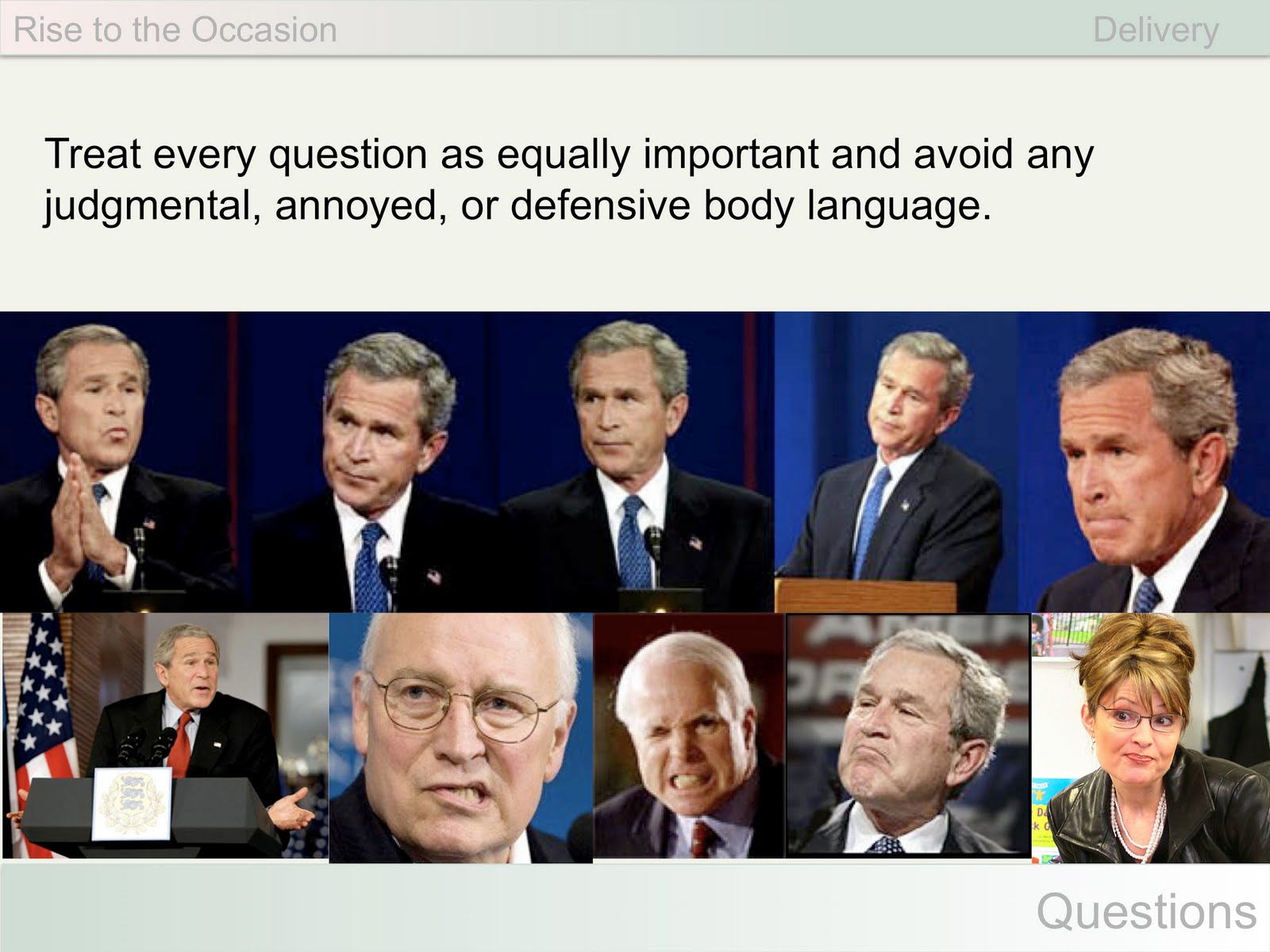
Here is an example of an aggressive question (the negative words are highlighted in red, key words to reuse are in bold):
"That was an interesting presentation, but you failed to discuss how your experimental treatments might affect this plant community in the long-run or explain the exact mechanism that led to the changes you observed. I'm wondering why you've ignored such important issues."
Here is a possible response that rephrases the question in a neutral way:
"My presentation today focused on community shifts in response to key factors important in this system. I am continuing this research in another study that is looking at these and other factors in an effort to track long-term responses and to identify key mechanisms, but that work is not complete. I hope to report on those findings in the near future."
Note that the response contains no defensive or aggressive language. It is neutral and simply restates what the speaker presented and what the speaker is currently working on (and is not yet ready to discuss). The negative, challenging words (failed, ignored) are addressed indirectly by saying that the important issues raised by the questioner have not been ignored because they are being investigated in an on-going study. The response also re-uses two key words from the question (long-run, mechanism), which further adds to the impression that you've previously considered these important points and are addressing them with follow-up study. Finally, by pointing out that your work is incomplete and that you hope to reveal those findings in the future tells the questioner and the audience that you are on top of the issue, but are not prepared to reveal your results just yet.
Almost as difficult to handle is the rambling question or statement, especially one that clearly is off-track and made by someone unfamiliar with the topic of your talk. You should be humble enough to recognize that if someone is confused about something in your talk, it's probably because you failed to explain it adequately. In your response, you can say that perhaps you did not make that clear in your description or that you did not include that information because it is a well-known procedure. Then proceed to give a brief explanation. If the questioner persists in asking about a well-known technique or concept, then suggest that you talk with them at the break. The audience will recognize that you are trying to spare the questioner any embarrassment and will appreciate your actions.
As in most of the previous posts on this topic, your goal as the speaker is to put your audience at ease and to leave them with a good impression of you and your skills as a speaker and scientist.
Tuesday, July 20, 2010
Distractions
Speakers who are nervous engage in distracting behavior. Most of us know not to jingle the change in our pockets, rock back and forth, or do other things that distract the audience from what we are saying.
 So it's no surprise that people misuse laser pointers, which seem to have taken the place of jingling change. If your hand shakes so much that you cannot hold the beam steadily on a point, then you should not use one. If the beam is jumping all around the screen, the audience is definitely not paying attention to you and is instead wondering if you are nervous or perhaps have some dreaded neurological disorder.
I've seen some people try to compensate by using the other hand to steady the hand holding the laser pointer, but this just calls attention to the fact that the speaker is nervous and trying to hide it.
Another misuse of laser pointers is when the speaker constantly circles various points on the screen...endlessly circling... and even pointing to things that don't need highlighting. It's just nervous activity, but is distracting to the audience.
I suggest using animation to highlight important points on your slide. Animation frees you from fumbling around with a laser pointer and is more effective, in my opinion, to emphasize a point.
Another distraction, also due to nervousness, is hesitant speech. Some people tend to say uh and um a lot when under stress. I've talked about this habit in a previous post and some ways to minimize or overcome this tendency. This impediment can be annoying to an audience when it happens frequently enough to be noticeable. Also, excessive pauses and uhs can signal to the audience that you are not knowledgeable about your subject. So it would be worthwhile to break the habit.
Another behavior that is distracting is rocking or pacing. These are soothing behaviors that nervous speakers use to calm themselves. Both behaviors divert attention away from your slides or what you are saying. Becoming aware that you engage in this type of behavior will help you stop it.
As I've stated in previous posts on the topic of giving presentations, your goal is to make your audience comfortable. Eliminating or minimizing nervous or distracting behavior will help your audience to feel at ease with you.

I've seen some people try to compensate by using the other hand to steady the hand holding the laser pointer, but this just calls attention to the fact that the speaker is nervous and trying to hide it.
Another misuse of laser pointers is when the speaker constantly circles various points on the screen...endlessly circling... and even pointing to things that don't need highlighting. It's just nervous activity, but is distracting to the audience.
I suggest using animation to highlight important points on your slide. Animation frees you from fumbling around with a laser pointer and is more effective, in my opinion, to emphasize a point.
Another distraction, also due to nervousness, is hesitant speech. Some people tend to say uh and um a lot when under stress. I've talked about this habit in a previous post and some ways to minimize or overcome this tendency. This impediment can be annoying to an audience when it happens frequently enough to be noticeable. Also, excessive pauses and uhs can signal to the audience that you are not knowledgeable about your subject. So it would be worthwhile to break the habit.
Another behavior that is distracting is rocking or pacing. These are soothing behaviors that nervous speakers use to calm themselves. Both behaviors divert attention away from your slides or what you are saying. Becoming aware that you engage in this type of behavior will help you stop it.
As I've stated in previous posts on the topic of giving presentations, your goal is to make your audience comfortable. Eliminating or minimizing nervous or distracting behavior will help your audience to feel at ease with you.
Friday, July 16, 2010
Good Speakers Connect with Their Audience

1. Notice that she is facing her audience and the screen is behind her. If you spend most of your time looking at your slides, you will not be making eye contact with your audience, and at times may have your back to your audience. Not only will you fail to connect, but people may sneak out when your back is turned! The same goes for reading your paper--your eyes are not on your audience, but turned down.
2. The audience needs to see you and your body language, especially your face. You don't want to be a shadowy figure standing in front of a bright screen. I realize that you don't always have control over lighting and related conditions at a conference, but often you can modify the conditions so that both you and your slides are visible.
3. Notice also, that the woman in the photo is gesturing to make a point. Gestures help tell the audience that she is engaged with them and also make her look more confident and authoritative because she is comfortable and claiming her space. Men typically have little difficulty with this. They wave their arms, pace around the stage--essentially staking out their territory. Some women who are not confident tend to remain motionless and even scrunch themselves up behind the podium. This behavior is immediately interpreted by the audience: she has little authority and her information is consequently irrelevant.
Here is a tip for women (and men) who are uncomfortable speaking in front of groups: watch confident speakers and try to emulate some of their body language (don't overdo it, though). Pick out some movements that are consistent with your demeanor and force yourself to use them (sparingly). You may find that the mere act of gesturing broadly to indicate a point, looking deliberately into the eyes of specific audience members, or leaning casually on the podium will eventually feel natural and that your "adopted" body language will actually make you feel more confident.
4. Your voice is important also. High, squeaky voices sound weak, whereas deeper voices sound more authoritative. Women are at a disadvantage here, but we can strive to use the lower end of our natural range when delivering our talks.
The whole point here is to make your audience comfortable with you. This idea may be a surprise to some, especially novice speakers, who are so focused on their own feelings and needs. People who are nervous speakers do things that make them feel more comfortable (hiding behind the podium; not looking at the audience; speaking softly; restricting movements; reducing visibility by having the lights too low; engaging in distracting behavior such as rocking, wringing hands, jingling change). These behaviors make your audience uncomfortable. They don't want to be anxious about you, but instead want to be reassured that they are in good hands.
It's within your control to make your audience comfortable or restless. If you antagonize them, they are likely to react aggressively during the question and answer period. So, reconsider whether those behaviors that make you feel more comfortable temporarily are really helping you in the long-run.
Subscribe to:
Posts (Atom)