I've been discussing myths about giving presentations. A lot of myths deal with fear of public speaking. The recommendation to imagine your audience naked or in their underwear or sitting on the commode is meant to allay the speaker's fear of being on stage. Supposedly, a naked audience is less intimidating. Rumor has it that this idea came from Winston Churchill, who used this technique (among others) to overcome his fears of speaking in public (he also apparently recommended that people practice their speeches in front of a mirror). I could not find confirmation that Churchill was the source of this advice, but it has certainly been repeated extensively.
This is one recommendation, however, that I've never even considered following, even though it has been suggested to me on a number of occasions throughout my career. I've also heard well-meaning teachers and advisors give this advice to students. First off, it sounds incredibly silly. I have enough trouble trying to remember what I should be saying without the extra mental effort that would be required to envision the audience without their clothes on. I could see myself walking onto the stage, turning to face the audience, trying to picture a roomful of naked people, and then blanking out completely on my speech as my head filled with unsavory images of my colleagues in their birthday suits. How would I face them later and carry on a conversation with a straight face?
No, no, no. This is bad advice not only because it's disrespectful of your audience but because it puts a barrier between you and them. Just the opposite of what you should be doing: Connecting with your audience. If you are afraid or contemptuous of your audience, then you are not connecting with them. If you are not connecting, then it's likely they are not paying much attention to what you are saying. Putting up barriers between you and your audience (huddling behind a podium, reading your speech and never looking up, looking at the screen with your back to your audience) makes for a bad presentation. Audience members will understand at a gut level that you are not confident about yourself or your message. People are incredibly skilled at reading body language, even if they are not quite aware of it at an intellectual level.
Along these same lines, I've heard about another "trick" that some speakers use to avoid looking into the audience members' eyes (but appear to be doing so). The trick, apparently, is to look at people's foreheads instead of their eyes. They supposedly cannot tell that you are faking eye contact. I'm not so sure that's true. If you are faking eye contact, you likely are giving off other subtle hints that you are afraid or insincere, which the audience will spot. Avoiding eye contact tells another person that you are not trustworthy and have something to hide. Faking eye contact is also bad advice because it means that you are missing important feedback from your audience. If you are not looking, you don't know if your audience can hear you, can understand you, or is interested in what you are saying. If you see negative expressions, maybe you can't do anything during that speech but it will be valuable information to help you improve your next talk.
Whenever I see someone in the audience frown or shake their head–it is disturbing–but I try not to dwell on it. I continue to look around the room until I see someone nodding or smiling. Another thing to keep in mind is that the audience members could be mirroring your expressions and body language. If you are exhibiting nervous tics or even fear, your audience is going to be uncomfortable and fidgety. If you are relaxed, smiling, and looking straight into your audience's eyes, they will likely feel comfortable and good about themselves and you.
Being nervous is no excuse for failing to make a connection with your audience. In fact, on the few occasions when I've heard a really nervous speaker admit to the audience that they were terrified of speaking, the audience immediately became sympathetic and encouraging. Most people want you to succeed and can empathize with your nervousness. If you have to imagine your audience in any condition, imagine that they admire you and are there to learn something from you.
Showing posts with label handling aggression/criticism. Show all posts
Friday, May 10, 2013
Wednesday, December 7, 2011
Respect
One of the things I admired the most about my father was that he was unfailingly respectful of other people, even when they were treating him with contempt. He was an uneducated man, a dirt-poor farmer who grew up in the rural Mississippi countryside. It was presumed (incorrectly) that he was unintelligent, unmannered, and bigoted, based solely on his situation (I also experienced similar presumptions when I first ventured to other parts of the country and the world). As a child, I watched more educated or wealthier people treat my father with disrespect. Yet, I never saw him get angry or raise his voice to anyone (not even his children when they let snakes loose in the house [a pest control experiment]). He listened respectfully and responded politely to others who clearly thought themselves to be his superior and made a point of emphasizing the difference.
As a teenager I was embarrassed by my parents (who wasn’t?), but the lesson of his respectful nature did sink in, and I’ve later come to appreciate just how important it is. I’ve tried hard to follow my father’s model, but it’s difficult, especially when other people are disrespectful of me. Some would argue that such people are not deserving of respect. However, it’s not really about them; what’s important is your behavior and whether you choose to take the high road or get down in the mud with your attacker. And I use the term, “attacker”, because disrespectful acts are definitely attacks. I’ve talked a bit in past posts about “verbal attacks” and ways to handle them (here and here). But often we don’t recognize when we are being attacked, especially when it involves subtle disrespect.
In any case, I know my father would say that to maintain one’s own self-respect, it’s essential to preserve your respectful treatment of others. I’m not advocating here that you should not defend yourself against unfair treatment. Just that you do so without showing disrespect for the other person.
Image Credit: The Farmer by Fred Neveu. I really like this painting, which perfectly captures the affable, hardworking character of a dying breed of family farmers.
Wednesday, October 12, 2011
What About Bob?
We are discussing a hypothetical scenario involving Jennifer, a scientist working for a consulting company, who has a problem with her co-worker Bob (see previous two posts). Jennifer has discovered that Bob is communicating on her behalf with the manager of a refuge where she is leading an important project. The refuge manager feels more comfortable communicating with Bob, even though Bob is not part of Jennifer's project. Instead of calling or emailing Jennifer, who is the project lead, the manager is contacting Bob, with whom he is better acquainted and has dealt with in the past.
Jennifer initially thought that Bob was just trying to be helpful....but now is not so sure.
I posed the possibility that Bob might have an ulterior motive for his actions, evident by his persistence in intercepting and responding to messages about Jennifer's project. In the last post, I noted that Jennifer failed to deal effectively with Bob in the beginning. In addition to straightening things out with the refuge manager, she should have confronted Bob and asked him not to respond to any more messages on her behalf...to instead forward emails or otherwise direct any communications to her. Instead, she made the mistake of thanking Bob for the forwarded messages, which apparently encouraged him to continue.
Let's assume that the situation has not improved, and Bob is still interjecting himself into Jennifer's affairs, even after being asked to stop. This is a warning sign that Bob is probably trying to undermine Jennifer.
What should Jennifer do? Storm into Bob's office and demand that he butt out? That's not likely to work, especially if Bob is deliberately trying to sabotage Jennifer's project. Even if Bob is simply a bumbling idiot who doesn't realize the damage he might be doing to Jennifer, her tirade will likely backfire. Should she go to her boss and complain? No, that will just send the message that she can't take care of the problem by herself.
Jennifer takes some time to think about her options and comes up with a three-pronged approach for dealing with Bob and his interference in her project:
1. First, she stops responding to or acting upon any emails or other messages from the refuge forwarded to her by Bob. She does not thank Bob or contact the refuge manager about whatever the email was about. By no longer acknowledging Bob or acting on these forwarded messages, Jennifer takes the first step in removing Bob as Gatekeeper of the information flow between her and the refuge. Bob no longer gets any feedback that his interference is working. The refuge manager, no longer getting responses to messages sent via Bob, begins to have second thoughts about communicating with Bob instead of Jennifer.
2. Second, Jennifer sends email progress reports to the refuge manager each month, enthusiastically highlighting significant findings. And, most importantly, she copies her boss at the consulting company on these emails (not Bob). This action accomplishes several things. She shows her boss that she's keeping the client updated about the project (which will counter any hints by Bob that she's having communication problems). Her boss responds to these messages with, "Great work, Jennifer! Thanks for keeping us all informed." Her emails regularly remind the refuge manager of who is in charge of this project and that the consulting company is supportive of her in this role. In addition, she creates written documentation of her communications with the refuge (in case the refuge manager later complains). Finally, her regular email correspondence prompts the refuge manager to begin responding directly to her once it's obvious that she is the one with knowledge about the project, not Bob.
3. Finally, Jennifer develops another line of communication with the refuge. She befriends the refuge manager's administrative assistant who readily agrees to provide Jennifer with a heads-up about any goings-on that relate to her project. The assistant sees and hears everything and, having had her own run-ins with the "good ole boys", is more than happy to help Jennifer out. This action might be useful if the manager continues to be obstinate about keeping Jennifer informed about refuge activities involving her project.
In the end, Jennifer successfully completes her project. Her boss is very pleased with how she kept the client (and him) informed about the project. He is confident that he can put her in charge of larger projects in the future.
And what about Bob? Well, he tried to tell Jennifer's boss about her communication difficulties with the refuge. However, things didn't turn out quite as he imagined. The boss, instead of asking questions about Jennifer, began quizzing Bob about his role in the situation and why he was wasting time monitoring Jennifer's activities. Bob ended up being reprimanded for interfering with Jennifer's project and was put on probation.
Jennifer initially thought that Bob was just trying to be helpful....but now is not so sure.
I posed the possibility that Bob might have an ulterior motive for his actions, evident by his persistence in intercepting and responding to messages about Jennifer's project. In the last post, I noted that Jennifer failed to deal effectively with Bob in the beginning. In addition to straightening things out with the refuge manager, she should have confronted Bob and asked him not to respond to any more messages on her behalf...to instead forward emails or otherwise direct any communications to her. Instead, she made the mistake of thanking Bob for the forwarded messages, which apparently encouraged him to continue.
Let's assume that the situation has not improved, and Bob is still interjecting himself into Jennifer's affairs, even after being asked to stop. This is a warning sign that Bob is probably trying to undermine Jennifer.
What should Jennifer do? Storm into Bob's office and demand that he butt out? That's not likely to work, especially if Bob is deliberately trying to sabotage Jennifer's project. Even if Bob is simply a bumbling idiot who doesn't realize the damage he might be doing to Jennifer, her tirade will likely backfire. Should she go to her boss and complain? No, that will just send the message that she can't take care of the problem by herself.
Jennifer takes some time to think about her options and comes up with a three-pronged approach for dealing with Bob and his interference in her project:
1. First, she stops responding to or acting upon any emails or other messages from the refuge forwarded to her by Bob. She does not thank Bob or contact the refuge manager about whatever the email was about. By no longer acknowledging Bob or acting on these forwarded messages, Jennifer takes the first step in removing Bob as Gatekeeper of the information flow between her and the refuge. Bob no longer gets any feedback that his interference is working. The refuge manager, no longer getting responses to messages sent via Bob, begins to have second thoughts about communicating with Bob instead of Jennifer.
2. Second, Jennifer sends email progress reports to the refuge manager each month, enthusiastically highlighting significant findings. And, most importantly, she copies her boss at the consulting company on these emails (not Bob). This action accomplishes several things. She shows her boss that she's keeping the client updated about the project (which will counter any hints by Bob that she's having communication problems). Her boss responds to these messages with, "Great work, Jennifer! Thanks for keeping us all informed." Her emails regularly remind the refuge manager of who is in charge of this project and that the consulting company is supportive of her in this role. In addition, she creates written documentation of her communications with the refuge (in case the refuge manager later complains). Finally, her regular email correspondence prompts the refuge manager to begin responding directly to her once it's obvious that she is the one with knowledge about the project, not Bob.
3. Finally, Jennifer develops another line of communication with the refuge. She befriends the refuge manager's administrative assistant who readily agrees to provide Jennifer with a heads-up about any goings-on that relate to her project. The assistant sees and hears everything and, having had her own run-ins with the "good ole boys", is more than happy to help Jennifer out. This action might be useful if the manager continues to be obstinate about keeping Jennifer informed about refuge activities involving her project.
In the end, Jennifer successfully completes her project. Her boss is very pleased with how she kept the client (and him) informed about the project. He is confident that he can put her in charge of larger projects in the future.
And what about Bob? Well, he tried to tell Jennifer's boss about her communication difficulties with the refuge. However, things didn't turn out quite as he imagined. The boss, instead of asking questions about Jennifer, began quizzing Bob about his role in the situation and why he was wasting time monitoring Jennifer's activities. Bob ended up being reprimanded for interfering with Jennifer's project and was put on probation.
Saturday, December 18, 2010
Who's Got Our Backs?
This past week, I've been attending the annual meeting of the American Geophysical Union (AGU) in San Francisco. Not being a geologist, I've never attended AGU before. However, I was invited to give a talk on carbon sequestration in one of the sessions, so here I am. Don't worry, though. I'm not going to talk about that.
Instead, I wanted to report about the interesting sessions that were held on science communication and also blogging. First of all, this was a huge meeting--around 19,000 attendees from all over the world. Easily the largest scientific conference I've ever attended. I can only imagine the planning that went into this conference.
Anyway, there were several sessions devoted to science communication and associated topics. In one session, I heard Michael Mann (Penn State Univ.) talk about his experiences with harassment due to his climate science work ("hockey-stick" temperature pattern). Mann has been the target of personal attacks and investigations by various special interest groups, certain media outlets and politicians who have sought to discredit him and his work. His presentation, "Climate Scientists in the Public Arena: Who's Got Our Backs?", focused on the dilemma of scientists who are out-funded and "outmanned" in the battle, especially if their institutions do not back them up. He described his experiences in the public arena, into which he was pushed. It was a chilling story he told. He was ultimately exonerated by investigations into his involvement with "Climategate". He is currently being pursued by the attorney general of Virginia (Ken Cuccinelli), who is also working to get the state seal changed.
One point Mann made, however, stood out. He wondered how the attacks on climate scientists would affect recruitment of students to the field, if they saw how their future research might lead to similar harassment.
I'm on the road, so will describe some of the other talks/sessions in the coming days.
Image credit: IPCC 2001 Report
Instead, I wanted to report about the interesting sessions that were held on science communication and also blogging. First of all, this was a huge meeting--around 19,000 attendees from all over the world. Easily the largest scientific conference I've ever attended. I can only imagine the planning that went into this conference.
Anyway, there were several sessions devoted to science communication and associated topics. In one session, I heard Michael Mann (Penn State Univ.) talk about his experiences with harassment due to his climate science work ("hockey-stick" temperature pattern). Mann has been the target of personal attacks and investigations by various special interest groups, certain media outlets and politicians who have sought to discredit him and his work. His presentation, "Climate Scientists in the Public Arena: Who's Got Our Backs?", focused on the dilemma of scientists who are out-funded and "outmanned" in the battle, especially if their institutions do not back them up. He described his experiences in the public arena, into which he was pushed. It was a chilling story he told. He was ultimately exonerated by investigations into his involvement with "Climategate". He is currently being pursued by the attorney general of Virginia (Ken Cuccinelli), who is also working to get the state seal changed.
One point Mann made, however, stood out. He wondered how the attacks on climate scientists would affect recruitment of students to the field, if they saw how their future research might lead to similar harassment.
I'm on the road, so will describe some of the other talks/sessions in the coming days.
Image credit: IPCC 2001 Report
Thursday, July 22, 2010
How to Deal with Aggressive Questions During Presentations
The final topic in this series on presentations is dealing with questions. This is the part of the presentation experience that people fear the most--or feel they handle poorly. Part of the reason is that while we are delivering our talk, we have control over things. We know what is coming next in each slide, and we've planned carefully what to say. However, when the audience is invited to participate, then we are no longer in complete control. We don't know what to expect precisely. Sometimes, we can anticipate questions, but often get questions that are rambling, incoherent, aggressive, or difficult to answer. We are basically put on the spot, but are expected to respond calmly and authoritatively. Dealing with different types of questions may require a slightly different approach, but there are a few things to keep in mind.
First off, listen carefully to the question and make sure you understand what is being asked before answering. If you are having trouble hearing or understanding the person, move closer to them if possible and ask them to repeat the question. You might also want to repeat the question if the audience was unable to hear it.
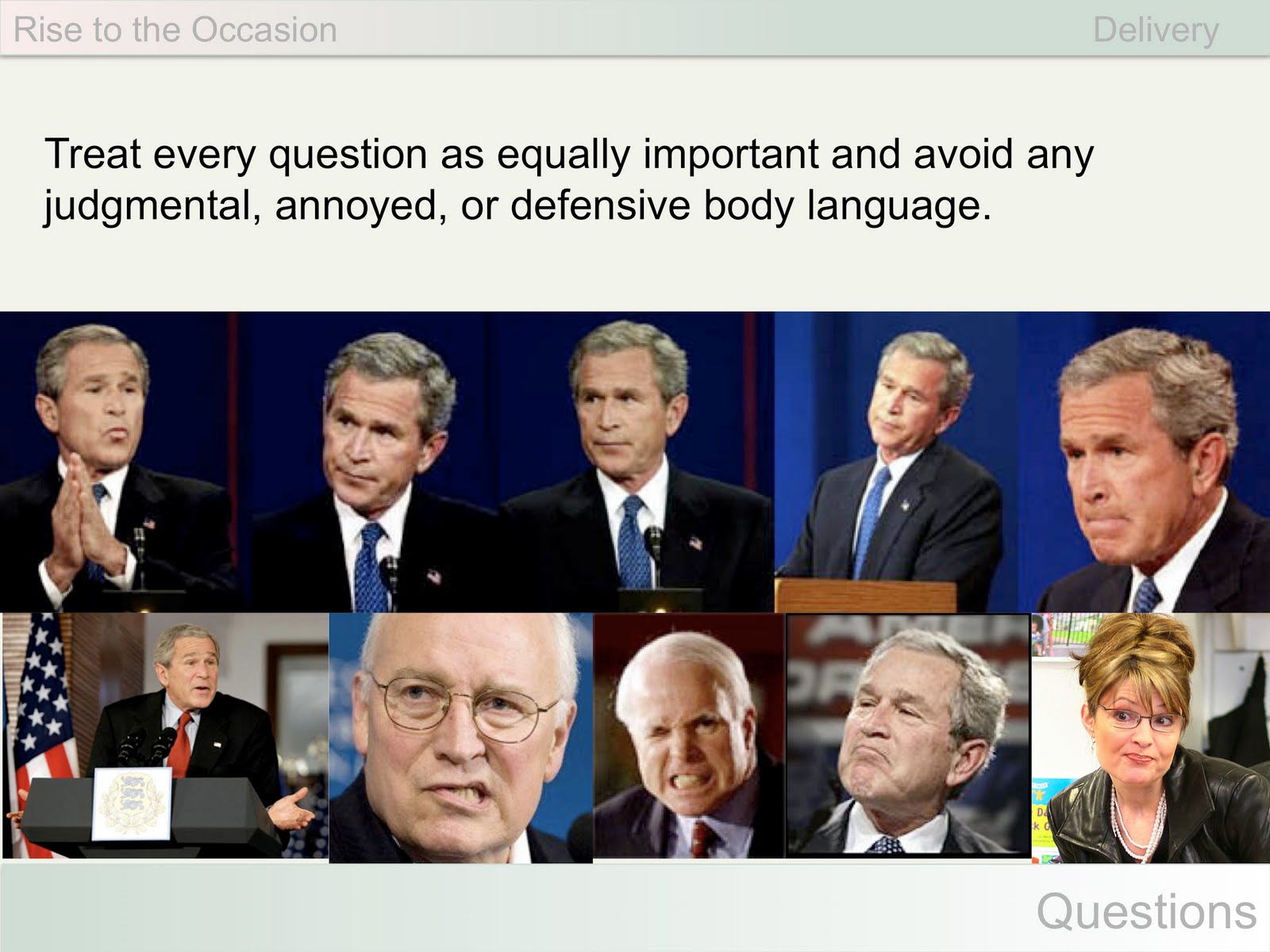
Second, you want to remain poised and respectful of your questioner and avoid any judgmental, annoyed, or defensive body language.
The latter point is especially important if you get an aggressive question--one that is clearly challenging your work or even a personal attack. How do you handle a challenging or aggressive question? Basically, your goal is to defuse the situation. Do not act aggressively or defensively or try to invalidate your questioner. This is difficult, I know, but if you can remain respectful, it will make your questioner look even worse than if you attack them. What you then want to do is turn their negative question or statement around and restate it in a more positive or neutral way. Focus in on the key words or phrases that they use.
Here is an example of an aggressive question (the negative words are highlighted in red, key words to reuse are in bold):
"That was an interesting presentation, but you failed to discuss how your experimental treatments might affect this plant community in the long-run or explain the exact mechanism that led to the changes you observed. I'm wondering why you've ignored such important issues."
Here is a possible response that rephrases the question in a neutral way:
"My presentation today focused on community shifts in response to key factors important in this system. I am continuing this research in another study that is looking at these and other factors in an effort to track long-term responses and to identify key mechanisms, but that work is not complete. I hope to report on those findings in the near future."
Note that the response contains no defensive or aggressive language. It is neutral and simply restates what the speaker presented and what the speaker is currently working on (and is not yet ready to discuss). The negative, challenging words (failed, ignored) are addressed indirectly by saying that the important issues raised by the questioner have not been ignored because they are being investigated in an on-going study. The response also re-uses two key words from the question (long-run, mechanism), which further adds to the impression that you've previously considered these important points and are addressing them with follow-up study. Finally, by pointing out that your work is incomplete and that you hope to reveal those findings in the future tells the questioner and the audience that you are on top of the issue, but are not prepared to reveal your results just yet.
Almost as difficult to handle is the rambling question or statement, especially one that clearly is off-track and made by someone unfamiliar with the topic of your talk. You should be humble enough to recognize that if someone is confused about something in your talk, it's probably because you failed to explain it adequately. In your response, you can say that perhaps you did not make that clear in your description or that you did not include that information because it is a well-known procedure. Then proceed to give a brief explanation. If the questioner persists in asking about a well-known technique or concept, then suggest that you talk with them at the break. The audience will recognize that you are trying to spare the questioner any embarrassment and will appreciate your actions.
As in most of the previous posts on this topic, your goal as the speaker is to put your audience at ease and to leave them with a good impression of you and your skills as a speaker and scientist.
First off, listen carefully to the question and make sure you understand what is being asked before answering. If you are having trouble hearing or understanding the person, move closer to them if possible and ask them to repeat the question. You might also want to repeat the question if the audience was unable to hear it.
Second, you want to remain poised and respectful of your questioner and avoid any judgmental, annoyed, or defensive body language.
The latter point is especially important if you get an aggressive question--one that is clearly challenging your work or even a personal attack. How do you handle a challenging or aggressive question? Basically, your goal is to defuse the situation. Do not act aggressively or defensively or try to invalidate your questioner. This is difficult, I know, but if you can remain respectful, it will make your questioner look even worse than if you attack them. What you then want to do is turn their negative question or statement around and restate it in a more positive or neutral way. Focus in on the key words or phrases that they use.
Here is an example of an aggressive question (the negative words are highlighted in red, key words to reuse are in bold):
"That was an interesting presentation, but you failed to discuss how your experimental treatments might affect this plant community in the long-run or explain the exact mechanism that led to the changes you observed. I'm wondering why you've ignored such important issues."
Here is a possible response that rephrases the question in a neutral way:
"My presentation today focused on community shifts in response to key factors important in this system. I am continuing this research in another study that is looking at these and other factors in an effort to track long-term responses and to identify key mechanisms, but that work is not complete. I hope to report on those findings in the near future."
Note that the response contains no defensive or aggressive language. It is neutral and simply restates what the speaker presented and what the speaker is currently working on (and is not yet ready to discuss). The negative, challenging words (failed, ignored) are addressed indirectly by saying that the important issues raised by the questioner have not been ignored because they are being investigated in an on-going study. The response also re-uses two key words from the question (long-run, mechanism), which further adds to the impression that you've previously considered these important points and are addressing them with follow-up study. Finally, by pointing out that your work is incomplete and that you hope to reveal those findings in the future tells the questioner and the audience that you are on top of the issue, but are not prepared to reveal your results just yet.
Almost as difficult to handle is the rambling question or statement, especially one that clearly is off-track and made by someone unfamiliar with the topic of your talk. You should be humble enough to recognize that if someone is confused about something in your talk, it's probably because you failed to explain it adequately. In your response, you can say that perhaps you did not make that clear in your description or that you did not include that information because it is a well-known procedure. Then proceed to give a brief explanation. If the questioner persists in asking about a well-known technique or concept, then suggest that you talk with them at the break. The audience will recognize that you are trying to spare the questioner any embarrassment and will appreciate your actions.
As in most of the previous posts on this topic, your goal as the speaker is to put your audience at ease and to leave them with a good impression of you and your skills as a speaker and scientist.
Wednesday, April 21, 2010
Lounging on the Beach
Do you find it annoying when other people assume that when you are away from your office or lab that you are not working? You may be working at home, trying to finish that proposal by the deadline and can’t afford the interruptions at the office. You may be a telecommuter and spend part or all of your time at a home office. Your job may require extensive travel—to do fieldwork or meet with colleagues/clients, for example. Most scientists travel to attend conferences a couple of times (or more) per year. Even when your off-site activities are clearly required to meet your job responsibilities and for career development, does there still seem to be a suspicion that you are getting away with something?
Somehow, official travel has become an activity that is viewed by outsiders as a “perk”. Maybe it has something to do with reimbursement for expenses (and the suspicion that you are getting a free vacation). Maybe it’s just the fact that you are allowed to escape the office drudgery periodically while others are not. You’ve probably read those newspaper articles that list travel expenditures of government officials who have gone on “junkets” somewhere--usually a resort setting; such revelations are often followed by expressions of outrage by the public as to how their taxes are being wasted. Maybe some of these trips are boondoggles, but most are probably not. The average person likely does not understand that conferences and workshops are often held in resorts or resort settings, and that the traveler typically does not have anything to do with the choice of venue. Newspaper reports can sound quite damning: "'Government Official X' made 8 trips in 2009 at a total cost to the taxpayer of $15,000." That's less than $2,000 per trip--very reasonable. However, the article often questions the need for these trips (as if the employee had a choice) and implies that the cost is not warranted.
Travel by scientists (e.g., to conferences) is sometimes questioned by administrators, but at least we (and our expense reports) are not held up to public scrutiny (yet). More about this in the next post...
Travel becomes even more suspect (in others' minds) when it involves a destination known for recreational opportunities such as swimming, diving, fishing, skiing, etc. As an example, I do a lot of fieldwork in coastal areas that contain a variety of habitats extending from the ocean to uplands: beach, dune, swale, and wetland (the latter being my research focus). Some of these locations one might want to visit on vacation. Unfortunately, I’m not on vacation, nor do I have time to relax and also get my work done. And even if I did have time to relax, lying on the beach is not my idea of fun.
My research sites are characterized by lots of mud (into which you might sink up to your thighs), vegetation so thick that it takes fifteen minutes to traverse a few feet, extreme heat and humidity in summer and cold and rain in winter, sometimes dangerous animals (crocodiles), and of course, a myriad of biting insects that would drive a normal person quite crazy. The accommodations in some field locations are quite rustic--no running water; intermittent electricity (if any) and definitely no air conditioning, TV, or internet; an outhouse on the end of a pier (unless it’s been washed away by the latest hurricane and you are reduced to using a bucket)....definitely not Shangri-La. I happen to love the rugged simplicity, but most people would be very unhappy campers when faced with such a setting for weeks on end.
But people only hear that you are off to ‘Fabulous Location’ and immediately jump to the wrong conclusion. Even co-workers who know better.
Just prior to departure for some distant shore, I invariably will have some person say to me, "I hear you are off to 'Fabulous Location'. I wish I could go places like that." Others will make more snide comments such as, "Well, aren't you lucky...getting to go to 'Fabulous Location'." Yes, I feel lucky, but only at the opportunity to do research in an interesting ecosystem, which is my job.
One of the first, disturbing interactions I’ve ever had in this regard was when I was a graduate student and had to meet with the chair of the graduate school. Although the subject of the meeting had to do with my resident status, he asked me about my dissertation research. I naively explained that it entailed field study in a foreign tropical country. He immediately began grilling me about why I had to do my research in that particular setting and ultimately insinuated that I was not really doing research but was instead cavorting in a bikini (!!) on a beach somewhere. I was flabbergasted. The harder I tried to convey the actual conditions surrounding such field research, the more suspicious he became and the more outrageous his comments. I got out of there as fast as I could (my request regarding residency was ultimately denied).
My relatives are usually the most resistant to the idea that I might be working while away from the office. Despite numerous explanations about the nature of my work, their automatic assumption, upon hearing I'm headed for another field trip to 'Fabulous Location', is that I will be lying on a beach somewhere with a cocktail in my hand. When I protest, they grin and say, "Yeah, right. You must think I'm stupid or something."
I've finally given up trying to explain and respond to such remarks with, "Well, it's hard work, but someone has to do it."
Somehow, official travel has become an activity that is viewed by outsiders as a “perk”. Maybe it has something to do with reimbursement for expenses (and the suspicion that you are getting a free vacation). Maybe it’s just the fact that you are allowed to escape the office drudgery periodically while others are not. You’ve probably read those newspaper articles that list travel expenditures of government officials who have gone on “junkets” somewhere--usually a resort setting; such revelations are often followed by expressions of outrage by the public as to how their taxes are being wasted. Maybe some of these trips are boondoggles, but most are probably not. The average person likely does not understand that conferences and workshops are often held in resorts or resort settings, and that the traveler typically does not have anything to do with the choice of venue. Newspaper reports can sound quite damning: "'Government Official X' made 8 trips in 2009 at a total cost to the taxpayer of $15,000." That's less than $2,000 per trip--very reasonable. However, the article often questions the need for these trips (as if the employee had a choice) and implies that the cost is not warranted.
Travel by scientists (e.g., to conferences) is sometimes questioned by administrators, but at least we (and our expense reports) are not held up to public scrutiny (yet). More about this in the next post...
Travel becomes even more suspect (in others' minds) when it involves a destination known for recreational opportunities such as swimming, diving, fishing, skiing, etc. As an example, I do a lot of fieldwork in coastal areas that contain a variety of habitats extending from the ocean to uplands: beach, dune, swale, and wetland (the latter being my research focus). Some of these locations one might want to visit on vacation. Unfortunately, I’m not on vacation, nor do I have time to relax and also get my work done. And even if I did have time to relax, lying on the beach is not my idea of fun.
My research sites are characterized by lots of mud (into which you might sink up to your thighs), vegetation so thick that it takes fifteen minutes to traverse a few feet, extreme heat and humidity in summer and cold and rain in winter, sometimes dangerous animals (crocodiles), and of course, a myriad of biting insects that would drive a normal person quite crazy. The accommodations in some field locations are quite rustic--no running water; intermittent electricity (if any) and definitely no air conditioning, TV, or internet; an outhouse on the end of a pier (unless it’s been washed away by the latest hurricane and you are reduced to using a bucket)....definitely not Shangri-La. I happen to love the rugged simplicity, but most people would be very unhappy campers when faced with such a setting for weeks on end.
But people only hear that you are off to ‘Fabulous Location’ and immediately jump to the wrong conclusion. Even co-workers who know better.
Just prior to departure for some distant shore, I invariably will have some person say to me, "I hear you are off to 'Fabulous Location'. I wish I could go places like that." Others will make more snide comments such as, "Well, aren't you lucky...getting to go to 'Fabulous Location'." Yes, I feel lucky, but only at the opportunity to do research in an interesting ecosystem, which is my job.
One of the first, disturbing interactions I’ve ever had in this regard was when I was a graduate student and had to meet with the chair of the graduate school. Although the subject of the meeting had to do with my resident status, he asked me about my dissertation research. I naively explained that it entailed field study in a foreign tropical country. He immediately began grilling me about why I had to do my research in that particular setting and ultimately insinuated that I was not really doing research but was instead cavorting in a bikini (!!) on a beach somewhere. I was flabbergasted. The harder I tried to convey the actual conditions surrounding such field research, the more suspicious he became and the more outrageous his comments. I got out of there as fast as I could (my request regarding residency was ultimately denied).
My relatives are usually the most resistant to the idea that I might be working while away from the office. Despite numerous explanations about the nature of my work, their automatic assumption, upon hearing I'm headed for another field trip to 'Fabulous Location', is that I will be lying on a beach somewhere with a cocktail in my hand. When I protest, they grin and say, "Yeah, right. You must think I'm stupid or something."
I've finally given up trying to explain and respond to such remarks with, "Well, it's hard work, but someone has to do it."
Sunday, February 28, 2010
How to Handle Sexual Harassment by a Subordinate
A reader wrote in a few weeks ago about a problem with an undergraduate assistant, sent as a comment on an older post. I am reproducing her statement here in case anyone would like to suggest a response or relate a similar experience.
"Hi, I was recently referred to this blog by a friend. I realize this is an older post, but I was hoping that someone might have some good advice. I am a woman PhD student and my research is in remote areas. I am a pretty small woman often mistaken for being a bit younger than I am and I have a pretty causal personality. Due to funding, I am only able to hire one field assistant and last year it was an undergraduate male. I wanted to have a relaxed work environment especially as we were camping. Unfortunately, my assistant began making inappropriate comments such as "you're a such a cute little boss" when I would outline his tasks. I found this pretty surprising (and inappropriate) and I wasn't sure what to do. I believe I indicated that I found this to be out of line, but such comments still occurred sometimes. This year, the top candidate for my technician position is again an undergraduate male. I was hoping someone might have advice about how to set the correct tone from the beginning and how to handle any comments over the line. While I prefer to be pretty casual and relaxed, I believe that I should be a little more formal this time?" Anonymous
Here's my take on this type of situation.
In some cases where subordinates overstep their roles and behave inappropriately (making sexist remarks, challenging their superior's authority, undermining the boss by making disparaging remarks to other employees, etc.), the problem may arise from the subordinate's problem with authority. It may also be inadvertently encouraged by the boss who tries to be "friends" with the employee. The worst case scenario is a combination of the two.
The potential employee with authority problems may be difficult to spot during interviews, but sometimes they might drop some clues in response to carefully crafted questions. You have two opportunities to deal with this type of person:
1. During the interview and hiring process, you can eliminate those candidates that do not appear to fit with the work situation (taking orders from a superior or working with a woman) and
2. On the first day of the job when their duties are explained. In the case of fieldwork in a remote setting, you can explain that because of safety and various other issues that your instructions must be followed. Be clear that any inappropriate behavior or failure to follow directions will result in their being sent home immediately. I take this approach with all undergraduate and graduate students and field assistants who accompany me on field trips or in field courses. Some PIs or field course instructors write out rules of conduct and safety precautions, which the student must sign in order to participate. You must follow through with the stated consequences. This can be inconvenient if it means making arrangements for their transport or cancellation of the trip. However, the consequences of ignoring warning signs can be much worse, especially if you are a lone female with a threatening male assistant.
The other situation involves the attempt to have a friendly, less formal relationship with subordinates. People usually have strong feelings about this-both for and against informal relationships. I personally think it's a mistake to set up a less than professional relationship with subordinates. The reason is that you cannot be truly friends with someone who is not your equal, and as a supervisor you have power over that other person no matter how friendly you are. By encouraging an informal relationship, a supervisor may eventually have serious behavioral issues to deal with in the future, but also puts the subordinate in a precarious and unfair situation. Your attempt at friendliness or informality may invite inappropriate behavior if the subordinate misinterprets your intentions. It's particularly important for females to consider the consequences of establishing an informal relationship with subordinates. It can be difficult enough establishing one's authority without inviting unwanted challenges from those who might take advantage of your good nature and desire to have a relaxed work environment.
Can you have enjoyable interactions with your research group and still retain a formal, professional relationship? Yes, definitely. I joke around with my group and we discuss general
topics of interest, have group lunches, etc. However, I maintain a professional distance and socialize with my own peer group.
Graduate students, post-docs, and technicians may have particular difficulty establishing authority over undergraduates or others because they are often not perceived as having any real power. If someone is helping you with your project and is being paid for their time, then you should speak up immediately if they fail to show respect for your position. You have to judge just how to react based on what they do or say.
Comments of a sexually harassing nature should be dealt with immediately and forcefully--not doing so can be a mistake if things escalate and you have to report it later. There is no excuse for that type of behavior, especially if it continues after the harasser is warned. The law is based on the victim's perception, not the harasser's. So if you perceive a co-worker's or subordinate's actions as being threatening, then you are justified in reporting it. If anyone tries to discourage you from reporting harassment, this is illegal and also grounds for complaint. The US Equal Opportunity Employment office has useful information and guidance.
The situation described by "Anonymous" would not normally be terribly threatening (in an office or lab), but the remote field setting puts a different slant on things. I doubt he realized that his comments, in combination with the remote setting actually may have created an intimidating/hostile environment, which meets the definition of sexual harassment. The correct way to approach such a situation is to first tell him that his comments are inappropriate and upsetting to you. If they continue, then this is a warning that this person does not view you as being in control, and it might be best to cancel or cut the trip short (first calling your supervisor to let him/her know what's going). In the future, projecting a more authoritative, professional attitude (at least initially until you get to know your assistant better) might help in preventing a similar situation.
If anyone has had a similar experience and would like to tell how they handled it or what you think should be done in such a situation, please comment.
"Hi, I was recently referred to this blog by a friend. I realize this is an older post, but I was hoping that someone might have some good advice. I am a woman PhD student and my research is in remote areas. I am a pretty small woman often mistaken for being a bit younger than I am and I have a pretty causal personality. Due to funding, I am only able to hire one field assistant and last year it was an undergraduate male. I wanted to have a relaxed work environment especially as we were camping. Unfortunately, my assistant began making inappropriate comments such as "you're a such a cute little boss" when I would outline his tasks. I found this pretty surprising (and inappropriate) and I wasn't sure what to do. I believe I indicated that I found this to be out of line, but such comments still occurred sometimes. This year, the top candidate for my technician position is again an undergraduate male. I was hoping someone might have advice about how to set the correct tone from the beginning and how to handle any comments over the line. While I prefer to be pretty casual and relaxed, I believe that I should be a little more formal this time?" Anonymous
Here's my take on this type of situation.
In some cases where subordinates overstep their roles and behave inappropriately (making sexist remarks, challenging their superior's authority, undermining the boss by making disparaging remarks to other employees, etc.), the problem may arise from the subordinate's problem with authority. It may also be inadvertently encouraged by the boss who tries to be "friends" with the employee. The worst case scenario is a combination of the two.
The potential employee with authority problems may be difficult to spot during interviews, but sometimes they might drop some clues in response to carefully crafted questions. You have two opportunities to deal with this type of person:
1. During the interview and hiring process, you can eliminate those candidates that do not appear to fit with the work situation (taking orders from a superior or working with a woman) and
2. On the first day of the job when their duties are explained. In the case of fieldwork in a remote setting, you can explain that because of safety and various other issues that your instructions must be followed. Be clear that any inappropriate behavior or failure to follow directions will result in their being sent home immediately. I take this approach with all undergraduate and graduate students and field assistants who accompany me on field trips or in field courses. Some PIs or field course instructors write out rules of conduct and safety precautions, which the student must sign in order to participate. You must follow through with the stated consequences. This can be inconvenient if it means making arrangements for their transport or cancellation of the trip. However, the consequences of ignoring warning signs can be much worse, especially if you are a lone female with a threatening male assistant.
The other situation involves the attempt to have a friendly, less formal relationship with subordinates. People usually have strong feelings about this-both for and against informal relationships. I personally think it's a mistake to set up a less than professional relationship with subordinates. The reason is that you cannot be truly friends with someone who is not your equal, and as a supervisor you have power over that other person no matter how friendly you are. By encouraging an informal relationship, a supervisor may eventually have serious behavioral issues to deal with in the future, but also puts the subordinate in a precarious and unfair situation. Your attempt at friendliness or informality may invite inappropriate behavior if the subordinate misinterprets your intentions. It's particularly important for females to consider the consequences of establishing an informal relationship with subordinates. It can be difficult enough establishing one's authority without inviting unwanted challenges from those who might take advantage of your good nature and desire to have a relaxed work environment.
Can you have enjoyable interactions with your research group and still retain a formal, professional relationship? Yes, definitely. I joke around with my group and we discuss general
topics of interest, have group lunches, etc. However, I maintain a professional distance and socialize with my own peer group.
Graduate students, post-docs, and technicians may have particular difficulty establishing authority over undergraduates or others because they are often not perceived as having any real power. If someone is helping you with your project and is being paid for their time, then you should speak up immediately if they fail to show respect for your position. You have to judge just how to react based on what they do or say.
Comments of a sexually harassing nature should be dealt with immediately and forcefully--not doing so can be a mistake if things escalate and you have to report it later. There is no excuse for that type of behavior, especially if it continues after the harasser is warned. The law is based on the victim's perception, not the harasser's. So if you perceive a co-worker's or subordinate's actions as being threatening, then you are justified in reporting it. If anyone tries to discourage you from reporting harassment, this is illegal and also grounds for complaint. The US Equal Opportunity Employment office has useful information and guidance.
The situation described by "Anonymous" would not normally be terribly threatening (in an office or lab), but the remote field setting puts a different slant on things. I doubt he realized that his comments, in combination with the remote setting actually may have created an intimidating/hostile environment, which meets the definition of sexual harassment. The correct way to approach such a situation is to first tell him that his comments are inappropriate and upsetting to you. If they continue, then this is a warning that this person does not view you as being in control, and it might be best to cancel or cut the trip short (first calling your supervisor to let him/her know what's going). In the future, projecting a more authoritative, professional attitude (at least initially until you get to know your assistant better) might help in preventing a similar situation.
If anyone has had a similar experience and would like to tell how they handled it or what you think should be done in such a situation, please comment.
Sunday, January 31, 2010
Do Scientists Need Better Manners?
Thanks to biochem belle for pointing out an article in The Scientist called "Mind Your Manners" by Steven Wiley. My previous post basically made a similar point regarding how disrespectful behavior on the part of some scientists (in public debates, on blogs, etc.) ultimately colors the perception of the public's view of us. It's one thing to be passionate about your ideas and opinions and quite another to express that passion in a negative diatribe against someone else with a different opinion.
I find it quite interesting that others are becoming concerned about exchanges among scientists that are increasingly disrespectful. My post "Rude Scientists" was basically about science communication and the public's perception of scientists, but it occurred to me while preparing it that how we treat each other could influence how we are perceived as a group by the public. I had not seen the article by Wiley in The Scientist, but we make similar points, albeit in different ways.
If you read the responses to Wiley's essay, you will see that quite a few respondents don't "get it". A few agree and express similar concern. One respondent to Wiley's article lays the blame on blogs. There may be something to that, although I wonder if it's more related to the anonymous nature of blogging that brings out the lack of manners? Perhaps this behavior is like road rage. People who are totally polite and mild-mannered in person turn into The Hulk on the highway. I've always believed that road rage was partly due to the (somewhat) anonymity of the driver, partly to the stress involved in driving, and partly the lack of face-to-face interaction that holds most people in check.
Wiley also makes an important point about maintaining your composure when attacked. If you remain calm and respectful toward your attacker, you will almost always win the respect of the audience--as well as the argument. I described some clear guidelines for dealing with verbal attacks in previous posts: "Sticks and Stones...", "Verbal Self-Defense", and "How to Counter a Verbal Attack". I agree with Wiley that going over the line (e.g., into an irrational screaming match) only shows you to be immature and out-of-control.
So I don't think blogs are to blame for the rude behavior that seems to be emerging in science exchanges on blogs and elsewhere. Blogs have just given those with little self-control a ready outlet for their frustrations.
I find it quite interesting that others are becoming concerned about exchanges among scientists that are increasingly disrespectful. My post "Rude Scientists" was basically about science communication and the public's perception of scientists, but it occurred to me while preparing it that how we treat each other could influence how we are perceived as a group by the public. I had not seen the article by Wiley in The Scientist, but we make similar points, albeit in different ways.
If you read the responses to Wiley's essay, you will see that quite a few respondents don't "get it". A few agree and express similar concern. One respondent to Wiley's article lays the blame on blogs. There may be something to that, although I wonder if it's more related to the anonymous nature of blogging that brings out the lack of manners? Perhaps this behavior is like road rage. People who are totally polite and mild-mannered in person turn into The Hulk on the highway. I've always believed that road rage was partly due to the (somewhat) anonymity of the driver, partly to the stress involved in driving, and partly the lack of face-to-face interaction that holds most people in check.
Wiley also makes an important point about maintaining your composure when attacked. If you remain calm and respectful toward your attacker, you will almost always win the respect of the audience--as well as the argument. I described some clear guidelines for dealing with verbal attacks in previous posts: "Sticks and Stones...", "Verbal Self-Defense", and "How to Counter a Verbal Attack". I agree with Wiley that going over the line (e.g., into an irrational screaming match) only shows you to be immature and out-of-control.
So I don't think blogs are to blame for the rude behavior that seems to be emerging in science exchanges on blogs and elsewhere. Blogs have just given those with little self-control a ready outlet for their frustrations.
Saturday, January 30, 2010
Rude Scientists
This series is about science communication. We now have so many wonderful outlets to share our excitement and fascination with science: websites, blogs, YouTube, Twitter, etc. How do we come across to the general public in these venues? Serious or Fun-loving? Boring or Interesting? Lackadaisical or Enthusiastic? Respectful or Rude? We each must develop a "voice", which is not necessarily the same for all scientists. I don't think we should all be deadly serious and focused entirely on facts and figures. There is room for many different styles that are informative, yet entertaining.
Blogs are great for giving others a glimpse into how scientists think and the idea that we are not all total nerds. Blogs are also helpful to aspiring scientists by providing some insight into the highs and lows that are encountered in our profession (reality check) as well as to provide some helpful guidance here and there (mentoring). Blogs can convey guidance and information that is not taught in school or can be found easily in books.
However, I’ve noticed in the blogosphere that some science bloggers gain notoriety by engaging in negative rants, heavily laden with cursing and rude attacks on anyone with a different opinion. You probably know which blogs I’m talking about. Some have huge followings, probably because readers mistakenly think that an angry voice is bound to be a truthful one. Instead of expending effort to develop an intelligent, interesting, or useful voice, these angry bloggers use their vitriol as an easy way to attract attention. Take a close look at some of these blogs, and you will see that very little real information or useful insight is conveyed.
I sometimes wonder if these negative bloggers behave equally rudely in real life among colleagues. I also wonder if their followers in the blogosphere would put up with them in person. I think not, because most rude and obnoxious people are ostracized or at least avoided by co-workers and acquaintances.
I’m not advocating that bloggers should (figuratively) sit around the campfire holding hands and singing Kumbaya, but to take the time to develop a positive voice. One can point out problems and have disagreements without all the acrimony and sarcasm. This is important, because how science bloggers behave can influence how scientists are perceived by the public. Most people have never met a scientist and never will. Their only insight into what a scientist might be like is through media interviews, film, and now blogs. The public's perception of scientists has been generally good in the past, but mainly because we were believed to be honest, dedicated, unbiased--all admirable traits. However, this could easily change as more and more people become "acquainted" with scientists through blogs and other venues.
I’m hoping some science blogs with respectful hosts will ultimately gain similarly large and loyal followers as the ranters.
(Fortunately, I could not find a photo of scientists in a fist-fight to illustrate this post. So I used one of rowdy politicians.)
Blogs are great for giving others a glimpse into how scientists think and the idea that we are not all total nerds. Blogs are also helpful to aspiring scientists by providing some insight into the highs and lows that are encountered in our profession (reality check) as well as to provide some helpful guidance here and there (mentoring). Blogs can convey guidance and information that is not taught in school or can be found easily in books.
However, I’ve noticed in the blogosphere that some science bloggers gain notoriety by engaging in negative rants, heavily laden with cursing and rude attacks on anyone with a different opinion. You probably know which blogs I’m talking about. Some have huge followings, probably because readers mistakenly think that an angry voice is bound to be a truthful one. Instead of expending effort to develop an intelligent, interesting, or useful voice, these angry bloggers use their vitriol as an easy way to attract attention. Take a close look at some of these blogs, and you will see that very little real information or useful insight is conveyed.
I sometimes wonder if these negative bloggers behave equally rudely in real life among colleagues. I also wonder if their followers in the blogosphere would put up with them in person. I think not, because most rude and obnoxious people are ostracized or at least avoided by co-workers and acquaintances.
I’m not advocating that bloggers should (figuratively) sit around the campfire holding hands and singing Kumbaya, but to take the time to develop a positive voice. One can point out problems and have disagreements without all the acrimony and sarcasm. This is important, because how science bloggers behave can influence how scientists are perceived by the public. Most people have never met a scientist and never will. Their only insight into what a scientist might be like is through media interviews, film, and now blogs. The public's perception of scientists has been generally good in the past, but mainly because we were believed to be honest, dedicated, unbiased--all admirable traits. However, this could easily change as more and more people become "acquainted" with scientists through blogs and other venues.
I’m hoping some science blogs with respectful hosts will ultimately gain similarly large and loyal followers as the ranters.
(Fortunately, I could not find a photo of scientists in a fist-fight to illustrate this post. So I used one of rowdy politicians.)
Sunday, September 27, 2009
Competition, Confidence, and Success

I was thinking the other day about the fact that scientists are dependent upon competitors (colleagues who compete with us for research $$ and for space in journals) for good reviews. Our promotions and status are often tied to how many papers we publish and how much grant funding we acquire. I can think of no other job in which a competitor has such an influence over the professional success of their peers. Attorneys, doctors, and other professionals have competitors, but their on-the-job performance is not often judged by peers in a way that has a substantive influence on their career success. Yes, their work may be judged by peers as outstanding, mediocre, or poor; but those opinions don’t necessarily prevent a doctor or attorney from having many clients and making lots of money. If they work for someone else, their job performance may be judged by supervisors or the owner of a business, but never based on the opinions of co-workers.
I was reminded of this difference while watching and reading about the confirmation hearings of Judge Sotomayor. Here is an instance in which a professional’s body of work is being put on display and which must be defended before being appointed to a prestigious position. She is being grilled by senators (mostly male), many of whom are either not educated in the law or who were not as successful as Sotomayor in the field of law. I can’t imagine what it would be like for a scientist to be quizzed by a group of non-scientists who do not really understand the finer points of one’s body of work. What you might think was a major finding that shed light on a particular topic, e.g., climate change, might be attacked by a questioner who claims that climate change is a hoax. Of course, that could be an opportunity to show how you can handle difficult questions. On the other hand, it might be easier to answer questions by non-scientists, rather than scientists, who know precisely where to dig.
I’ve noticed that scientists who confidently answer questions, even if the answer is wrong, are viewed as more erudite than those who are cautious in their answers. Scientists are notorious for not giving definitive answers to difficult questions—they provide so many caveats that the questioner concludes the scientist just isn’t knowledgeable. Ironically, it’s often the more knowledgeable person who equivocates—because they know how complicated the topic is and that there is no single, absolute answer. Ignorance, on the other hand, “begets confidence more frequently than does knowledge” (Charles Darwin).
Females tend to be more hesitant in giving a confident answer and standing by it when challenged. I see this all the time at meetings, in student defenses, etc. Yes, there are exceptions, but I’m talking about in general. What is it that makes us so uncertain about our abilities? Is the new generation of women more assured and fearless? What is different about those women who are confident? Were they always so, or did it develop over time?
I don’t have the answers. But my observation is that women’s opinions tend to be questioned more than men’s. If you are constantly challenged, it wears down your confidence. It takes a particularly strong-willed person to maintain their confidence in the face of frequent questioning or criticism. If you are never challenged, then I can imagine that you would develop a mindset that you are always right and ultimately exude an erudite bearing (warranted or not). This would suggest that we are trained to be confident (or not) based how we were treated growing up, in school, in the workplace, and other experiences. Also, there are likely biochemical differences (testosterone vs. estrogen) that determine aggression, modesty, etc., which determine how we react to such treatment. Nature and nurture.
We can’t do much about nature, but we can control our environment to some extent. If you are surrounded by negative people who are always critical of you, you have the option of changing your environment and relationships. It’s not always easy, of course, but then nothing worth having is typically easy.
Sunday, August 16, 2009
Intuition

What do you do if you suspect someone of scientific misconduct? What if you are accused of scientific fraud?
I just finished reading an academic novel called “Intuition”, which is about scientific fraud, whistle-blowing, and interpersonal relationships in a scientific laboratory devoted to investigating potential cancer cures. I found it a fascinating look at ethics as well as an entertaining story about scientists behaving badly.
Image by J. Taylor
When I was younger and more idealistic, I would not have hesitated to report misconduct. Now, I would tread more carefully.
Upon seeing a bank being robbed, a hit-and-run, or a child being abused, many people will call the authorities without thinking twice and stick around to provide eyewitness statements. But when it comes to reporting a coworker, a supervisor, an employee, or a colleague of suspected wrongdoing, people are more likely to hesitate because of the potential consequences—for themselves as well as for the accused.
Whistleblowers often suffer consequences equal to or even more serious than the people they accuse--which gives one pause. There is also the situation in which the evidence of scientific misconduct is not clear-cut. If you suspect misconduct, you must decide if there is enough evidence to warrant instigating an investigation. If you are mistaken, the person you accuse will suffer damage to their reputation that may never be overcome. There is also the possibility that the person you accuse will turn the tables on you and sue for slander and/or initiate an investigation into your scientific integrity in retaliation.
What if it’s you who’s accused of misconduct? Early in my career someone put some documents in my mailbox that insinuated I had altered data. There were two photocopies of a graph: one from a draft report to a funding agency and the other from the published article based on the same work. The same data point on each graph was circled with a red marking pen. The mean values on the two graphs differed slightly, and the first had a larger standard error. There were several question marks written next to these data points. That’s all there was—no note and no indication of who had put it in my mailbox. But the implication was clear: someone was threatening me with “evidence” of wrongdoing.
Of course, I knew who had done it. I had been harassed for years by a male coworker. This particular incident occurred about a week after I had cleaned out some of my old files, discarding duplicate copies and early drafts of old reports and manuscripts into the recycle bin. This individual apparently had been monitoring the recycle bin looking for something damaging.
This was one of those situations that superficially looked suspicious, but for which there was a reasonable explanation. The first photocopied graph was from an early draft of a report. I later noticed that one data point had an unusually large standard error compared to the others. I rechecked the original data and discovered a data entry error (a misplaced decimal point), which I then corrected. The final draft of the report and the journal article had the correct data. The difference between the two versions of the graph had no impact on the overall conclusions of the study or even the interpretation of that specific graph. Of course, that would not matter if the change had been made inappropriately.
The individual who had put these documents into my mailbox never reported it. I think he got more satisfaction out of me waiting to be accused of misconduct. I did worry about it for a long time—until it was clear nothing would come of it. There was little I could do because I had no proof that it was this person who had done this.
After that incident, I never put anything in the paper recycle bin.
Wednesday, August 5, 2009
Welcome to the Dollhouse

….is a film about the brutal and Kafkaesque experience of a girl in junior high school (in America). It basically portrays how cruel kids can be to each other. Dawn Wiener (aka “Wiener Dog” to her classmates) is the central character who is psychologically tormented by both family members and classmates primarily because she is somewhat nerdy, unattractive, and exudes a “victim vibe” that seems to attract bullying.
I often think about this film whenever I contemplate how things in the workplace/field of science are not much different from the schoolyard.
We’ve all (male and female) experienced instances in which we are not treated with respect. For women in science, however, disrespectful and unequal treatment is fairly insidious and very difficult to articulate, much less prove.
I realize that some women, particularly younger women, entering the field of science think that all these “feminist” problems were solved back in the 60s. Unfortunately, that’s not the case. A number of recent reports suggest that female scientists still lag far behind their male counterparts (see previous posts). The fact that many members of the new generation of female scientists seem unaware of this is quite disturbing.
There are many reasons for lack of progress, which include lack of mentors, family-work conflicts, and others. The point is that we have enough obstacles without having to deal with subtle discrimination. The point of articulating recurring problems is not to complain or whine about unfair treatment, but to raise awareness in both the potential victim and the (sometimes well-meaning, but clueless) perpetrator. And possibly this articulation will suggest ways of dealing effectively with these situations so that we can concentrate on more important things.
So, over the past few months, I’ve been collecting examples of ways in which female scientists are marginalized, discouraged, or undermined. Some of these are from my own experience (some as recent as this month), some have been forwarded to me by other female scientists, and others have been gleaned from blogs written by female scientists.
What I find interesting is the similarity among examples reported by other women. In the past, the ways that women (and other minorities) were discriminated against were quite consistent and blatant. It seems that although the means are no longer so blatant, there are still consistent themes.
Here is my list so far (in no particular order):
1. Deja-vu: You make a valid point, but it is ignored. Later (sometimes minutes after), someone else (usually male) poses the same idea and only then is it acknowledged by others. This is a direct putdown of you and your ideas.
2. Do I Exist?: A male member of a group consistently ignores you in meetings, looking only at other males in the group and directing questions or comments to everyone except you. No, it’s not your imagination.
3. Alpha Male: A male scientist tries to get you to turn over your dataset or method (that you’ve spent years or your career developing) to them, with no offer of collaboration. This often happens right after you give a presentation. The implication is that you do not know what to do with such excellent data; whereas he, the alpha male, does.
4. Subordinate (Insecure) Male: A male, typically a lackluster scientist, upon hearing about your research, announces that he’s already doing that study or “has the paper ready to go”. In fact, he doesn’t. He’s just threatened by someone who has actually completed work he wishes he had done.
5. We All Look Alike: You are often confused with other female scientists (despite major differences in appearance). This behavior is a dead give-away that you are not considered to be an individual, but a member of a group of “not-so-important others”.
6. Misplaced Chivalry: Men frequently offer their help in telling you how to do something or even try to intervene physically (even if it is your job or your project). When you politely decline their assistance, they protest that they are only trying to be nice, helpful, etc. Actually, they are undermining your authority (whether consciously or not).
7. Inappropriate Comments: Women are more frequently judged based on their appearance than men. People feel free to comment on your appearance, often in the context of an overall assessment of your abilities.
8. Call Me Dr.: You are frequently referred to as “Miss”, “honey”, “young lady”, or titles other than your correct professional title (Dr.). If you think this is the result of ignorance, ask yourself if your male colleagues with Ph.D.s are often mistakenly called “Mr., Boy, “Little Guy”, or “Sonny”.
9. Boy’s Club: You hear about a lunch or meeting that you were not invited to or an email that was sent to all your male colleagues, partners, or coworkers, but somehow you were left off the list of correspondents. Once is an oversight. Twice or more is a pattern.
10. Territorial Imperative: Other male scientists attack your work like a pack of wild dogs pouncing on an innocent rabbit, making outrageous accusations and hinting at your incompetence. Some write nasty letters to you, telling you how you misinterpreted your data. A few call you to demand that you stop working on THEIR TOPIC. Others write directly to journals trying to get your papers withdrawn. Still others actually go to your field site in an attempt to collect data to refute your previously published research that disproved their pet theory.
We can deal with isolated incidents or slights by ignoring them; but when they occur regularly, it gradually eats away at our confidence. The frustration can even lead us to subvert our principles (so as to be accepted by the crowd) or even behave like our tormenters.
Which brings us back to “Welcome to the Dollhouse”. The film is a spot-on portrayal of human behavior in an unrelentingly hostile environment. Dawn Wiener is so starved for acceptance that when a bully orders her to meet him after school so that he can “rape” her—she actually shows up for it. The bully is also abused, and so on…
Friday, July 31, 2009
Techniques for Dealing with Aggressive Scientists
A few people have written to describe their experiences with aggressive scientists who, for example, write scathing reviews or letters to the editor about published papers with which they disagree. Although most journals strive to “tone down” the vituperative nature of some of these writings, this is not always entirely successful.
Also, any scientific paper can be picked apart on various conceptual, methodological, or statistical grounds. This is mainly because scientific articles are at best simplifications of the full suite of questions, approaches, and interpretations one might include in conducting a research project and in preparing the article.
In addition, editorial restrictions on article length limit the details that one can include to explain the array of considerations that went into the decisions made in the course of the study and manuscript preparation.
In other words, in writing scientific articles, we often find ourselves open to attack on many grounds.
How do you deal with an attack on your work? In this post, I focus specifically on the most public of attacks: the letter to the editor or a formal comment. How you respond to such an attack is crucial to your reputation as a scientist, because all of your colleagues will see the exchange in print, and both the criticism of your work and your reply will be publicly available to anyone (including your employer).
In general, you must understand first what the journal wants. Most editors want to publish a reply that is of interest to the readers. They could care less whether your feelings have been hurt or whether the author of the critique has a personal vendetta against you. They are only interested in the SCIENTIFIC aspects of the interchange. The more you stick to the science, the better you will look in the long run.
If you have a strong need to rant, then I suggest you talk to a trusted colleague or write out all your emotional reactions in a letter that you never send. Get it all out of your system.
Now you are ready to deal with the situation and deliver a devastating reply.
The key point you want to keep in mind in preparing your reply is what your objective is: to expound upon your work and how important, exciting, and insightful it is. Look at this as a golden opportunity to elaborate on your original paper and at the same time derail your attacker.
This often proves to be ridiculously easy. Most of the people who write such letters (and many of them never see the light of day) are insecure and try to compensate by attacking anyone they perceive as a threat to their status. This means that they typically cite their work ad nauseam in their letter/comment. What this approach does is open the door for you to critique their work in your reply.
If you are lucky, your attacker will be a mediocre to poor scientist, and you will have lots of fodder from which to choose. This does not mean you should do a tit for tat rebuttal, but a creative assessment/review of the literature that happens to include your attacker’s work.
If possible, your reply should be structured so as to characterize the disagreement as being one based on two conflicting viewpoints (yours being the more relevant one, of course). For an example of how to write such a reply, see this Comment and Reply. (I can only point you to the abstracts, but they will give you an idea of how the author replied to criticisms)
In the next post, I will try to outline some steps to writing such a reply.
Photo by Doug Jansen: http://www.pbase.com/dougj
Sunday, July 26, 2009
Primitive behavior in males?

This is a continuation of the previous post regarding territorial behavior that seems to be prevalent among the more aggressive scientists. I told a story earlier about a male competitor trespassing on my field site.
Another time, I published a review paper. A male scientist, who had published one of the papers I reviewed, wrote to the journal demanding the retraction of my paper. His argument was that he had already studied this topic and closed the book on it twenty years earlier and that there was no need for any further work (particularly by an uppity woman!). He tried to criticize my statistics (to further question the validity of my work), but in his zeal confused variance with standard deviation. In my reply to the editor regarding this guy’s comments, I calmly pointed out that much had been done in the twenty years since his work and that my paper summarized and analyzed data from many sources, his being only one of many. I also pointed out his apparent unfamiliarity with even the most basic statistical principles. The journal refused to publish his letter or consider retraction (and basically told him to “take a hike”); my paper has been cited many times in the succeeding years.
I’ve since heard several stories from other female scientists who relate similar experiences. In one case, a colleague had studied a particular ecosystem and in her paper had included a species list. One day, she got a phone call from an irate scientist (male) who apparently studied a rare species that was included in her species list (not a focus of her study). He told her that this was “his species” and that she could not work on it. She assured him that she had no interest in “his species”.
Another colleague tells of a male coworker scrutinizing a recently published paper of hers and then reporting to her supervisor the occurrence of several “errors”. She was able to show that this coworker was mistaken about these “errors”, but her supervisor remained annoyed with her, not the coworker.
I’m sure these things happen to male scientists occasionally, but so far I’ve not found any who have experienced such extreme territoriality from other males. If you have such a story, I’d really like to hear it.
Saturday, July 25, 2009
The Territorial Imperative

Imagine you have an opportunity to conduct research in a specific wetland in a remote location and subsequently spend years studying that particular ecosystem and publish several papers on your work. You have permission to work in this particular site and have established permanent plots that you plan to continue monitoring in the years to come. You then hear that another researcher (senior male) has traveled to your study site (without permission) to specifically gather data to “refute” your earlier findings. Sound unbelievable? Well, this happened to me a number of years ago.
The way I found out was that this person presented their findings at a major conference and even reported his intent at the beginning of his talk. He had published a couple of papers earlier on the topic, so apparently felt that this was “his field”. Several colleagues in the audience told me about it later (I was not at the conference). They also reported that the presentation and the data this guy presented were so lame, that no one had the heart to challenge him (Huh?). He never published any of these data. But I always wondered if his efforts to attack my work were due to a sense of “territoriality”. Did my being female have anything to do with his sense of entitlement and apparent belief that he could trespass on my study sites? Does this happen more frequently to female vs. male scientists? To junior vs. senior scientists?
Sunday, June 14, 2009
How to Counter a Verbal Attack Disguised as a Compliment

The previous two posts have described some tactics for dealing with verbal attacks (based on the writings of Suzette Elgin), some blatant, some not so apparent. Most verbal attacks contain a statement designed to sucker you into a lengthy defense of yourself or your actions (the bait), but they also contain a “presupposition”, which is an indirect challenge. You should never respond to the bait. Instead, address the presupposition. In the last post, I gave an example of a verbal attack that appeared to be a complement.
Mary’s supervisor is describing her work to her colleagues and to his superiors:
“Well, Mary’s work is APPARENTLY highly regarded by our clients; I’m not sure why exactly, but I guess it’s true.”
I asked in the previous post: What is the bait? What is the presupposition? What would you say in response, if you were Mary?
The attack is evident by the emphasis on the word "APPARENTLY" and in the off-hand remark, "I'm not sure why exactly, but I guess it's true." The bait can be restated as, “the clients mistakenly think that Mary’s work is good, but it is not”.
You might be tempted to respond (in a very insulted tone of voice), “My work is excellent and is always completed on time and in full!! That’s what impresses the clients.”
If you respond this way, you will look defensive and people will wonder why you are so upset. Your supervisor will likely smirk and say that he only meant to compliment you on your work and doesn’t understand why you are “so sensitive” or are “over-reacting” to an innocuous comment. He may go on to apologize to everyone for your outburst. You, in the meantime, will be looking for a hole to crawl into. He may later confide to his superiors that despite your apparent good work, your emotional instability makes you a bad risk to put in charge of projects or to deal directly with clients. This scenario is not what you want, no matter how tempting it is to defend your abilities.
What should you do instead? Identify the presupposition and respond only to that. The presupposition is that your supervisor does not have any evidence that your work is highly regarded by clients. Your response should be:
“When did you begin thinking that my work is not highly regarded by clients?” Say this in a neutral, non-confrontational tone.
This response 1) does not lead you into an undignified defense of your abilities or accomplishments, 2) puts your attacker on the defensive (where he belongs), and 3) tells your attacker that you recognize the attack for what it is and are not going to play his game.
Your surprising response will very likely discombobulate your attacker (especially if he is accustomed to getting a defensive reaction). He will likely sputter a bit, but eventually will have to admit that your work is indeed excellent and the clients are very right to acknowledge you. There's not much else he can say.
For more examples, see the previous two posts.
More on Verbal Self-Defense

Imagine you are in a meeting among colleagues, post-docs, support staff, and clients. You are part of a group who has received a $1.2 million grant from BP (British Petroleum) to do environmental impact assessments at some of their drill sites. You have just given an overview of your research project (to assess the effects of oil exploration activities on wetlands in Kookamoonga, BP’s newest drill site). When you finish and look to the group for some positive feedback, a senior male scientist (known for being loud and opinionated) states that:
“The research proposed by Mary involves a large amount of fieldwork in a VERY remote location, and in my opinion is too difficult for a woman to lead or conduct. I think it would be best assigned to Bob (his protege') to head up; maybe Mary can be responsible for the sample processing and data analysis back here at BIU.”
What do you do?
If you read the previous post, you will have an idea of what not to do. Verbal attacks almost always contain a statement (the bait), which is designed to sucker you into a pointless argument and make you look ridiculous and weak. Under no circumstances should you fall for the bait and try to respond as in the following:
“What! I can do fieldwork just as well as a man.”
“What has being a woman have to do with anything?”
“I’m perfectly capable of leading this expedition to Kookamoonga! No way am I staying behind as a lab tech or a desk jockey.”
If you respond this way, you will walk right into the attacker’s trap. You will then get embroiled in an undignified verbal battle with this bigot—in front of everyone.
Verbal attacks such as this are designed to enrage you and put you into a defensive position. As Dr. Suzette Elgin explains in several of her books on verbal tactics, the verbal attack also contains a “presupposition”, an indirect attack (sometimes very innocuous). It is the presupposition that you should address in your response.
In this case, being female, your leadership ability, and your role in the larger project have been attacked. What is the presupposition here? It can be stated as, “Women are inferior and second-rate scientists (and poor leaders).” You should respond directly to this presupposition:
“The idea that women are somehow inferior scientists and poor leaders, especially in our field, is quite outdated---so I am astonished to hear it from you, Dr. Blowhard.”
Alternatively, you can say:
“The idea that women scientists are somehow inferior and poor leaders is quite outdated—I am sorry to hear that you feel that way.” If you can say this in a tone that conveys pity for the attacker’s apparent lack of modern thinking, all the better.
Then immediately begin reiterating the major points in your plan to carry out your project in Kookamoonga (important point: avoid making eye contact with Dr. Blowhard or any other member who may agree with him while you are restating your points). If you are interrupted by Dr. Blowhard, state again that, “you are sorry he feels that way” and continue with your description (again avoiding eye contact).
The above tactic can be applied to innumerable situations. Be aware that not all verbal attacks will be as blatant as in this example. Some will appear as off-hand remarks. For example, your supervisor is describing your work to your colleagues or to his superiors:
“Well, Mary’s work is APPARENTLY highly regarded by our clients; I’m not sure why exactly, but I guess it’s true.”
This is a verbal attack disguised as a compliment. If you are Mary, you may or may not be present to defend yourself. If you did hear this, how would you respond? What is the bait? What is the presupposition? What should you say in response?
The answers will be in the next post.
Sticks and Stones May Break My Bones, But Words Will Never Hurt Me

We’ve all found ourselves facing someone who is unjustifiably critical of us or our actions. For example, you are called into your advisor’s/boss’s office, and he proceeds to criticize your work habits. This comes as a complete shock to you because you work really, really hard, putting in many more hours than other people in the lab and generally do an excellent job. He finally says, “If you REALLY want to get your degree (keep your job, etc.), YOU would get to WORK on time.”
What is your response? Go ahead and take a few minutes to think of your answer….
I can almost guarantee that you went for the “bait”. You would launch into a defense of your occasional lateness or whatever it is you are being accused of. You huffily reply that you are sometimes late coming in because of traffic, sick children, etc., but that you also frequently work overtime during lengthy lab analyses or fieldwork. He comes back at you saying that your overtime does not compensate for chronic lateness. You continue to defend your actions, ad infinitum.
First of all, it’s important to recognize that what happened was a Verbal Attack (VA). How do you know this? According to Dr. Suzette Haden Elgin, a VA is characterized by two features. The first is the structure of the statement. It is composed of two parts: the bait, which is the obvious attack, and the “presupposition”, which is the less obvious attack. In the above example, the “bait” is the charge that you do not get to work on time. The “presupposition” is that you do not want to get your degree (keep your job, get a promotion, etc.). The other cardinal feature of a VA is the word emphasis. The emphasis on certain words (REALLY, YOU, WORK) alerts you to an abnormal intonation.
A VA often takes the form: If you REALLY wanted to__________, you would ____________.
If you REALLY want to keep your job, YOU would WORK harder.
If you REALLY cared about your office mates, YOU would not talk LOUDLY on the phone.
If you REALLY intend to finish your DEGREE on time, YOU would have completed your ANALYSES by now.
Without this anomalous word emphasis or without the bait-presupposition sentence structure, the statement may not be an attack, but an expression of concern. The person delivering this statement in a calm, non-judgmental manner may be trying to point out a problem s/he sees in your performance. If delivered with the anomalous intonation, it may be a VA. If your advisor/boss is typically a reasonable person who has always looked out for your interests, then such a VA might simply mean they are having a bad day or are under some undue pressure. On the other hand, if your supervisor is routinely critical of you without substantive justification, then such a statement is very likely a VA. There are also people who routinely use VAs to control and manipulate others, especially subordinates, and you may run into them occasionally.
Your gut will immediately tell you if you are under attack. And your first inclination will be to go for the bait.
So how do you deflect such an attack? The answer is, avoid going for the bait. Instead, you say something like, “When did you start thinking that I did not want to finish my degree (get a promotion, etc.)?” The phrasing is important. By starting with “when”, you presuppose only that the other person at some point started thinking that you don’t care (it’s neutral and reflects what they just said to you).
If you instead respond with “Why do you think…” or “What makes you think…”, then your question presupposes that your supervisor has a reason for thinking that what you just said is true and that you want them to tell you what that reason is. If you hand your attacker this invitation, you can be certain that they will take it and gleefully respond, “Waltzing in here late every day tells me YOU DON’T CARE about your DEGREE!!”
By instead asking, “When did you start thinking that I don’t care about…?”, short-circuits the entire attack. According to Dr. Elgin, it will likely result in one of two outcomes. Your attacker may be so discombobulated that you did not go for the bait, they give up the attack entirely. The other likely response is to give a specific example of your lateness, to which you will have a much better chance of responding (by explaining, for example, that you came in at 9 am on Tuesday because you stopped at the campus science supply store to pick up something that your advisor/boss ordered for the lab). In which case, you will have set yourself up for an immediate apology, sheepishly delivered by your attacker.
An even better response is to say, “Of course I care about my thesis (job, promotion, etc.).” and then quickly change the subject by asking your supervisor’s opinion about something or saying that you thought of a really great idea while driving to work. You do this quickly without pausing between sentences and without making eye contact with your attacker. If they persist in the attack, then go to your “When did you start thinking…” question.
What do these responses do? First, they tell your attacker that you are ignoring their “bait” (this is always a surprise, especially for people who routinely use this method of attack to control others). Second, you respond directly to the real attack instead of letting it pass unchallenged (also a big surprise). Third, you send them a clear message not to try that again with you; that you won’t play that game. Most importantly, they allow you to deal with the attack without wasting your time and energy in an endless argument that might escalate into a name-calling, nasty exchange.
If your supervisor is normally a decent human being and is just having a bad day, you want to defuse the situation as quickly as possible, allow him/her to save face, and preserve your good working relationship. If your attacker does this routinely to you and others, creating a toxic workplace, you can use this approach to derail their bad behavior while preserving your dignity.
To those bullies who use such verbal attacks to intimidate others: STOP it. We’re ON to you.
Subscribe to:
Posts (Atom)