Those of you familiar with rhythm and blues singer, Bettye LaVette, will recognize the title of this post as the lyrics from the song, "Joy", written for her by Lucinda Williams. I was sitting in the audience listening to LaVette singing this song when it hit me that these lyrics described something I've been feeling lately....about science.
It may sound strange that I had this reaction to this song, which reflects LaVette's early career struggles in Detroit, New York, and Memphis. LaVette has been singing for a long time now (she's in her 60s), but only recently has been "discovered", earning a Grammy nomination for "Best Contemporary Blues Album" and and an award for "Best Contemporary Blues Female Artist". But there are many parallels between the competitive worlds of music and science in finding success and simultaneously keeping one's "joy".
LaVette has been in the music business for over forty years, much of it struggling to gain respect and recognition for her work. If you listen to her perform today, you see why critics call her "the greatest soul singer in American music". LaVette is a consummate performer. She's not just technically good; she reaches out and grabs the audience emotionally. Her voice literally oozes raw emotion, gritty and defiant. The video link above does not do justice to the actual, live experience, but gives some idea about her style. As I listened to her performance, I recognized (without knowing anything about her history) the years of practice and focused effort required to attain the level of expertise I was witnessing. I knew I was in the presence of someone unique, someone who had struggled to become the best. She made it seem effortless, of course. That's the hallmark of an artist at the top of her profession.
Many talented women working in competitive fields are often overlooked. As we all know, this is the story for women in science. Actually, more than overlooked. Many of us struggled to even be allowed to practice science. Even without the early discrimination, however, women would have had a difficult time (and still do). Science is a hard profession. It's especially hard when our work goes unrecognized, and the joy we once felt at doing science is slowly, inexorably ground out of us. The things that attracted us to it in the first place (curiosity, passion, concern for the environment, a desire to help others) are gradually bled out of us in the struggle to find research funds, to publish, to fit into a male-dominated world, and to gain a modicum of respect.
This is what LaVette sings about in "Joy". Of her early years trying to make it in a hard industry. First in Detroit, then New York, and later in West Memphis and Muscle Shoals (Alabama). The song's lyrics describe how she lost her joy and looked for it in different places; in the end, she sings that "I don't want you anymore...cause you took my joy" and finally "you took my joy...I want it back". The song describes the loss of joy, the subsequent search for it, the despair at ever finding it, the dismissal of what led to the loss of joy, and then the angry demand for getting her joy back.
I can only imagine the struggles a young, black woman went through during the early 60s in America and in the highly competitive world of music. She put out her first single in 1962, but did not cut her first album until 1982--twenty years later. And twenty more years went by before she began to receive major awards and recognition commensurate with her talent. How many of you could continue in this way, for so long, for so little? But she clearly kept at it, honing her craft. During the performance I saw, LaVette talked ironically about her recent "discovery" by the music industry and the awards and nominations that are now being showered on her. I think there are a number of women, in many laboratories and offices around the world, who are shaking their heads at similar ironies.
How can such obvious talent be overlooked for so long? I've talked about "talent" in previous blog posts and how it is not something one is necessarily born with, but instead is the result of "deliberate practice" conducted over thousands of hours. Perhaps a person is borne with a suite of physical, intellectual, and emotional attributes that predisposes them to be musicians, artists, or scientists. But it still takes enormous amounts of time and focused energy to acquire the necessary technical skills and confidence to outperform everyone else with those inherent attributes. To observers, their performance seems effortless; hence, the perception that it did not require much effort or practice to achieve. We may intellectually recognize that a famous musician or athlete has to spend a lot of time practicing her craft, but emotionally we believe that they must have a special talent that no one else has.
I think people believe in "natural talent" because they don't want to consider having to invest all that time and effort on something and then fail to succeed at it. It's easier to say, "Well, I tried, but I just wasn't as talented as Bob or Sue (who outperformed us)." Unfortunately for these people, the belief that talent, not hard work and practice, is all that is required to succeed will doom them to mediocrity, if not outright failure. Many other people, especially young people, want success and fame now, in their twenties, certainly by their thirties. Why should it wait until they are old and can't enjoy it? It's much easier to watch someone like LaVette perform and think, "I could do that, only if I had the talent." Or luck. That's the other belief about "sudden" success. One only has to watch the early tryouts for American Idol to see that hundreds of thousands of young people believe they have the talent to be performers, yet have exerted little effort at developing their skills. The naivete is simply breathtaking.
The truth is that to become really good at something, even if you have some basic "talent" for it, requires a lot of work, sacrifice, and time. My guess is that even for the best, it is about ten percent talent and ninety percent drive, hard work, and endless (deliberate) practice. Maybe a few, exceedingly lucky people hit it big early in their career, but if you look at the history of most early achievers or so-called prodigies, you find that they have spent at least ten years at hard practice before they were "discovered".
If so much time and effort are required to attain a high level of skill, how can one possibly keep going without reward or acknowledgment for so long? That has been the lot of LaVette in the music field and is also the story of many women in science. We plug along while watching less talented men sail past us. But we are catching up. A few women are getting the recognition they deserve. And the struggle has given us something that those, who have not had to work hard, lack. We have put more effort into developing our talents, creating our unique voices, and learning to persevere. We've had to, to survive. LaVette's style, for example, would not be so emotionally charged, so compelling, or so distinctive without that long, hard experience getting to where she is today. I think the same is true for women in science. We've had to work harder and smarter than male colleagues, but it has made us unique.
There is a message here for women in science, which is why I'm describing Bettye LaVette's story. It's not that we should keep struggling because success will eventually come. That might be one eventuality of perseverance at a career and a welcome reward at the end. It might be one lesson to learn from her story. No, the message is about not losing one's joy in the pursuit of one's dream. From the moment we make the decision to embark on a science career (or any career), we begin to give up some of those early ideals, passions, dreams, and other emotions that attracted us in the first place. We begin to compromise as we encounter the realities in the process of training, getting a job, and keeping that job. Some of us manage to hang on to a few of our early dreams and passions, but I doubt that there are many mature scientists out there who are completely satisfied with their scientific emotional well-being. All one has to do is ask, "Do you still feel the same joy and excitement (about your work) as you did when you first dreamed about being a scientist?"
In the beginning, many of us are simply driven by the need to know and are completely satisfied with finding the answer (as well as the process of looking for it). We don't need an award to feel good about figuring something out. But somehow, we gradually move away from that simple satisfaction to wanting more as we advance through school and into the working world. For some, it's to beat the competition to publication, or to gain international standing in the scientific community, or to win prestigious awards or positions on panels, or all of these. These achievements are all false goals that bring only temporary satisfaction and, worse, feed the desire for bigger and better accolades. We get focused on numbers of publications and citations, our H-index, landing a big grant, or getting our next paper published in a Glamor Science Mag. These are the measures of "success" by which others judge us and may be important for us to advance in a science career, but we should take care that the pursuit of such things does not take over our emotional well-being. If we do, we risk losing that original joy of seeking knowledge and making discoveries.
When I was a child, I experienced the simple pleasures of discovery and learning. I saw that scientists could continue seeking knowledge and experiencing that joy of discovery...and make a career of it. What a deal! I recognized that this aspect set a science career apart from many other types of careers one might choose from. I could actually do work that I loved to do and be paid for it. Interestingly, this emotional reward that scientists enjoy is the same for musicians and artists. Their work is their passion; their passion is their work. This is another interesting parallel that the Bettye LaVette story has reminded me of: how closely related science and art are from an emotional (and creative) standpoint.
What I did not realize, when starting out, was how difficult it would be to sustain that original joy; how career setbacks, professional jealousies, work-life pressures, struggle for respect and recognition, and other factors could dampen and bury my joy. I imagine that that is what LaVette is singing about. In the process of doing what she loves (singing), she lost her joy. The business (and politics) of music must interfere greatly with the sheer joy of performing music. And the same is true of science. Women in science may find themselves singing the same song...if they are not careful.
So after almost forty years in science, I can relate to the refrain, "they took my joy....I want it back". I don't just want it back; like Bettye LeVette, I'm demanding it back.
Showing posts with label inspiration. Show all posts
Showing posts with label inspiration. Show all posts
Sunday, October 30, 2011

Sunday, August 21, 2011
Science Fans

I then asked the students about their interests and what their research projects were about. They were soon joined by other women, professors and students, all of whom were apparently fans of my work. We had a great time exchanging stories about our work and experiences (problems, triumphs).
Anyway, this was the first time I've ever experienced this--being asked to have my picture taken with someone...a stranger. I have been approached by students before who liked my papers and wanted to meet me. The request for a photo was new, though. It seemed awkward from my viewpoint, because I do not know this student. However, I realized that she felt she knew me through my papers and especially just having heard me give a presentation. So, it makes sense, I suppose, to want to have a photo of me. I'm not sure what she will do with this photo. Keep it on her computer desktop as encouragement through her graduate program?
I relate this story to make a point, which is that we often don't know how much our research articles influence others, especially students and junior scientists. It's only when they come up to us at meetings and tell us about the impact our work has had on them personally that it becomes apparent.
These students (and their female professors) explained that they followed my work and looked forward to each new paper. They also explained that they had been encouraged (by my work) to pursue a particular area of research themselves. I hesitate to use the term, role-model, but that was what I was thinking when they were explaining how they viewed me and my publications. I had not thought of being a role-model in this way before...for strangers I may never meet or meet only briefly.
Is it better to meet someone you admire (who perhaps will not live up to your expectations) or never meet and maintain your mental image of them?
I recall meeting a Famous Scientist early in my career, someone whose work I admired, and being quite shocked to discover what a jerk he was. It may have been better had I never met him, as I could never look at his papers with quite the same admiration after meeting him.
On the other hand, I've met scientists whose work I had followed for years and who turned out to be great people and very supportive. Some have become good friends over the years.
Sunday, November 29, 2009
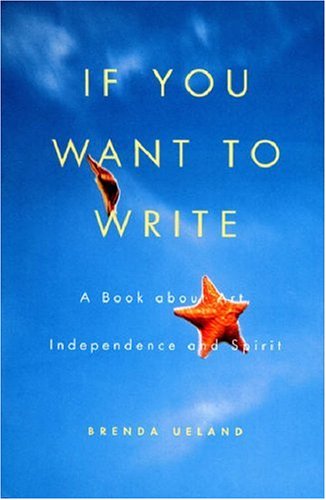
If You Want to Write
We've been talking about writing and ways to increase productivity in this recent series of posts. I'd like to take a little side-trip at this point into the realm of creativity and inspiration.

The title of this post is the title of a book I stumbled across a while ago. Written by Brenda Ueland in 1938, it is described by Carl Sandburg as "the best book ever written about how to write". For my money, it's the best book ever written about creativity and inspiration--and how to nurture them. During her 93 years, Ueland published six million words. The book, "If You Want to Write", contains not only her philosophy about writing, but many examples and inspirational stories from her writing classes and workshops, in which she taught professors, housewives, and factory workers alike.
Ueland's advice is clearly useful for fiction writers, but do any of her insights have relevance for us as technical writers? I think so, which is why I'm taking the time to discuss her book. Everything she has to say about how to tap into one's genius is relevant to us, not only in writing but in stimulating creative ideas and innovative ways to pursue them.
Ueland taught all kinds of people to write: rich and poor, educated and those who had never been to high school, housewives and salesmen, professors and students. This is what she learned: "everybody is talented, original and has something important to say". Some of her most amazing examples of enthralling, inspired writing were penned by timid stenographers, lonely unemployed women, and housewives who had no prior training or experience. Ueland compares these writings to those in glossy magazines of the time written by highly paid writers--boring, uninspired drivel. The message for us scientists and students of science is that we can just as readily tap into our creative nature and produce something original and worthwhile. How did Ueland get this result from her students?
Here are a few nuggets:

The imagination works slowly and quietly. You should not expect inspiration to come like a bolt of lightning. Instead, you may spend a lot of time just sitting and thinking or daydreaming. If you are always busy, talking to other people, running around carrying out tasks, or always plugged into your iPod, your thoughts have no chance to grow and develop into creative ideas. Ueland encourages people to dare to be idle for a time, not always pressed or driven to accomplish something. I have a long commute from home to work (2 hours roundtrip) during which I just think. I do not listen to the radio or to "books on tape" (which is always what people encourage me to do). Ideas don't always come to me during the drive--the drive allows my thoughts to swirl around and begin to gel. Suddenly, at some later time, the creative idea will pop into my head.
Be in the present. When you sit down to write or to contemplate a research project, no logical thought comes to mind. You try to force thought, but paralysis sets in (sounds familiar). You begin to doubt yourself and to suspect that your mental abilities must be limited because you have no good ideas. Ultimately, you give up and go do some menial task: washing glassware or filing reprints, and only then you have some original, illuminating thoughts. You are self conscious in the first instance, not so in the second.
Be careless, reckless. Many novice writers start out being pretentious and use a lot of jargon and overblown phrases because they think this is a sign of good writing. Actually, it is boring and annoying to read such writing. Don't worry about what other people will think. Write simply and honestly. Technical papers that are dense and take a tremendous effort to understand are not a pleasure to read. Why would any scientist aspire to write such things? You are writing about science, a fascinating topic. Why not show in your writing how interesting, thought-provoking, and exciting your findings are?
Develop true self-confidence. Ueland: "..self-confidence never rests, but is always working and striving, and it is always modest and grateful and open to what is new and better." That is one of my favorite definitions of self-confidence. It is different from conceit, which is "a static state where you rest on some past (or fancied) accomplishment." Today, conceit is additionally colored by a sense of entitlement, based not on any accomplishment or positive traits, but simply on the belief that adulation is deserved. True self-confidence will carry you safely through criticism of your work, rejection of your papers, and various other disappointments. Conceit will fail you in such instances.
Be microscopically truthful. We often write things by rote, repeating the same boring information in our introductions and methods. We may repeat what we've read in other papers a dozen times, trying to reword it in a fresh way. We may be stumped as to how to describe our results in an interesting way. To write in a microscopically truthful way is to write "...with exquisite and completely detached exactness and truthfulness." You say precisely what you observed and what you think about it, even if it sounds awkward at first. Don't imagine what someone else might say or expect you to say. Think about your topic, your experiment and write about it in your own eloquent way, providing those precise details that make it uniquely yours.
Keep a diary. Or a blog. Here's Ueland: "Yes, from writing a diary I am sure that I have learned things. But I don't think the learning process would have moved on so well, if I had not written down today's minute revelation. And that is why, if you want to write, you might try it." I think she would have approved of blogs.
Write what is next. Here's Ueland again: "And so try this yourself when you write an article. Do not worry about the whole. Write what is next, the idea that comes now at the moment. Don't be afraid. For there will be more coherence and arrangement in your thoughts than you think."
The essential message here is to nurture your creative side by spending time 1. with your thoughts and 2. writing unselfconsciously--in a diary or a blog.
If you never spend time alone thinking and are always listening to music, commentary, and other distractions, creative ideas are less likely to develop. Your head becomes so filled with other people's thoughts and opinions, that there is no room for yours. Some people are afraid to be alone with their thoughts--as if something dreadful might jump out. But such solitary musings are essential to writing well.
To write well, you must also practice it regularly and deliberately. Keeping a diary of daily events, thoughts, dreams, or insights helps develop an ease with writing unselfconsciously. There is no pressure to produce something witty or wise in a diary, so you can learn to easily express yourself in writing. Even writing about mundane things can produce some amazing results, if you let yourself go and write what is in your heart. Blogging is a step further in which you put your writing in the public eye and invite feedback. If you look at your favorite blogs--the ones that really speak to you--you will see that the author is writing unselfconsciously.
The next post describes in more detail how to write spontaneously.
Ueland's advice is clearly useful for fiction writers, but do any of her insights have relevance for us as technical writers? I think so, which is why I'm taking the time to discuss her book. Everything she has to say about how to tap into one's genius is relevant to us, not only in writing but in stimulating creative ideas and innovative ways to pursue them.
Ueland taught all kinds of people to write: rich and poor, educated and those who had never been to high school, housewives and salesmen, professors and students. This is what she learned: "everybody is talented, original and has something important to say". Some of her most amazing examples of enthralling, inspired writing were penned by timid stenographers, lonely unemployed women, and housewives who had no prior training or experience. Ueland compares these writings to those in glossy magazines of the time written by highly paid writers--boring, uninspired drivel. The message for us scientists and students of science is that we can just as readily tap into our creative nature and produce something original and worthwhile. How did Ueland get this result from her students?
Here are a few nuggets:
Be in the present. When you sit down to write or to contemplate a research project, no logical thought comes to mind. You try to force thought, but paralysis sets in (sounds familiar). You begin to doubt yourself and to suspect that your mental abilities must be limited because you have no good ideas. Ultimately, you give up and go do some menial task: washing glassware or filing reprints, and only then you have some original, illuminating thoughts. You are self conscious in the first instance, not so in the second.
Be careless, reckless. Many novice writers start out being pretentious and use a lot of jargon and overblown phrases because they think this is a sign of good writing. Actually, it is boring and annoying to read such writing. Don't worry about what other people will think. Write simply and honestly. Technical papers that are dense and take a tremendous effort to understand are not a pleasure to read. Why would any scientist aspire to write such things? You are writing about science, a fascinating topic. Why not show in your writing how interesting, thought-provoking, and exciting your findings are?
Develop true self-confidence. Ueland: "..self-confidence never rests, but is always working and striving, and it is always modest and grateful and open to what is new and better." That is one of my favorite definitions of self-confidence. It is different from conceit, which is "a static state where you rest on some past (or fancied) accomplishment." Today, conceit is additionally colored by a sense of entitlement, based not on any accomplishment or positive traits, but simply on the belief that adulation is deserved. True self-confidence will carry you safely through criticism of your work, rejection of your papers, and various other disappointments. Conceit will fail you in such instances.
Be microscopically truthful. We often write things by rote, repeating the same boring information in our introductions and methods. We may repeat what we've read in other papers a dozen times, trying to reword it in a fresh way. We may be stumped as to how to describe our results in an interesting way. To write in a microscopically truthful way is to write "...with exquisite and completely detached exactness and truthfulness." You say precisely what you observed and what you think about it, even if it sounds awkward at first. Don't imagine what someone else might say or expect you to say. Think about your topic, your experiment and write about it in your own eloquent way, providing those precise details that make it uniquely yours.
Keep a diary. Or a blog. Here's Ueland: "Yes, from writing a diary I am sure that I have learned things. But I don't think the learning process would have moved on so well, if I had not written down today's minute revelation. And that is why, if you want to write, you might try it." I think she would have approved of blogs.
Write what is next. Here's Ueland again: "And so try this yourself when you write an article. Do not worry about the whole. Write what is next, the idea that comes now at the moment. Don't be afraid. For there will be more coherence and arrangement in your thoughts than you think."
The essential message here is to nurture your creative side by spending time 1. with your thoughts and 2. writing unselfconsciously--in a diary or a blog.
If you never spend time alone thinking and are always listening to music, commentary, and other distractions, creative ideas are less likely to develop. Your head becomes so filled with other people's thoughts and opinions, that there is no room for yours. Some people are afraid to be alone with their thoughts--as if something dreadful might jump out. But such solitary musings are essential to writing well.
To write well, you must also practice it regularly and deliberately. Keeping a diary of daily events, thoughts, dreams, or insights helps develop an ease with writing unselfconsciously. There is no pressure to produce something witty or wise in a diary, so you can learn to easily express yourself in writing. Even writing about mundane things can produce some amazing results, if you let yourself go and write what is in your heart. Blogging is a step further in which you put your writing in the public eye and invite feedback. If you look at your favorite blogs--the ones that really speak to you--you will see that the author is writing unselfconsciously.
The next post describes in more detail how to write spontaneously.
Subscribe to:
Posts (Atom)