Some of you may be familiar with a new trend at some science journals: video abstracts in which the authors explain their findings on camera, sometimes enhanced with animations or other visually-rich media. A few journals routinely accept and publish video abstracts prepared by authors. Two of these are the New Journal of Physics and Cell, and you can see examples of their video abstracts by going to their websites.
These video abstracts are typically short (3-5 minutes) and often published on a video-sharing site such as YouTube, rather than on the journal website. By providing video summaries on such accessible and popular video-sharing sites, authors make their work widely available. Anyone can access these media without having a subscription or paying a fee.
In addition to the above journals, several other journals are currently "experimenting" with video abstracts. This movement reflects the overall trend in multimedia communication of information on the internet, in combination with the availability of digital devices and software for creating and sharing video.
What are the advantages for an author? By using video, authors can explain their work in a way that they are not able to do in print, such as showing footage of their laboratory setups or methods, field sites, and/or study organisms. The authors are able to provide a more personal explanation of their findings and put them into a broader perspective. By posting a video on the internet, the author can raise the visibility of themselves and their research because search engines rank video high in comparison to text-only descriptions (especially if it's the only video out there on the topic). People searching for information on a topic will be more likely to find their video abstract, and the video will lead viewers to the technical paper. Also, if the video is published on YouTube, the authors are free to embed their video abstract on their own websites, something they often cannot do with their journal publication because of copyright restrictions.
What are the advantages for the reader? Video can provide a richer, more interactive experience for a reader. For non-specialist readers, a video in which the authors explain their work in everyday language would provide greater insight, spark their curiosity about the topic, and possibly encourage them to learn more about it. For example, as a scientist, I'm interested in keeping up with major discoveries in other fields. Although I'm not likely to read a technical paper about the Higgs boson, I would watch a video that explains what's been discovered and what it means.
Are video abstracts just a fad or will it become a common practice at science journals? Hard to say.
Some video abstracts are well-done:
Others are pretty awful:
Some science disciplines (physics) seem to be getting on the multimedia bandwagon faster than others. Whatever the future of video abstracts, we are clearly in a learning phase. Many of my colleagues have never even heard of video abstracts and expressed no interest in doing one, even if offered the opportunity. Students seemed to be more receptive to the idea, and I suspect this is because they are more technically-savy and accustomed to watching YouTube videos than most of their professors.
If video abstracts become standard practice, authors will need to either develop some skills at creating such videos or will need access to multimedia specialists who can help them. My guess is that most authors will end up paying someone, either at their institution or a free-lancer, to produce a video abstract. Possibly some journals will offer the service at a price. It will be interesting to see how this practice evolves.
For more on the video revolution in science communication, see this video:
Image Credit: modified photograph from USAID
Showing posts with label science writing. Show all posts
Friday, April 19, 2013
Monday, February 14, 2011
Three Easy Steps
We're talking about good writing habits. In the last post, I emphasized the importance of developing and sticking to a regular writing schedule. In the next few posts, we'll take a closer look at how scientists learn to write...in particular, how they develop a writing schedule.
As I look back on my science career, my satisfaction over the body of work that I've published is somewhat dampened by the knowledge of all those papers (and books) that were never written. I've got the data; it's filed away in lab and field notebooks, spreadsheets, and half-finished manuscripts. In fact, I would estimate that for every paper I've published, there are five more that were never written. Most of my colleagues who are the same age would admit to the same. A lot of the unpublished data were collected during and just after I finished my Ph.D. I was bursting with ideas, questions, and energy. In some cases, these were side-projects that I carried out alongside a primary research goal. In others, they were stand-alone projects that were separately funded. All of these studies were completed, but the work was never written up--for various reasons. Often, it was lack of time--more specifically, lack of a period of time scheduled in the project for writing. Back then, I thought the writing should take place after all data were collected. A typical project might have three months set aside at the end of the project, which was designated for writing things up. However, what usually happened was that I had to spend those three months completing some aspect of the research, redoing some analysis, writing the next grant proposal, and/or initiating the next research project. There never seemed to be time for writing manuscripts.
I now think that I could have taken most of this research to its logical conclusion--publication--if I had only developed better writing skills and habits early on. In the last post, I made the point that having a regular writing schedule (e.g., 2 hours per day, every weekday) was essential for sustained productivity. Part of the problem I had during my early research years was that I believed what I had been taught about how to write up research. My graduate advisers taught me the following procedure: design the study, conduct the study, write up the study. In that order. Only when I had all data in hand should I begin thinking about writing. Three easy steps, taken in sequential order. Sounds logical. It was never suggested to me that I could (or should) begin writing the moment I had an idea for a study.
As I look back on my science career, my satisfaction over the body of work that I've published is somewhat dampened by the knowledge of all those papers (and books) that were never written. I've got the data; it's filed away in lab and field notebooks, spreadsheets, and half-finished manuscripts. In fact, I would estimate that for every paper I've published, there are five more that were never written. Most of my colleagues who are the same age would admit to the same. A lot of the unpublished data were collected during and just after I finished my Ph.D. I was bursting with ideas, questions, and energy. In some cases, these were side-projects that I carried out alongside a primary research goal. In others, they were stand-alone projects that were separately funded. All of these studies were completed, but the work was never written up--for various reasons. Often, it was lack of time--more specifically, lack of a period of time scheduled in the project for writing. Back then, I thought the writing should take place after all data were collected. A typical project might have three months set aside at the end of the project, which was designated for writing things up. However, what usually happened was that I had to spend those three months completing some aspect of the research, redoing some analysis, writing the next grant proposal, and/or initiating the next research project. There never seemed to be time for writing manuscripts.
I now think that I could have taken most of this research to its logical conclusion--publication--if I had only developed better writing skills and habits early on. In the last post, I made the point that having a regular writing schedule (e.g., 2 hours per day, every weekday) was essential for sustained productivity. Part of the problem I had during my early research years was that I believed what I had been taught about how to write up research. My graduate advisers taught me the following procedure: design the study, conduct the study, write up the study. In that order. Only when I had all data in hand should I begin thinking about writing. Three easy steps, taken in sequential order. Sounds logical. It was never suggested to me that I could (or should) begin writing the moment I had an idea for a study.
Friday, December 18, 2009
CPR for Bad Scientific Writing
When your advisor or a peer reviewer writes on your paper comments such as, “unclear” or “ambiguous” or “obtuse”, do you think that s/he:a) is just picking on you
b) doesn’t understand your unique “style”
c) is making a subjective judgment
d) might be right
If you picked d, you have taken the first step toward becoming a good writer.
It’s true that some professors are a bit obsessed with grammar and punctuation, but the real obstacle to good scientific writing is poor style. In fact, a paragraph with proper punctuation and grammar might be utterly incomprehensible, whereas one that has not followed grammatical rules is perfectly clear in its message. Consider the following grammatically correct sentence:
Increasing foreign competition and technological change, in a variety of forms, are now, as they always have been, disrupting various well-established patterns in terms of industrial organization.
Difficult to understand, right? That’s because the style is poor.
Next, consider an ungrammatical, but quite understandable sentence:
The material applied to the blades of wind turbines age rapidly in tests.
It should be obvious that the first example would be much more difficult for an editor to fix than the second example. I’m not saying that you should neglect grammar and punctuation. My point is that style is crucial.
What you should strive for, above all else, is clarity in your writing style. Clarity is an aspect of style that is particularly relevant to scientific writing, but is one of the most difficult for some scientists to achieve. So how do you develop clarity and other stylistic goals?
If you are having extreme difficulty, there are a few things you can do immediately. By attending to three aspects of writing: concision, precision, and revision (CPR), you can quickly improve your technical writing.
Concision
Begin by eliminating all unnecessary or meaningless words: “it is noted”, “as we have seen”, “in terms of”. By dropping extraneous words, we not only reduce the wordiness, but can better see what other revisions are necessary.
Precision
Precision can be improved by selecting those phrases that are not exact in their meaning and rewriting them. Pay particular attention to those noun clusters that scientists are so fond of: “nutrient use efficiency respiratory rates” or “plant trait plasticity variation” The best way to improve a paragraph’s meaning is to choose clear, meaningful nouns and follow them with verbs that explain the noun’s meaning in the sentence: “Plasticity of plant traits varies among species.”
Revision
After cleansing our writing of excess verbiage and improving the meaning of the remaining words, we can now revise and improve the style of the writing. The preceding posts provide guidance as to how to make transitions from one sentence to the next and to meet reader expectations in sentence structure. However, some very simple approaches such as using connecting words (this, also, as well as, recently) will go a long way toward improving the reader’s understanding.
To take the next steps in improving your technical writing skills, you must delve into writing guides, particularly ones that focus on style and clarity. The best known of these is The Elements of Style by Strunk and White. There are many others readily found on the internet.
Monday, December 14, 2009
Closing the Gap
This is the final post in the series on the "Science of Scientific Writing" by the authors cited above. The objective of their paper was to introduce some principles of writing that will help to close the gap between writer interpretation and reader comprehension.
In the previous posts, we've worked through five principles designed to improve comprehension of scientific writing. There are two more principles that provide further guidance in writing to meet reader expectations. Here's number six:
In general, provide context for your reader before asking that reader to consider anything new.
When the writer fails to provide context, the reader is left floundering. Writers often neglect to provide context because the information seems obvious to them and they fail to recognize that the reader may not be similarly acquainted.
The earthquake example we considered in previous posts did not provide context for the abstract, but instead jumped right into the technical information:
Large earthquakes along a given fault segment do not occur at random intervals because it takes time to accumulate the strain energy for the rupture. The rates at which tectonic plates move and accumulate strain at their boundaries are approximately uniform....rest of abstract.
Isabella's version added the necessary context by explaining in the first sentence that this discourse was about how strain buildup causes earthquakes:
Earthquakes occur when a certain amount of strain caused by the movement of tectonic plates has been accumulated.
The reader is now prepared mentally to consider more technical aspects of earthquake frequency. As the writer proceeds through the technical information, she should provide context for each new bit of information introduced in the piece. This approach requires that the writer ask herself if the reader will understand what is being introduced in each succeeding sentence or if some explanation or backward linkage to "old information" is required.
We've now come to the final principle, which is:
In general, try to ensure that the relative emphases of the substance coincide with the relative expectations for emphasis raised by the structure.
The foregoing principles relate to sentence structure and how it sets up reader expectations. For example, the reader expects to see the person or thing that the discourse is about in the "topic position" near the beginning of the sentence.
Squirrels hide acorns. The topic is squirrels.
Acorns are hidden by squirrels. The topic is acorns (or oak trees, seed dispersal).
The writer must choose the appropriate sentence structure that is consistent with both the material being presented and with reader expectations. If the reader has been told that the discourse is about acorns and seed dispersal, then the second sentence provides the substance to be emphasized in the expected position in the sentence.
We've now covered all seven principles of scientific writing:
1. Follow a grammatical subject as soon as possible with its verb.
2. Place in the stress position the "new information" you want the reader to emphasize.
3. Place the person or thing whose "story" a sentence is telling at the beginning of the sentence, in the topic position.
4. Place appropriate "old information" (material already stated in the discourse) in the topic position for linkage backward and contextualization forward.
5. Articulate the action of every clause or sentence in its verb.
6. In general, provide context for your reader before asking that reader to consider anything new.
7. In general, try to ensure that the relative emphases of the substance coincide with the relative expectations for emphasis raised by the structure.
Keep in mind that these are principles, not rules. You will not necessarily be able to apply all seven in every sentence or even in every paragraph. In some cases, you may have to make a choice between two structures. Also, some highly skilled writers can violate reader expectations quite effectively, for example to make a memorable point.
The key is to recognize when you consistently violate reader expectations in one or more of these principles. A writer who continually fails to put new information in the stress position during early writing attempts typically continues that structural pattern in subsequent writing. It becomes a habit that is difficult to break, particularly if the writer is unaware of how it affects reader comprehension. If you get reviewer comments that your writing is "unclear" or "ambiguous" on a frequent basis, you may be violating one of these principles.
As a further exercise, I suggest you select a couple of papers in your field--one that you think is particularly good (clear, understandable, compelling) and another that is difficult to follow, that requires frequent rereading of sentences to understand. From those papers select a paragraph or two and dissect them based on what we've covered in this series. I think you'll find that the better paper adheres to the seven principles, and the difficult paper violates one or more of them. By doing this exercise with someone else's writing, you develop an "eye" for discourse that needs revision to improve reader comprehension. Once you've become proficient at spotting problematic structure in other writings, then you are prepared to tackle your own writing.
Editing your own writing is not as easy as it sounds. It's easy to become enamored of your own words and sentence structures and are loathe to change them. I find this infatuation with one's own words quite insidious and difficult to overcome. Students are particularly prone to this condition. They think that every sentence is a pearl of wisdom that needs no revision. So they are quite shocked to get their work returned, and it is covered with "red ink". Some are so obstinate that they refuse to make the suggested changes (which is why I always keep a copy of my marked-up version to compare with their revision). Such students never improve and continue to have increasingly difficult problems. Other students learn quickly because they take the time to consider what their mistakes were and why they need revision.
Even seasoned writers have this problem of falling in love with their writing (maybe even more so than others). However, that sentence, which you worked so hard to produce and that are now so proud of, may be confusing to the reader. If it is, it needs to be revised. You must learn to be ruthless with your own writing. If you find yourself balking at changing a sentence you know to be flawed, tell yourself that the new sentence will also be your creation and an even better one than the original. I also agree with the common advice of putting your writing away for awhile to get some distance from it. By distancing yourself, you not only can take a fresh look at your writing at a later date, but you minimize your feeling of ownership. With a less possessive attitude, you can more easily rearrange and discard words.
I hope readers have learned something in this series. I know I have. It's made me take an even closer look at my writing tendencies and in particular my favorite sentence structures that need improvement. I still find myself falling back into bad habits on occasion, but now I can more easily spot those indiscretions. By becoming aware of how poor constructions affect reader comprehension, we can resist and consciously change such habits.
Thursday, December 10, 2009
Scientific Writing Principles Cont'd
This post continues a series on principles of scientific writing, as proposed by Gopen and Swan (1990). We've already covered the first three principles (to understand the material in this post, you need to read the previous material starting here).Readers expect a unit of discourse (a sentence) to be a story about whoever or whatever is mentioned first, i.e., in the topic position. The example I've been using is "squirrels hide acorns" versus "acorns are hidden by squirrels". The first version suggests the focus is on squirrels, whereas the second one indicates the focus is on oak trees and/or seed dispersal. These examples also illustrate active versus passive voice.
The importance of the topic position forms the third principle of scientific writing:
Place the person or thing whose "story" a sentence is telling at the beginning of the sentence, in the topic position.
Another expectation for material in the topic position is that it provides a linkage backward (to previous information). Previously introduced material is called "old information", and its placement in the topic position helps readers follow the author's logic. Now we consider the fourth principle, which can be stated this way:
Place appropriate "old information" (material already stated in the discourse) in the topic position for linkage backward and put in the stress position the information you want the reader to emphasize (for contextualization forward).
Have we done this with our example? In the abstract below, I've highlighted in pink the "old information" that should be in the topic position. New information (yellow) should be in the "stress position" for contextualization forward.
The discrete-dipole approximation (DDA) is [often] used in scattering calculations, but its accuracy is unclear in relation to that of other computational methods such as complex-conjugate gradient algorithms and fast-Fourier-transform methods. The accuracy of the DDA was tested in computations of scattering and absorption by different targets: isolated, homogeneous spheres and two contiguous spheres. For dielectric materials (¦m¦ ≲ 2), the DDA permitted calculations that were accurate to within a few percent.
We've done a pretty good job of placing the old information in the topic position for linkage backward and new information in the stress position. The only quibble might be with the phrase "For dielectric materials". This term is suddenly introduced without explanation, but presumably would be understandable to experts in this field.
To illustrate this principle further, I will use the example given in Gopen and Swan:
Large earthquakes along a given fault segment do not occur at random intervals because it takes time to accumulate the strain energy for the rupture. The rates at which tectonic plates move and accumulate strain at their boundaries are approximately uniform. Therefore, in first approximation, one may expect that large ruptures of the same fault segment will occur at approximately constant time intervals. If subsequent main shocks have different amounts of slip across the fault, then the recurrence time may vary, and the basic idea of periodic mainshocks must be modified. For great plate boundary ruptures the length and slip often vary by a factor of 2. Along the southern segment of the San Andreas fault the recurrence interval is 145 years with variations of several decades. The smaller the standard deviation of the average recurrence interval, the more specific could be the long term prediction of a future mainshock.
At first read, one has the impression that this is a fairly straightforward description of earthquakes and tectonic plates and is written well. However, by the time we reach the end of the passage we are feeling somewhat befuddled and would be hard-pressed to say exactly what the point of this paragraph was. Gopen and Swan analyze this example and conclude that the main problem is that virtually every piece of new information makes its first appearance in the spot we expect to find the old, familiar information.
If your writing continually begins sentences with new information and ends with the old information, you will definitely disorient your readers and reduce comprehension, as the above example does. So how would one go about fixing the above paragraph? Take a second look at the fourth principle stated above and see if you can rewrite the paragraph.
I'll provide the revision suggested by Gopen and Swan in the next post along with some additional explanations.
Tuesday, December 8, 2009
More Principles of Scientific Writing
In the last post, we covered the first principle of scientific writing dealing with subject-verb separation. We are using an example of scientific writing (an abstract) selected randomly from the literature to examine principles of writing proposed by Gopen and Swan (1990). In this post, we'll consider the "stress position" and the "topic position" and how to use these concepts to improve our writing. The Stress Position
Readers expect to see the point of a sentence appear in what is known as the "stress position", i.e., the place of emphasis in the sentence. The idea here is that readers naturally look for the “pay-off” at the end of a sentence. We begin reading a sentence with a sense of expectation that builds as we approach the reward at the end of the sentence. Our original example does not do this:
The discrete-dipole approximation (DDA) for scattering calculations, including the relationship between the DDA and other methods, is reviewed. Computational considerations, i.e., the use of complex-conjugate gradient algorithms and fast-Fourier-transform methods, are discussed.
Instead, the first two sentences in the original example end limply with “is reviewed” and “are discussed”. These sentences leave the reader feeling annoyed by promising, but not delivering information. On top of this, the sentences are more difficult to follow (because of undue separation of subject and verb) and are not very interesting (being written in passive voice).
To revise, I moved the verbs closer to their subjects and tried to place the material to be emphasized at the end of the sentence:
We review the discrete-dipole approximation (DDA) used in scattering calculations and its relationship to other methods. Other computational considerations include the complex-conjugate gradient algorithms and fast-Fourier-transform methods.
The stress position is where the reader needs and expects closure and the information that is being emphasized ("...complex-conjugate gradient algorithms and fast-Fourier-transform methods.").
We can summarize the first aspect of the stress position as: "Save the best for last." However, we also have to worry about the beginning of the sentence: the topic position.
The Topic Position
The topic position provides the reader with perspective. Whatever begins a sentence is what the reader interprets as being what the story is about: "Squirrels hide acorns" vs. "Acorns are hidden by squirrels". Both sentences are correct, but the first indicates to the reader that the discourse is focused on squirrels, whereas the second emphasizes acorns. If you use the first version, but your topic is actually oak trees (or seed dispersal), then you will confuse your readers.
This concept of topic position gets tricky when we use first person in technical writing. With sentences such as: "We review several methods for computing light scattering." or "We studied the role of salinity in determining distribution of coastal plant species.", the emphasis is placed on us, the investigators, rather than on the topic under investigation. So let's reconsider my revision above. The second sentence seems fine with respect to subject-verb separation, the stress position, and the topic position:
Other computational considerations include the complex-conjugate gradient algorithms and fast-Fourier-transform methods.
The topic ("computational considerations") is introduced to the reader at the beginning of the sentence. The information that is to be emphasized ("complex-conjugate gradient algorithms and fast-Fourier-transform methods") is placed at the end of the sentence, where the reader expects it. And the subject and verb are in close proximity ("considerations include").
The first sentence, however, has the problem of emphasizing the authors ("We review...") instead of the science topic. This first-person style is certainly acceptable and not a major problem, in my opinion, if it is used sparingly. But if we wanted to revise this sentence to adhere to the third principle, how would we do it? Here is one possibility (I'm making some assumptions here, being unfamiliar with the topic, but it illustrates the point):
The discrete-dipole approximation (DDA) is [often] used in scattering calculations, but its accuracy is unclear in relation to that of other methods.
This sentence now tells the reader what the topic is (DDA), places the point of the sentence (its questionable accuracy) in the stress position toward the end of the sentence, and also explains the "problem" that the paper will address. All the subjects are in close proximity to their verbs. Although the sentence is now written in passive voice, this is the choice one must make to ensure the reader knows what the actual topic is (acorns vs. squirrels).
The first-person version "We review..." is perfectly fine, as is "This study provides...". However, the new version puts the actual topic (DDA) in the topic position and also tells us more explicitly why the study needed to be done. Another option would be to combine the first two sentences:
The discrete-dipole approximation (DDA) is [often] used in scattering calculations, but its accuracy is unclear in relation to that of other computational methods such as complex-conjugate gradient algorithms and fast-Fourier-transform methods.
This sentence is quite long, but flows well and is easy to understand. It also prepares the reader for the next sentences that explain what was done and what the results were:
The accuracy of the DDA was tested in computations of scattering and absorption by different targets: isolated, homogeneous spheres and two contiguous spheres. For dielectric materials ((¦m¦ ≲ 2), the DDA permitted calculations that were accurate to within a few percent.
We now have covered the first three principles proposed by Gopen and Swan:
1. Follow a grammatical subject as soon as possible with its verb.
2. Place in the stress position the "new information" you want the reader to emphasize.
3. Place the person or thing whose "story" a sentence is telling at the beginning of the sentence, in the topic position.
Saturday, December 5, 2009
Scientific Writing Secrets Revealed!
This post continues the series on writing, but focuses more specifically on scientific writing. Before your eyes glaze over, let me hasten to add that this will not be your routine discussion of grammar, punctuation, and style. I’m assuming that readers have a basic grasp of these skills.Instead, I’ll be reviewing guidelines given in a paper by Gopen and Swan (1990) called “The Science of Scientific Writing”. In this paper, they analyze what it is about scientific writing that makes it so difficult to read (and enjoy). The authors don't stop there, but go on to develop clear rules for avoiding incomprehensible writing. The underlying message of the paper can be summarized thus:
“If the reader is to grasp what the writer means, the writer must understand what the reader needs.”
Gopen and Swan go on to state that the rhetorical principles they outline produce “clarity in communication without oversimplifying scientific issues.” They argue that the results [of applying these principles] are not cosmetic, but that “improving the quality of writing actually improves the quality of thought.”
Amen.
If you are interested in reading their paper, the reference is given at the end of this post. However, if you’d rather not read it, I’ll be giving the CliffsNotes version. What I will do is take the same approach they did and use an example from a technical paper to illustrate their principles. It’s something of an exercise for me, but you can follow along and see how well we both do in figuring out how to improve the writing in the selected excerpt.
I selected an example at random from the internet. I could have picked anything, but this was the first to pop up. It is an abstract from a journal focused on optics, a topic I know absolutely nothing about but that appears to be fraught with convoluted, jargon-ridden language. By the way, my example is not nearly as dense and full of jargon as the one Gopen and Swan use. Here it is:
The discrete-dipole approximation (DDA) for scattering calculations, including the relationship between the DDA and other methods, is reviewed. Computational considerations, i.e., the use of complex-conjugate gradient algorithms and fast-Fourier-transform methods, are discussed. We test the accuracy of the DDA by using the DDA to compute scattering and absorption by isolated, homogeneous spheres as well as by targets consisting of two contiguous spheres. It is shown that, for dielectric materials (¦m¦ ≲ 2), the DDA permits calculations of scattering and absorption that are accurate to within a few percent.
Here is my translation of the abstract: The authors reviewed the use of a computational method (DDA), tested its accuracy in computing light scattering and absorption by different types of spheres, and found the method to be highly accurate.
Most people would find this paragraph moderately difficult to understand, but not for the obvious reasons of technical jargon or lack of background in the field of study. So what is the problem?
The first problem is subject-verb separation. The first sentence places a string of words between the subject (“DDA”) and verb (“reviewed”). Any words placed between the subject and its verb are viewed by the reader as interruptions and of lesser importance. The reader must wait a long time to get to the verb and understand what the whole sentence is about. In the meantime, the reader may be mentally skipping over key information in an attempt to close the gap between subject and verb. Also, one wonders if DDA is used to calculate something or if its purpose is instead to scatter calculations around the room. The second sentence similarly interjects a string of words between subject and verb. These two sentences also state that something “is reviewed” and “is discussed”, a no-no in an abstract.
How would you go about fixing this subject-verb separation problem and write something that is more consistent with reader expectations? We're just focusing for now on the first two sentences of the example. Think about it, and I’ll provide my revision in the next post.
“Information is interpreted more easily and more uniformly if it is placed where most readers expect to find it.”
Gopen, G.D. and J.A. Swan. 1990. The science of scientific writing. American Scientist 78: 550-558.
Sunday, November 29, 2009
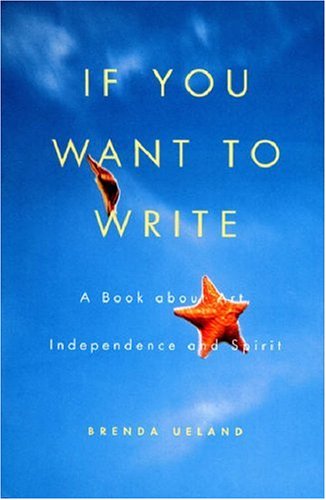
If You Want to Write
We've been talking about writing and ways to increase productivity in this recent series of posts. I'd like to take a little side-trip at this point into the realm of creativity and inspiration.
The title of this post is the title of a book I stumbled across a while ago. Written by Brenda Ueland in 1938, it is described by Carl Sandburg as "the best book ever written about how to write". For my money, it's the best book ever written about creativity and inspiration--and how to nurture them. During her 93 years, Ueland published six million words. The book, "If You Want to Write", contains not only her philosophy about writing, but many examples and inspirational stories from her writing classes and workshops, in which she taught professors, housewives, and factory workers alike.
Ueland's advice is clearly useful for fiction writers, but do any of her insights have relevance for us as technical writers? I think so, which is why I'm taking the time to discuss her book. Everything she has to say about how to tap into one's genius is relevant to us, not only in writing but in stimulating creative ideas and innovative ways to pursue them.
Ueland taught all kinds of people to write: rich and poor, educated and those who had never been to high school, housewives and salesmen, professors and students. This is what she learned: "everybody is talented, original and has something important to say". Some of her most amazing examples of enthralling, inspired writing were penned by timid stenographers, lonely unemployed women, and housewives who had no prior training or experience. Ueland compares these writings to those in glossy magazines of the time written by highly paid writers--boring, uninspired drivel. The message for us scientists and students of science is that we can just as readily tap into our creative nature and produce something original and worthwhile. How did Ueland get this result from her students?
Here are a few nuggets:
The imagination works slowly and quietly. You should not expect inspiration to come like a bolt of lightning. Instead, you may spend a lot of time just sitting and thinking or daydreaming. If you are always busy, talking to other people, running around carrying out tasks, or always plugged into your iPod, your thoughts have no chance to grow and develop into creative ideas. Ueland encourages people to dare to be idle for a time, not always pressed or driven to accomplish something. I have a long commute from home to work (2 hours roundtrip) during which I just think. I do not listen to the radio or to "books on tape" (which is always what people encourage me to do). Ideas don't always come to me during the drive--the drive allows my thoughts to swirl around and begin to gel. Suddenly, at some later time, the creative idea will pop into my head.
Be in the present. When you sit down to write or to contemplate a research project, no logical thought comes to mind. You try to force thought, but paralysis sets in (sounds familiar). You begin to doubt yourself and to suspect that your mental abilities must be limited because you have no good ideas. Ultimately, you give up and go do some menial task: washing glassware or filing reprints, and only then you have some original, illuminating thoughts. You are self conscious in the first instance, not so in the second.
Be careless, reckless. Many novice writers start out being pretentious and use a lot of jargon and overblown phrases because they think this is a sign of good writing. Actually, it is boring and annoying to read such writing. Don't worry about what other people will think. Write simply and honestly. Technical papers that are dense and take a tremendous effort to understand are not a pleasure to read. Why would any scientist aspire to write such things? You are writing about science, a fascinating topic. Why not show in your writing how interesting, thought-provoking, and exciting your findings are?
Develop true self-confidence. Ueland: "..self-confidence never rests, but is always working and striving, and it is always modest and grateful and open to what is new and better." That is one of my favorite definitions of self-confidence. It is different from conceit, which is "a static state where you rest on some past (or fancied) accomplishment." Today, conceit is additionally colored by a sense of entitlement, based not on any accomplishment or positive traits, but simply on the belief that adulation is deserved. True self-confidence will carry you safely through criticism of your work, rejection of your papers, and various other disappointments. Conceit will fail you in such instances.
Be microscopically truthful. We often write things by rote, repeating the same boring information in our introductions and methods. We may repeat what we've read in other papers a dozen times, trying to reword it in a fresh way. We may be stumped as to how to describe our results in an interesting way. To write in a microscopically truthful way is to write "...with exquisite and completely detached exactness and truthfulness." You say precisely what you observed and what you think about it, even if it sounds awkward at first. Don't imagine what someone else might say or expect you to say. Think about your topic, your experiment and write about it in your own eloquent way, providing those precise details that make it uniquely yours.
Keep a diary. Or a blog. Here's Ueland: "Yes, from writing a diary I am sure that I have learned things. But I don't think the learning process would have moved on so well, if I had not written down today's minute revelation. And that is why, if you want to write, you might try it." I think she would have approved of blogs.
Write what is next. Here's Ueland again: "And so try this yourself when you write an article. Do not worry about the whole. Write what is next, the idea that comes now at the moment. Don't be afraid. For there will be more coherence and arrangement in your thoughts than you think."
The essential message here is to nurture your creative side by spending time 1. with your thoughts and 2. writing unselfconsciously--in a diary or a blog.
If you never spend time alone thinking and are always listening to music, commentary, and other distractions, creative ideas are less likely to develop. Your head becomes so filled with other people's thoughts and opinions, that there is no room for yours. Some people are afraid to be alone with their thoughts--as if something dreadful might jump out. But such solitary musings are essential to writing well.
To write well, you must also practice it regularly and deliberately. Keeping a diary of daily events, thoughts, dreams, or insights helps develop an ease with writing unselfconsciously. There is no pressure to produce something witty or wise in a diary, so you can learn to easily express yourself in writing. Even writing about mundane things can produce some amazing results, if you let yourself go and write what is in your heart. Blogging is a step further in which you put your writing in the public eye and invite feedback. If you look at your favorite blogs--the ones that really speak to you--you will see that the author is writing unselfconsciously.
The next post describes in more detail how to write spontaneously.
The title of this post is the title of a book I stumbled across a while ago. Written by Brenda Ueland in 1938, it is described by Carl Sandburg as "the best book ever written about how to write". For my money, it's the best book ever written about creativity and inspiration--and how to nurture them. During her 93 years, Ueland published six million words. The book, "If You Want to Write", contains not only her philosophy about writing, but many examples and inspirational stories from her writing classes and workshops, in which she taught professors, housewives, and factory workers alike.
Ueland's advice is clearly useful for fiction writers, but do any of her insights have relevance for us as technical writers? I think so, which is why I'm taking the time to discuss her book. Everything she has to say about how to tap into one's genius is relevant to us, not only in writing but in stimulating creative ideas and innovative ways to pursue them.
Ueland taught all kinds of people to write: rich and poor, educated and those who had never been to high school, housewives and salesmen, professors and students. This is what she learned: "everybody is talented, original and has something important to say". Some of her most amazing examples of enthralling, inspired writing were penned by timid stenographers, lonely unemployed women, and housewives who had no prior training or experience. Ueland compares these writings to those in glossy magazines of the time written by highly paid writers--boring, uninspired drivel. The message for us scientists and students of science is that we can just as readily tap into our creative nature and produce something original and worthwhile. How did Ueland get this result from her students?
Here are a few nuggets:
The imagination works slowly and quietly. You should not expect inspiration to come like a bolt of lightning. Instead, you may spend a lot of time just sitting and thinking or daydreaming. If you are always busy, talking to other people, running around carrying out tasks, or always plugged into your iPod, your thoughts have no chance to grow and develop into creative ideas. Ueland encourages people to dare to be idle for a time, not always pressed or driven to accomplish something. I have a long commute from home to work (2 hours roundtrip) during which I just think. I do not listen to the radio or to "books on tape" (which is always what people encourage me to do). Ideas don't always come to me during the drive--the drive allows my thoughts to swirl around and begin to gel. Suddenly, at some later time, the creative idea will pop into my head.
Be in the present. When you sit down to write or to contemplate a research project, no logical thought comes to mind. You try to force thought, but paralysis sets in (sounds familiar). You begin to doubt yourself and to suspect that your mental abilities must be limited because you have no good ideas. Ultimately, you give up and go do some menial task: washing glassware or filing reprints, and only then you have some original, illuminating thoughts. You are self conscious in the first instance, not so in the second.
Be careless, reckless. Many novice writers start out being pretentious and use a lot of jargon and overblown phrases because they think this is a sign of good writing. Actually, it is boring and annoying to read such writing. Don't worry about what other people will think. Write simply and honestly. Technical papers that are dense and take a tremendous effort to understand are not a pleasure to read. Why would any scientist aspire to write such things? You are writing about science, a fascinating topic. Why not show in your writing how interesting, thought-provoking, and exciting your findings are?
Develop true self-confidence. Ueland: "..self-confidence never rests, but is always working and striving, and it is always modest and grateful and open to what is new and better." That is one of my favorite definitions of self-confidence. It is different from conceit, which is "a static state where you rest on some past (or fancied) accomplishment." Today, conceit is additionally colored by a sense of entitlement, based not on any accomplishment or positive traits, but simply on the belief that adulation is deserved. True self-confidence will carry you safely through criticism of your work, rejection of your papers, and various other disappointments. Conceit will fail you in such instances.
Be microscopically truthful. We often write things by rote, repeating the same boring information in our introductions and methods. We may repeat what we've read in other papers a dozen times, trying to reword it in a fresh way. We may be stumped as to how to describe our results in an interesting way. To write in a microscopically truthful way is to write "...with exquisite and completely detached exactness and truthfulness." You say precisely what you observed and what you think about it, even if it sounds awkward at first. Don't imagine what someone else might say or expect you to say. Think about your topic, your experiment and write about it in your own eloquent way, providing those precise details that make it uniquely yours.
Keep a diary. Or a blog. Here's Ueland: "Yes, from writing a diary I am sure that I have learned things. But I don't think the learning process would have moved on so well, if I had not written down today's minute revelation. And that is why, if you want to write, you might try it." I think she would have approved of blogs.
Write what is next. Here's Ueland again: "And so try this yourself when you write an article. Do not worry about the whole. Write what is next, the idea that comes now at the moment. Don't be afraid. For there will be more coherence and arrangement in your thoughts than you think."
The essential message here is to nurture your creative side by spending time 1. with your thoughts and 2. writing unselfconsciously--in a diary or a blog.
If you never spend time alone thinking and are always listening to music, commentary, and other distractions, creative ideas are less likely to develop. Your head becomes so filled with other people's thoughts and opinions, that there is no room for yours. Some people are afraid to be alone with their thoughts--as if something dreadful might jump out. But such solitary musings are essential to writing well.
To write well, you must also practice it regularly and deliberately. Keeping a diary of daily events, thoughts, dreams, or insights helps develop an ease with writing unselfconsciously. There is no pressure to produce something witty or wise in a diary, so you can learn to easily express yourself in writing. Even writing about mundane things can produce some amazing results, if you let yourself go and write what is in your heart. Blogging is a step further in which you put your writing in the public eye and invite feedback. If you look at your favorite blogs--the ones that really speak to you--you will see that the author is writing unselfconsciously.
The next post describes in more detail how to write spontaneously.
Labels:
brenda ueland,
creativity,
inspiration,
science writing
Tuesday, November 24, 2009
"I Hate Writing"
...was the emphatic statement made by a young acquaintance recently. Why do some find writing akin to passing kidney stones, whereas others absolutely love writing?
I think the answer is that people who abhor writing are people with writing problems, otherwise known as "writer's block". Contrary to what most people imagine writer's block to be, this affliction encompasses a whole suite of behaviors (and their accompanying thoughts) that many writers will recognize:
"I don't feel like writing [this morning, today, this week, this semester......the rest of my life]!"
"I have no ideas for this writing project."
"Even if I do a good job [writing], the reviewers will criticize it for some picayune reason."
"I write best when I'm under the gun."
"I wish I had never agreed to write this [paper, book chapter, review]."
"My writing will never be as good as my peers."
"I've got too much to do, and not enough time."
"I like to keep revising and perfecting, even after the paper is 'good enough'."
"What if I've made a mistake or left out an important reference?"
"I hate outlines."
"I can't write unless I can set aside large blocks of time when no deadlines are looming."
The above thoughts are from a test for writer's block in a book by R. Boice. The next series of posts is going to focus on writing problems. I hope to cover the causes of writing problems and some possible solutions for dealing with them. Some of this discussion will be based on information in resources such as the book mentioned above. Other insights will be based on my own experience and that of colleagues.
But first, a personal story to illustrate the fact that it is possible to go from near paralysis at the thought of writing to adoring writing (technical and non-technical) and everything about writing.
I was entering the home stretch of my master's program, having completed all my field and laboratory research and data analysis. It was time to write my thesis. I had not given much thought to this part of the process up to that point because I had been so busy taking classes, working in the lab, and admiring my data. The memory of the moment I sat down to begin writing is scorched into my brain. I was in my apartment at my desk, which faced a window overlooking a forested lot. Outside, the day was somewhat overcast, but still bright enough so that I did not need additional light. I had a new yellow legal pad and several new pencils sharpened to perfection (this was way before personal computers). I picked up a pencil, looked at the blank page, and.....froze. Not my mind though. It was going 90 miles an hour. Thoughts of how to start, what should I say, which parts should I include, what did my results mean--all tumbled around in my head. I could not focus on any single thought. The harder I tried, the worse it got. It was like trying to grasp an handful of sand. The more I squeezed, the faster the grains escaped.
I thought, "Oh, God. I'm stuck."
And I was, in more ways than one. For the next several hours, I sat there, paralyzed. I could not move. The longer I sat, the more difficult it was to move...to even imagine moving. The light grew dimmer as evening approached. Still I sat, staring at that yellow pad. My initial shock turned to despair. I began imagining how I was going to explain to my adviser that I couldn't finish my thesis. What would happen to me? Where would I go now? What about my dreams of becoming a scientist?
"Stop it! Stop thinking. Just sit and try to relax." I finally started talking to myself. I did not know what else to do. Eventually, I felt the need to go to the bathroom, but I could not move. I felt that if I moved from my spot that something dreadful would happen. "You've got to move," I said to myself. "Are you just going to sit there and wet your pants?" That thought galvanized me. I told myself all I had to do was to go to the bathroom and then I could come back and cower in the chair.
That was all it took. Once I started moving, I was able to gradually do other things. I eventually applied the same tactic to my writing--breaking it into small stages. I would set a tiny goal for myself in the beginning--write the first paragraph of the methods. Then another paragraph. I did not think about anything beyond the next small task. Before I knew it, I had a rough draft of the Materials and Methods done. Eventually, I finished my thesis and passed my defense.
That experience put me off writing for a long, long time--years in fact. In the coming posts, I'll describe how I transformed from that writing-averse person to a well-published author, now approaching my 100th publication. Along the way, I'll relate my experiences to known causes of writing problems and describe what can be done to resolve them... or avoid them in the first place.
I hope you'll share your writing problems and solutions.
I think the answer is that people who abhor writing are people with writing problems, otherwise known as "writer's block". Contrary to what most people imagine writer's block to be, this affliction encompasses a whole suite of behaviors (and their accompanying thoughts) that many writers will recognize:
"I don't feel like writing [this morning, today, this week, this semester......the rest of my life]!"
"I have no ideas for this writing project."
"Even if I do a good job [writing], the reviewers will criticize it for some picayune reason."
"I write best when I'm under the gun."
"I wish I had never agreed to write this [paper, book chapter, review]."
"My writing will never be as good as my peers."
"I've got too much to do, and not enough time."
"I like to keep revising and perfecting, even after the paper is 'good enough'."
"What if I've made a mistake or left out an important reference?"
"I hate outlines."
"I can't write unless I can set aside large blocks of time when no deadlines are looming."
The above thoughts are from a test for writer's block in a book by R. Boice. The next series of posts is going to focus on writing problems. I hope to cover the causes of writing problems and some possible solutions for dealing with them. Some of this discussion will be based on information in resources such as the book mentioned above. Other insights will be based on my own experience and that of colleagues.
But first, a personal story to illustrate the fact that it is possible to go from near paralysis at the thought of writing to adoring writing (technical and non-technical) and everything about writing.
I was entering the home stretch of my master's program, having completed all my field and laboratory research and data analysis. It was time to write my thesis. I had not given much thought to this part of the process up to that point because I had been so busy taking classes, working in the lab, and admiring my data. The memory of the moment I sat down to begin writing is scorched into my brain. I was in my apartment at my desk, which faced a window overlooking a forested lot. Outside, the day was somewhat overcast, but still bright enough so that I did not need additional light. I had a new yellow legal pad and several new pencils sharpened to perfection (this was way before personal computers). I picked up a pencil, looked at the blank page, and.....froze. Not my mind though. It was going 90 miles an hour. Thoughts of how to start, what should I say, which parts should I include, what did my results mean--all tumbled around in my head. I could not focus on any single thought. The harder I tried, the worse it got. It was like trying to grasp an handful of sand. The more I squeezed, the faster the grains escaped.
I thought, "Oh, God. I'm stuck."
And I was, in more ways than one. For the next several hours, I sat there, paralyzed. I could not move. The longer I sat, the more difficult it was to move...to even imagine moving. The light grew dimmer as evening approached. Still I sat, staring at that yellow pad. My initial shock turned to despair. I began imagining how I was going to explain to my adviser that I couldn't finish my thesis. What would happen to me? Where would I go now? What about my dreams of becoming a scientist?
"Stop it! Stop thinking. Just sit and try to relax." I finally started talking to myself. I did not know what else to do. Eventually, I felt the need to go to the bathroom, but I could not move. I felt that if I moved from my spot that something dreadful would happen. "You've got to move," I said to myself. "Are you just going to sit there and wet your pants?" That thought galvanized me. I told myself all I had to do was to go to the bathroom and then I could come back and cower in the chair.
That was all it took. Once I started moving, I was able to gradually do other things. I eventually applied the same tactic to my writing--breaking it into small stages. I would set a tiny goal for myself in the beginning--write the first paragraph of the methods. Then another paragraph. I did not think about anything beyond the next small task. Before I knew it, I had a rough draft of the Materials and Methods done. Eventually, I finished my thesis and passed my defense.
That experience put me off writing for a long, long time--years in fact. In the coming posts, I'll describe how I transformed from that writing-averse person to a well-published author, now approaching my 100th publication. Along the way, I'll relate my experiences to known causes of writing problems and describe what can be done to resolve them... or avoid them in the first place.
I hope you'll share your writing problems and solutions.
Subscribe to:
Posts (Atom)