Tuesday, December 8, 2009

More Principles of Scientific Writing

In the last post, we covered the first principle of scientific writing dealing with subject-verb separation.  We are using an example of scientific writing (an abstract) selected randomly from the literature to examine principles of writing proposed by Gopen and Swan (1990).  In this post, we'll consider the "stress position" and the "topic position" and how to use these concepts to improve our writing.

The Stress Position

Readers expect to see the point of a sentence appear in what is known as the "stress position", i.e., the place of emphasis in the sentence.  The idea here is that readers naturally look for the “pay-off” at the end of a sentence.  We begin reading a sentence with a sense of expectation that builds as we approach the reward at the end of the sentence.  Our original example does not do this:

The discrete-dipole approximation (DDA) for scattering calculations, including the relationship between the DDA and other methods, is reviewed. Computational considerations, i.e., the use of complex-conjugate gradient algorithms and fast-Fourier-transform methods, are discussed. 

Instead, the first two sentences in the original example end limply with “is reviewed” and “are discussed”.  These sentences leave the reader feeling annoyed by promising, but not delivering information. On top of this, the sentences are more difficult to follow (because of undue separation of subject and verb) and are not very interesting (being written in passive voice).

To revise, I moved the verbs closer to their subjects and tried to place the material to be emphasized at the end of the sentence:

We review the discrete-dipole approximation (DDA) used in scattering calculations and its relationship to other methods.  Other computational considerations include the complex-conjugate gradient algorithms and fast-Fourier-transform methods.


The stress position is where the reader needs and expects closure and the information that is being emphasized ("...complex-conjugate gradient algorithms and fast-Fourier-transform methods."). 
We can summarize the first aspect of the stress position as:  "Save the best for last."  However, we also have to worry about the beginning of the sentence:  the topic position.

The Topic Position

The topic position provides the reader with perspective.  Whatever begins a sentence is what the reader interprets as being what the story is about: "Squirrels hide acorns" vs. "Acorns are hidden by squirrels".  Both sentences are correct, but the first indicates to the reader that the discourse is focused on squirrels, whereas the second emphasizes acorns.  If you use the first version, but your topic is actually oak trees (or seed dispersal), then you will confuse your readers.

This concept of topic position gets tricky when we use first person in technical writing.  With sentences such as: "We review several methods for computing light scattering." or "We studied the role of salinity in determining distribution of coastal plant species.", the emphasis is placed on us, the investigators, rather than on the topic under investigation.  So let's reconsider my revision above.  The second sentence seems fine with respect to subject-verb separation, the stress position, and the topic position:

Other computational considerations include the complex-conjugate gradient algorithms and fast-Fourier-transform methods. 

The topic ("computational considerations") is introduced to the reader at the beginning of the sentence.  The information that is to be emphasized ("complex-conjugate gradient algorithms and fast-Fourier-transform methods") is placed at the end of the sentence, where the reader expects it.  And the subject and verb are in close proximity ("considerations include").

The first sentence, however, has the problem of emphasizing the authors ("We review...") instead of the science topic.  This first-person style is certainly acceptable and not a major problem, in my opinion, if it is used sparingly.  But if we wanted to revise this sentence to adhere to the third principle, how would we do it?  Here is one possibility (I'm making some assumptions here, being unfamiliar with the topic, but it illustrates the point):


The discrete-dipole approximation (DDA) is [often] used in scattering calculations, but its accuracy is unclear in relation to that of other methods.

This sentence now tells the reader what the topic is (DDA), places the point of the sentence (its questionable accuracy) in the stress position toward the end of the sentence, and also explains the "problem" that the paper will address. All the subjects are in close proximity to their verbs.  Although the sentence is now written in passive voice, this is the choice one must make to ensure the reader knows what the actual topic is (acorns vs. squirrels).

The first-person version "We review..." is perfectly fine, as is "This study provides...".  However, the new version puts the actual topic (DDA) in the topic position and also tells us more explicitly why the study needed to be done.  Another option would be to combine the first two sentences:

The discrete-dipole approximation (DDA) is [often] used in scattering calculations, but its accuracy is unclear in relation to that of other computational methods such as complex-conjugate gradient algorithms and fast-Fourier-transform methods.   

This sentence is quite long, but flows well and is easy to understand.  It also prepares the reader for the next sentences that explain what was done and what the results were:


The accuracy of the DDA was tested in computations of scattering and absorption by different targets: isolated, homogeneous spheres and two contiguous spheres. For dielectric materials ((¦m¦ ≲ 2), the DDA permitted calculations that were accurate to within a few percent.

We now have covered the first three principles proposed by Gopen and Swan:


1.    Follow a grammatical subject as soon as possible with its verb.

2.    Place in the stress position the "new information" you want the reader to emphasize. 


3.    Place the person or thing whose "story" a sentence is telling at the beginning of the sentence,  in the topic position.  


Monday, December 7, 2009

First Principle of Scientific Writing

We're talking about the principles of scientific writing introduced by Gopen and Swan (1990).  In contrast to rules of grammar, these principles are meant to be guidelines that the author uses in accordance with the writing situation and goals.  As we will see later, a choice sometimes must be made between two principles.

The previous post introduced the idea of subject-verb separation and gave an example (an abstract) that contained sentences in which the subject and verb were separated by a long string of words.  Here is the original example:

The discrete-dipole approximation (DDA) for scattering calculations, including the relationship between the DDA and other methods, is reviewed. Computational considerations, i.e., the use of complex-conjugate gradient algorithms and fast-Fourier-transform methods, are discussed. We test the accuracy of the DDA by using the DDA to compute scattering and absorption by isolated, homogeneous spheres as well as by targets consisting of two contiguous spheres. It is shown that, for dielectric materials (¦m¦ ≲ 2), the DDA permits calculations of scattering and absorption that are accurate to within a few percent.

I asked readers to think about how they would revise the writing to improve comprehension based on this first writing principle: minimize the distance between subject and verb.  I was hoping someone would take a stab at rewriting this abstract using the first principle.  So far, only Comrade PhysioProf has submitted a revision, which I reproduce here:

We review several aspects of the discrete-dipole approximation (DDA) for scattering calculations, including the relationship between the DDA and other methods. We discuss the computational considerations relating to DDA of complex-conjugate gradient algorithms and fast-Fourier-transform methods. We test the accuracy of the DDA by using the DDA to compute scattering and absorption by isolated, homogeneous spheres as well as by targets consisting of two contiguous spheres. Using these approaches, we demonstrate that for dielectric materials (¦m¦ ≲ 2), the DDA permits calculations of scattering and absorption that are accurate to within a few percent.

For comparison, here is my revision:

We review the discrete-dipole approximation (DDA) used in scattering calculations and its relationship to other methods.  Other computational considerations include the complex-conjugate gradient algorithms and fast-Fourier-transform methods.  The accuracy of the DDA is tested in computations of scattering and absorption by different targets: isolated, homogeneous spheres and two contiguous spheres.  For dielectric materials ((¦m¦ ≲ 2), the DDA permits calculations that are accurate to within a few percent.

Both CPP and I changed the first two sentences to place subject and verb closer together.  We also maintained the present tense throughout (which seems to be the style of this particular journal).  So now the reader knows by the second word in the first sentence that this paper is (in part) a review.  So even if we don’t know anything about light-scattering calculations, we understand that the authors reviewed and compared several methods, the primary focus being DDA.  Also, by putting “we review” at the beginning of the sentence we’ve changed the voice from passive to active, a move that makes writing come alive (more about this later).

CPP maintained the same sentence style throughout ("We review...we discuss...we test....we demonstrate"), which makes for a consistent, balanced description of what was done in the study.  I chose to take a different approach and reduced the use of first person while still keeping active voice (considerations include.... DDA permits).  Either way works and is an improvement over the original.  My version is shorter (68 words) than CPP's (94 words); if there is a word limit, then the shorter version might be preferable.  In addition, there are several other principles to consider that will be covered in the coming posts, some of which may lead us to further revisions.

So to summarize, we can state the first principle of scientific writing thus:

Follow a grammatical subject as soon as possible with its verb.

The next expectation is that the point being made is expected to appear in what is known as the “stress position”, i.e., the place of emphasis in the sentence.  The next post takes a closer look at this concept.

Saturday, December 5, 2009

Scientific Writing Secrets Revealed!

This post continues the series on writing, but focuses more specifically on scientific writing.  Before your eyes glaze over, let me hasten to add that this will not be your routine discussion of grammar, punctuation, and style.  I’m assuming that readers have a basic grasp of these skills.

Instead, I’ll be reviewing guidelines given in a paper by Gopen and Swan (1990) called “The Science of Scientific Writing”.  In this paper, they analyze what it is about scientific writing that makes it so difficult to read (and enjoy).  The authors don't stop there, but go on to develop clear rules for avoiding incomprehensible writing.  The underlying message of the paper can be summarized thus:

“If the reader is to grasp what the writer means, the writer must understand what the reader needs.”

Gopen and Swan go on to state that the rhetorical principles they outline produce “clarity in communication without oversimplifying scientific issues.”  They argue that the results [of applying these principles] are not cosmetic, but that “improving the quality of writing actually improves the quality of thought.” 

Amen.

If you are interested in reading their paper, the reference is given at the end of this post.  However, if you’d rather not read it, I’ll be giving the CliffsNotes version.  What I will do is take the same approach they did and use an example from a technical paper to illustrate their principles.  It’s something of an exercise for me, but you can follow along and see how well we both do in figuring out how to improve the writing in the selected excerpt. 

I selected an example at random from the internet.  I could have picked anything, but this was the first to pop up.  It is an abstract from a journal focused on optics, a topic I know absolutely nothing about but that appears to be fraught with convoluted, jargon-ridden language.  By the way, my example is not nearly as dense and full of jargon as the one Gopen and Swan use.  Here it is:

The discrete-dipole approximation (DDA) for scattering calculations, including the relationship between the DDA and other methods, is reviewed. Computational considerations, i.e., the use of complex-conjugate gradient algorithms and fast-Fourier-transform methods, are discussed. We test the accuracy of the DDA by using the DDA to compute scattering and absorption by isolated, homogeneous spheres as well as by targets consisting of two contiguous spheres. It is shown that, for dielectric materials (¦m¦ ≲ 2), the DDA permits calculations of scattering and absorption that are accurate to within a few percent.

Here is my translation of the abstract:  The authors reviewed the use of a computational method (DDA), tested its accuracy in computing light scattering and absorption by different types of spheres, and found the method to be highly accurate.

Most people would find this paragraph moderately difficult to understand, but not for the obvious reasons of technical jargon or lack of background in the field of study.  So what is the problem?
 
The first problem is subject-verb separation.  The first sentence places a string of words between the subject (“DDA”) and verb (“reviewed”).  Any words placed between the subject and its verb are viewed by the reader as interruptions and of lesser importance.  The reader must wait a long time to get to the verb and understand what the whole sentence is about.  In the meantime, the reader may be mentally skipping over key information in an attempt to close the gap between subject and verb.  Also, one wonders if DDA is used to calculate something or if its purpose is instead to scatter calculations around the room.  The second sentence similarly interjects a string of words between subject and verb.  These two sentences also state that something “is reviewed” and “is discussed”, a no-no in an abstract.

How would you go about fixing this subject-verb separation problem and write something that is more consistent with reader expectations?  We're just focusing for now on the first two sentences of the example.  Think about it, and I’ll provide my revision in the next post.

“Information is interpreted more easily and more uniformly if it is placed where most readers expect to find it.”

Gopen, G.D. and J.A. Swan. 1990. The science of scientific writing. American Scientist 78: 550-558.

Friday, December 4, 2009

The Fruits of Our Labors


Is it worthwhile for scientists to expend the effort to hone their writing skills? One might argue that if the scientific findings are good, then it's not necessary to be the best writer in the world.  One might also think that the writing will get polished during editing, so that it's not really essential to spend a lot of time revising and improving the writing before submission.  Unfortunately, the competition for space in journals is so keen that such an attitude is not wise.  Anything you can do to give yourself an edge is worthwhile. 

I was reminded this week of how important it is to submit a highly polished paper when I received an acceptance email.  I was pleasantly surprised not only that the paper was accepted, but that the editor and reviewers were so complimentary.  The editor even went out of his way to quote the personal comments of one of the reviewers: "Oh, if they were all this easy.  This paper was a pleasure to review." The editor went on to congratulate me for this and say that, "If all the papers submitted to [this journal] were so good, it would be marvelous." 

I don't often get such compliments, so you'll have to forgive me for savoring the moment.  We get so beaten and bruised by most reviews that when one of our manuscripts sails through and even garners some praise, it's reason for celebration.

I also wanted to share the news because it illustrates dramatically why writing skills are important (in addition to good science).  We should make it easy for reviewers and editors to enjoy reviewing our manuscripts and to check that accept (with minor revision) box.  Reviewers and editors don't get the opportunity very often to handle a really top-notch paper.  I know I rarely do.  Having reviewed hundreds of papers and served as associate editor, I know what it's like to struggle through inumerable obtuse, boring, poorly organized, and typo-ridden manuscripts.  About 90% of the papers I handle are substandard--in the science, the presentation, or both.  The well-written, compelling, novel papers are as rare as jewels--at least in my field.

I tell students that the top journals in our field accept only 15 to 20 percent (sometimes less) of submitted papers.  This means that to get their paper accepted, it must be better than 80 to 85 percent of all papers submitted to that journal.  The percentages vary among journals, but generally, the competition is stiff.  Those statistics should be sobering to anyone preparing a paper for publication.  Many good papers get rejected by journals, not because there is anything wrong with them, but because there were other papers that were better.  Often, the authors of those better papers were able to state their message in a more compelling, interesting, and erudite manner.

The previous posts provide some ideas for developing excellent writing skills and habits.  More to come....

Wednesday, December 2, 2009

Writing Strategies for the Long-Run


In the previous posts, I've covered a lot of ways to improve writing productivity and to avoid writing problems.  Some of the suggested strategies are useful to get people started writing regularly (e.g., contingency management), to write unselfconsciously (e.g., spontaneous writing), and to deal with specific problems (e.g., perfectionism, procrastination).  Eventually, however, writers must develop a strategy for the long-term.

The long-term strategy will incorporate some of the short-term techniques, such as writing when fresh (early morning) or having a conducive writing space.  But what are the most important factors determining whether a writer becomes highly productive?  Based on my own experience and discussions with colleagues, the most successful, highly productive writers have three characteristics:

1. They make writing the priority in their daily work schedule.
2. They enjoy writing.
3. They continually work to improve their writing.

I certainly did not start out with these characteristics--far from it.  Initially, I put other things before writing, which was delayed until I had a block of time to write.  I found writing to be a chore, a struggle, and definitely not my idea of fun.

Writing is easy to put off when it's not a priority and is not enjoyable.  We have labwork, fieldwork, meetings, administrative tasks and email that demand our immediate attention.  We finish a research project and think, "Well, I guess I'd better start thinking about writing something up."  There follows a long period of dithering around, staring at the data, hoping that the words will magically jump from our brains onto the page, and when that does not happen we begin wishing that we could just go on collecting more data and not have to worry about authoring a brilliant exposition.  Time passes and no real writing progress occurs.  Or if it does, the result is pedestrian, unimaginative, and disjointed.

Sound familiar?

If you've been reading the previous posts, you'll know that writing should be done on a regular, daily basis.  Binge writing, particularly starting from scratch is the least efficient way of proceeding.  Better to write in small increments and to start writing early--not at the end of the study.  By developing the habit of daily writing--even for short periods, a scientist can become much more productive than one who only writes in jags.

As I progressed through my career, I went from avoiding writing to writing in binges--essentially waiting until I had all data in hand to begin writing.  It was easy to procrastinate because there was always something else that needed my attention.  Now, however, I put writing tasks at the top of my list.  What this means is that every day I'm in the office, my goal is to write.  Everything else is an interruption to the writing.  If I have to stop and go over something with a staff member or deal with an administrative issue, it is only an interlude in the writing.  As soon as I finish the other task, I go back immediately to the writing.  Writing is my default position.

Of course, some days I only manage 30 minutes or an hour of writing.  I always have several writing projects underway, and I try to keep them all moving forward.  When I only have brief snatches of time, I try to get a few paragraphs or a page done on the newer writing projects.  Days that I have longer blocks of time are devoted to the papers that are closer to completion.  Once I have a rough draft of all main segments (Introduction through Discussion), I focus completely on that paper until it's finished and submitted.  If a paper is accepted, I drop everything to do the revision (a bird in the hand...).   That is what I did today--revised an accepted manuscript with minor revision. 

The second factor--to enjoy, even love writing--is a bit more difficult to accomplish.  For most people, this comes with time and experience, but only if writing problems are consciously avoided.  I tend to think about writing experts as being similar to skillful musicians or dancers.  The people who are at the top of their field are so good that they make it look easy.  But the key to loving what you do--playing music, dancing, or writing--is to reach that stage where you can relax and have fun with it.  Some estimates suggest that to become an expert at something, you have to spend about 20,000 hours practicing.  That's about ten years--the same amount of time one spends in graduate and post-doctoral work.  So if one focuses on writing skills early, beginning in graduate school (or earlier), it's possible to be an expert by the time that first job comes along.

The third factor is that excellent writers constantly work to improve their skills.  They never rest on their laurels and think, "Now that I'm an expert, I have nothing else to learn." I read about writing, study other writers' work, try new writing approaches, and think a lot about writing.  This may be too much of a good thing for some people, but people who love to write pay a lot of attention to improvement.  And this effort pays off.

In coming posts, I'll try to talk about some specific techniques to improve technical (science) writing.

Tuesday, December 1, 2009

Spontaneous Writing

....is a way to tap into your creative side and quell the self-consciousness that stifles fluent writing.  If you have trouble writing smoothly, have trouble thinking of the right words, or cannot seem to write unless you "feel ready to write", then spontaneous writing exercises might help.  Even if you are already writing, practicing such techniques can help you generate ideas, raise your consciousness about your writing habits, and lead you toward more fluid and rewarding writing experiences.

The method is to rise early and before you do anything else such as having coffee or reading the paper, you write about anything that comes to mind.  You write as fast as you can without concern about grammar, punctuation, or if your writing is interesting.  Don't reread what you've written; don't think about what you should write next; just put down whatever thought comes to you.  If you can't think of a word, just leave a blank or series of letters and move on.  This is done daily for 10-15 minutes for about 2 weeks.  Below is an example:

My mind is blank.  I find it difficult to think when faced with getting something down on paper.  It's the blankness of the paper that haunts me.  The paper is almost mocking me by being so empty--like my mind is at the moment.  I try to think of a topic, but nothing occurs to me except writing and why I have such a difficult time of it.  I want to be able to write, but can't seem to get past this problem of initial dread at the thought of filling up an entire sheet of blank paper.  I'm surprised now at how many words I've already written, and I've done this pretty quickly, maybe a minute?  It's hard to judge how much time has passed, but it seems pretty quick.  I've written almost a paragraph, which is beginning to feel somewhat amazing to me.  I've never been able to write so much in such a short period.  It's beginning to feel natural now to write without thinking about what to write next.  It just seems to come, to flow out of my fingers and onto the page.  I don't know if what I've written makes sense or not, but it definitely feels good.

I wrote the above example by pretending to be a person who has primary writer's block (unable to write at all) and writing what I imagined that person might write on their first try at spontaneous writing.  I did it as one would actually do spontaneous writing--quickly, without thinking, and without editing. The words are exactly as they came and without any thinking or planning beforehand.  I was not sure what would happen, but was curious to see how it would turn out.    

Spontaneous writing can help people with writing anxiety or who are perfectionists.  Self-consciousness is the culprit here.  If you worry about potential imperfections or what others might think of your writing, your brain gets jammed up and puts the brakes on.  If you let your internal critic restrict you, then spontaneity and fluidity are repressed.  The objective of spontaneous writing is to learn to write unselfconsciously.

Practicing spontaneous writing is particularly good for jump-starting someone who is paralyzed by the thought of writing. I once had a member of my staff who had extreme difficulty writing.  His problem was that he thought he had to write each sentence perfectly, and this thought prevented him from making any progress.  I suggested that he try writing a section of a paper without worrying about grammar--just to get the ideas down on paper.  He resisted at first, but I showed him an example of a draft of a paper I was writing.  It had sections missing, and there were incomplete sentences and thoughts.  He was quite amazed because he thought my papers, which he had read, just came out of my head in a form very close to the final version.  After trying my suggestion, he came back very excited at how he was able to get an entire section drafted without his usual difficulty.  


Spontaneous writing has its origins in what was known as automatic writing, popular during the 1800s.  Spiritualists used it as a way to tap into the spirit world.  Automatic writing was done in a meditative or trance-like state, but sometimes produced some surprisingly creative writing.  Instead of communicating with the spirits, practitioners were actually connecting with their sub-conscious and by-passing the self-critic.

There is a downside to spontaneous writing, however, if it's taken too far.  The problem is that people get hooked on it and cannot move on to more mature, productive forms of writing. They become addicted to the spontaneity.  Also, it can tap into disturbing or traumatic memories and possibly lead to emotional distress.  So take care with this method.

For the aspiring author, continuing too long in the spontaneous writing phase is unproductive because it prevents the next step, which is to incorporate planning and direction into the spontaneity.  This more mature type of writing is called generative writing.  The method is similar to that for spontaneous writing in that you write quickly and without editing.  The difference is that you write about a specific topic and have a direction in mind.  The easiest way to do this is to pick a memorable event and write it as though telling a story.  Once your ideas are on paper, you can go back and edit, correcting grammar and punctuation or rearranging sentences into a more logical sequence.

Sharing your attempts at either spontaneous or generative writing with others is beneficial to the process.  Writing groups composed of peers who are supportive and uncritical can share their writing by reading aloud.  I find that students and novice writers are very reluctant to share their initial attempts with someone whose writing they admire or are perceived as excellent writers.  However, when everyone is similarly inexperienced, the fear of looking bad is somewhat diminished.

I can imagine such a writing group starting out with descriptions of past experiences and then moving on to assignments in which the group spontaneously writes a paragraph or a page related to their topic of study, e.g., explaining why their work is important and how it will contribute to the field.  Such practice often leads to some creative and interesting insights.  It ultimately teaches a writer to trust that lack of control (by the internal editor) is not to be feared and that the act of writing actually generates insights and creative thoughts that don't occur while just thinking about writing projects.

An advanced writer can write spontaneously and edit simultaneously without inhibiting spontaneity.  But it's a fine balancing act.  The trick is not to get stumped when you can't think of a word--just leave a blank and go on.  The idea is to let your imagination go free and get your ideas down on paper.  This ability does not mean never having to edit or rewrite.  You will always have to carefully review and revise a rough draft.  Even if you are able to write fairly polished sentences in a rough draft, you might need to go through several versions before settling on the best way to express your ideas.

The next posts will deal with long-term writing strategies and some specific recommendations for improving technical writing.

Sunday, November 29, 2009

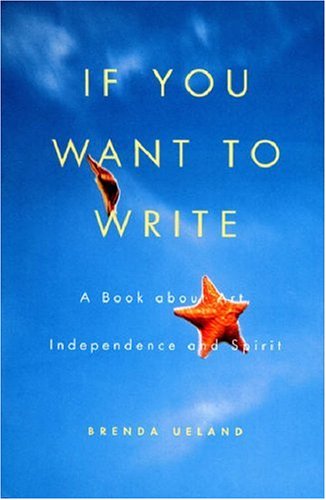
If You Want to Write

We've been talking about writing and ways to increase productivity in this recent series of posts.  I'd like to take a little side-trip at this point into the realm of creativity and inspiration.


The title of this post is the title of a book I stumbled across a while ago.  Written by Brenda Ueland in 1938, it is described by Carl Sandburg as "the best book ever written about how to write".  For my money, it's the best book ever written about creativity and inspiration--and how to nurture them.  During her 93 years, Ueland published six million words.  The book, "If You Want to Write", contains not only her philosophy about writing, but many examples and inspirational stories from her writing classes and workshops, in which she taught professors, housewives, and factory workers alike.

Ueland's advice is clearly useful for fiction writers, but do any of her insights have relevance for us as technical writers?  I think so, which is why I'm taking the time to discuss her book.  Everything she has to say about how to tap into one's genius is relevant to us, not only in writing but in stimulating creative ideas and innovative ways to pursue them.

Ueland taught all kinds of people to write: rich and poor, educated and those who had never been to high school, housewives and salesmen, professors and students.  This is what she learned:  "everybody is talented, original and has something important to say".  Some of her most amazing examples of enthralling, inspired writing were penned by timid stenographers, lonely unemployed women, and housewives who had no prior training or experience.  Ueland compares these writings to those in glossy magazines of the time written by highly paid writers--boring, uninspired drivel.  The message for us scientists and students of science is that we can just as readily tap into our creative nature and produce something original and worthwhile.  How did Ueland get this result from her students?

Here are a few nuggets:

The imagination works slowly and quietly.  You should not expect inspiration to come like a bolt of lightning.  Instead, you may spend a lot of time just sitting and thinking or daydreaming.  If you are always busy, talking to other people, running around carrying out tasks, or always plugged into your iPod, your thoughts have no chance to grow and develop into creative ideas.  Ueland encourages people to dare to be idle for a time, not always pressed or driven to accomplish something.  I have a long commute from home to work (2 hours roundtrip) during which I just think.  I do not listen to the radio or to "books on tape" (which is always what people encourage me to do).  Ideas don't always come to me during the drive--the drive allows my thoughts to swirl around and begin to gel.  Suddenly, at some later time, the creative idea will pop into my head.

Be in the present.  When you sit down to write or to contemplate a research project, no logical thought comes to mind.  You try to force thought, but paralysis sets in (sounds familiar).  You begin to doubt yourself and to suspect that your mental abilities must be limited because you have no good ideas.  Ultimately, you give up and go do some menial task: washing glassware or filing reprints, and only then you have some original, illuminating thoughts.  You are self conscious in the first instance, not so in the second.

Be careless, reckless.  Many novice writers start out being pretentious and use a lot of jargon and overblown phrases because they think this is a sign of good writing.  Actually, it is boring and annoying to read such writing.  Don't worry about what other people will think.  Write simply and honestly.  Technical papers that are dense and take a tremendous effort to understand are not a pleasure to read.  Why would any scientist aspire to write such things?  You are writing about science, a fascinating topic.  Why not show in your writing how interesting, thought-provoking, and exciting your findings are?

Develop true self-confidence.  Ueland:  "..self-confidence never rests, but is always working and striving, and it is always modest and grateful and open to what is new and better."  That is one of my favorite definitions of self-confidence.  It is different from conceit, which is "a static state where you rest on some past (or fancied) accomplishment."  Today, conceit is additionally colored by a sense of entitlement, based not on any accomplishment or positive traits, but simply on the belief that adulation is deserved.  True self-confidence will carry you safely through criticism of your work, rejection of your papers, and various other disappointments.  Conceit will fail you in such instances.

Be microscopically truthful.  We often write things by rote, repeating the same boring information in our introductions and methods. We may repeat what we've read in other papers a dozen times, trying to reword it in a fresh way.  We may be stumped as to how to describe our results in an interesting way.  To write in a microscopically truthful way is to write "...with exquisite and completely detached exactness and truthfulness."  You say precisely what you observed and what you think about it, even if it sounds awkward at first.  Don't imagine what someone else might say or expect you to say. Think about your topic, your experiment and write about it in your own eloquent way, providing those precise details that make it uniquely yours.


Keep a diary.  Or a blog.  Here's Ueland: "Yes, from writing a diary I am sure that I have learned things. But I don't think the learning process would have moved on so well, if I had not written down today's minute revelation. And that is why, if you want to write, you might try it."  I think she would have approved of blogs.


Write what is next.  Here's Ueland again: "And so try this yourself when you write an article. Do not worry about the whole. Write what is next, the idea that comes now at the moment. Don't be afraid. For there will be more coherence and arrangement in your thoughts than you think."

The essential message here is to nurture your creative side by spending time 1. with your thoughts and 2. writing unselfconsciously--in a diary or a blog.

If you never spend time alone thinking and are always listening to music, commentary, and other distractions, creative ideas are less likely to develop.  Your head becomes so filled with other people's thoughts and opinions, that there is no room for yours.  Some people are afraid to be alone with their thoughts--as if something dreadful might jump out.  But such solitary musings are essential to writing well.

To write well, you must also practice it regularly and deliberately.  Keeping a diary of daily events, thoughts, dreams, or insights helps develop an ease with writing unselfconsciously.  There is no pressure to produce something witty or wise in a diary, so you can learn to easily express yourself in writing.  Even writing about mundane things can produce some amazing results, if you let yourself go and write what is in your heart.  Blogging is a step further in which you put your writing in the public eye and invite feedback.  If you look at your favorite blogs--the ones that really speak to you--you will see that the author is writing unselfconsciously.

The next post describes in more detail how to write spontaneously.